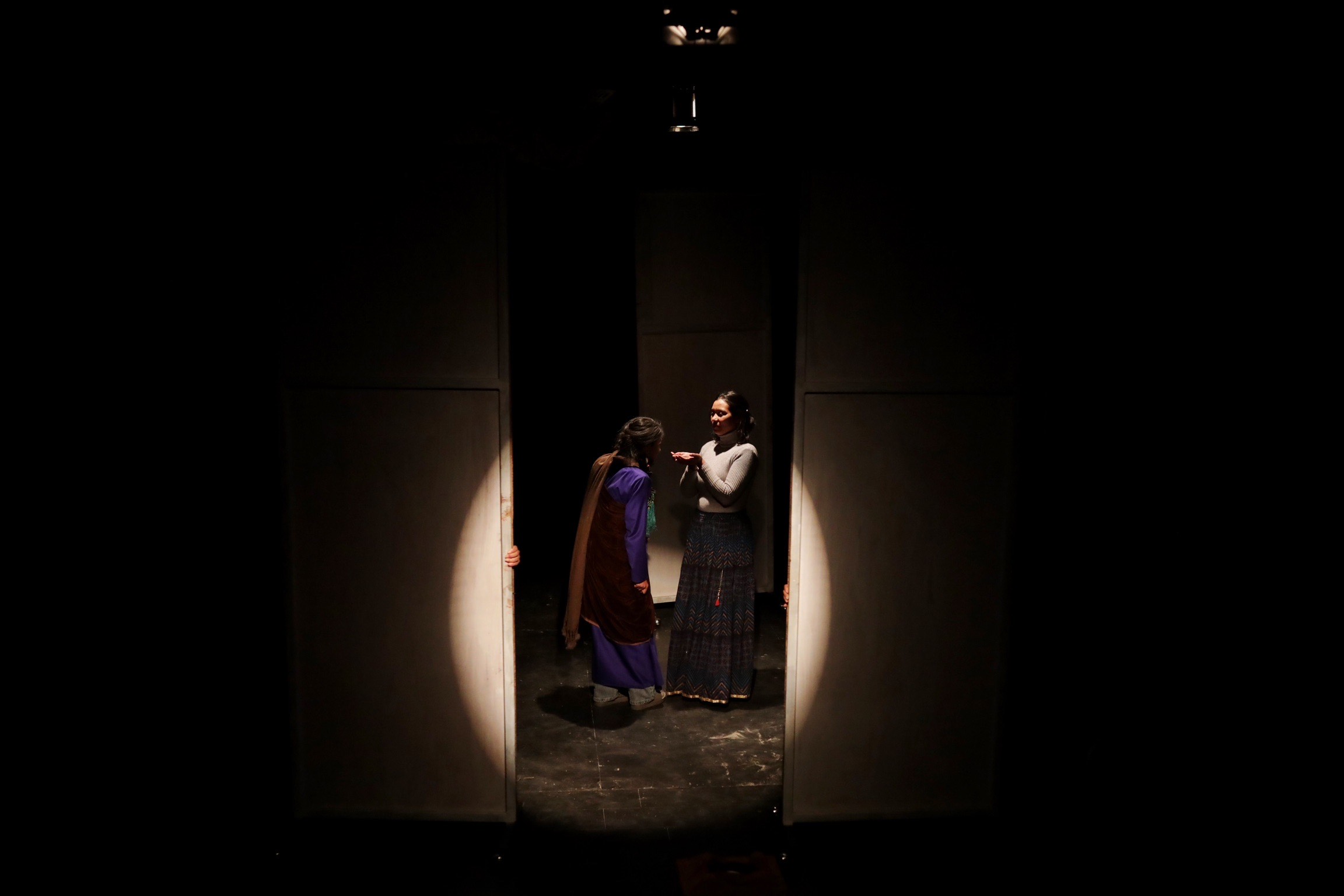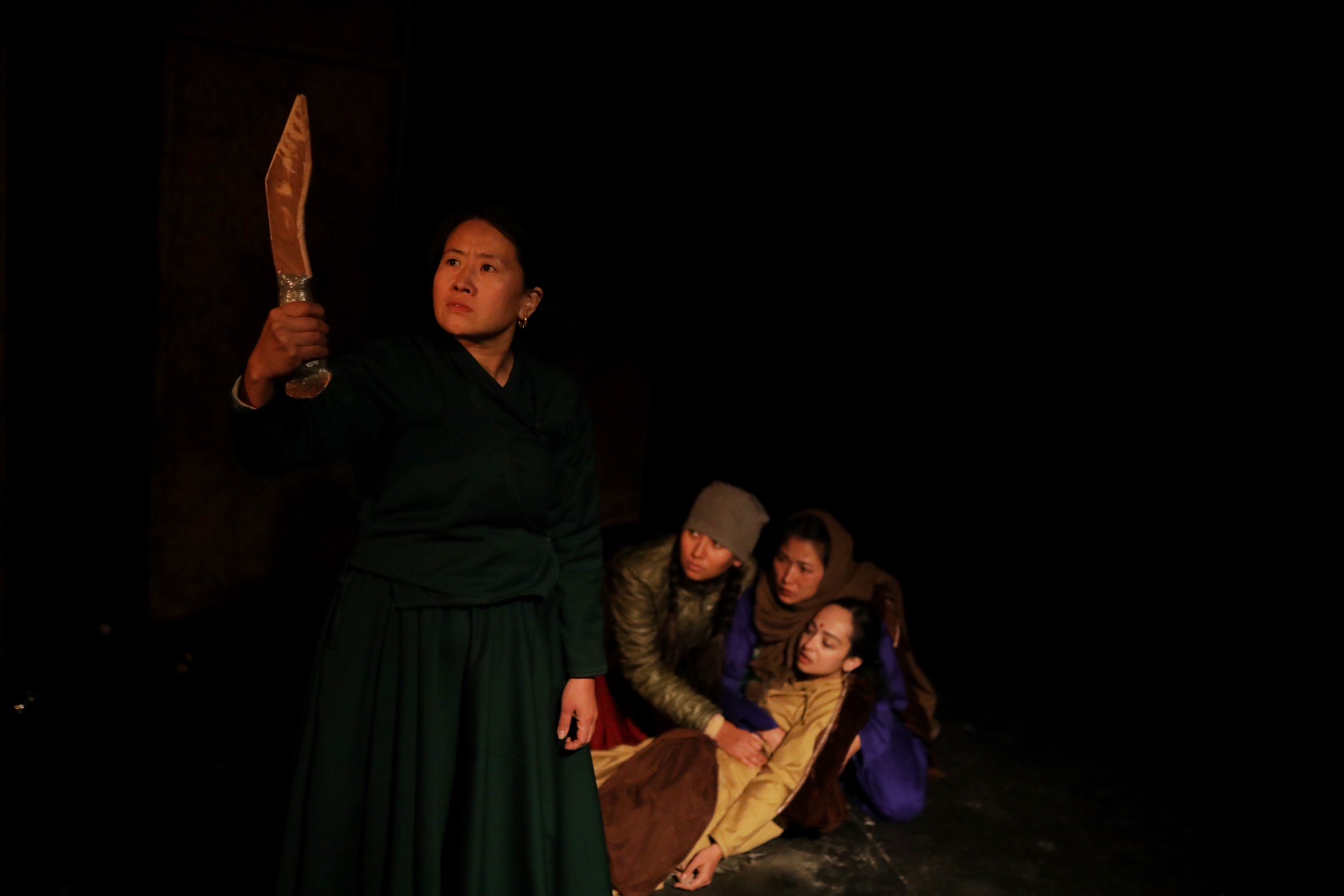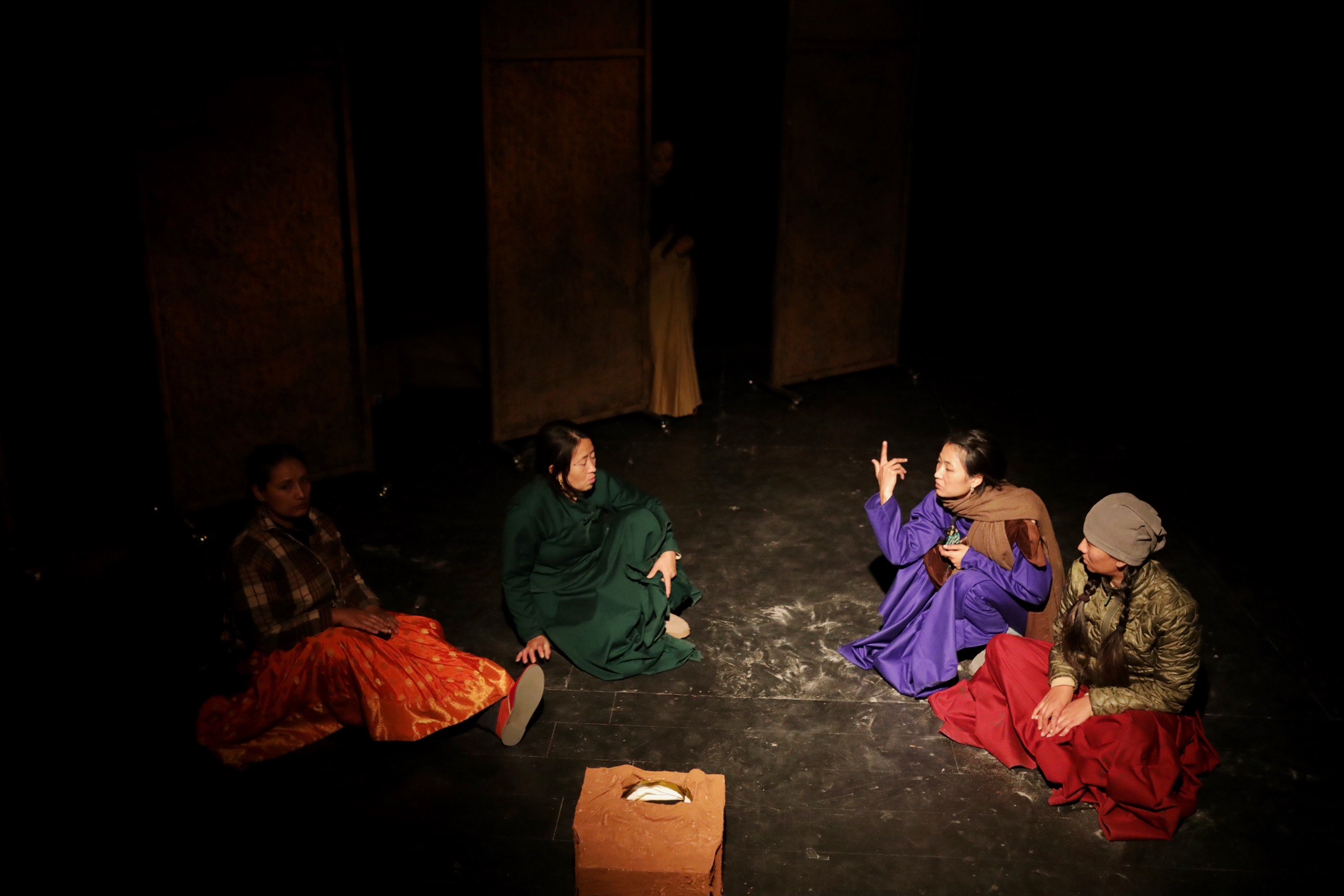
There is darkness, except for the faint trace of a white tree at one corner, dancing ripples (or golden flames?) at another. Light pours downward like the first rays of creation upon four figures lying on the ground. Sound of the madal drum fills the air.
The women rise, fluid to the music of nature. Their expressions dart from sombre to elated, reflecting the beat. One raises her hand high in the air while another reaches deep into the earth. They go around in circles, and behold: a child is born.
Meanwhile, a shadow surrounded by cool blue light dances in perfect sync with the women on stage -- Reflecting them? Guiding them? There is a sense of womanhood, motherhood, as life is created. The child grows into a girl who now learns the dance from the women who came before her. This is a form of storytelling that bridges the past and present, future, preparing and shaping expectations.
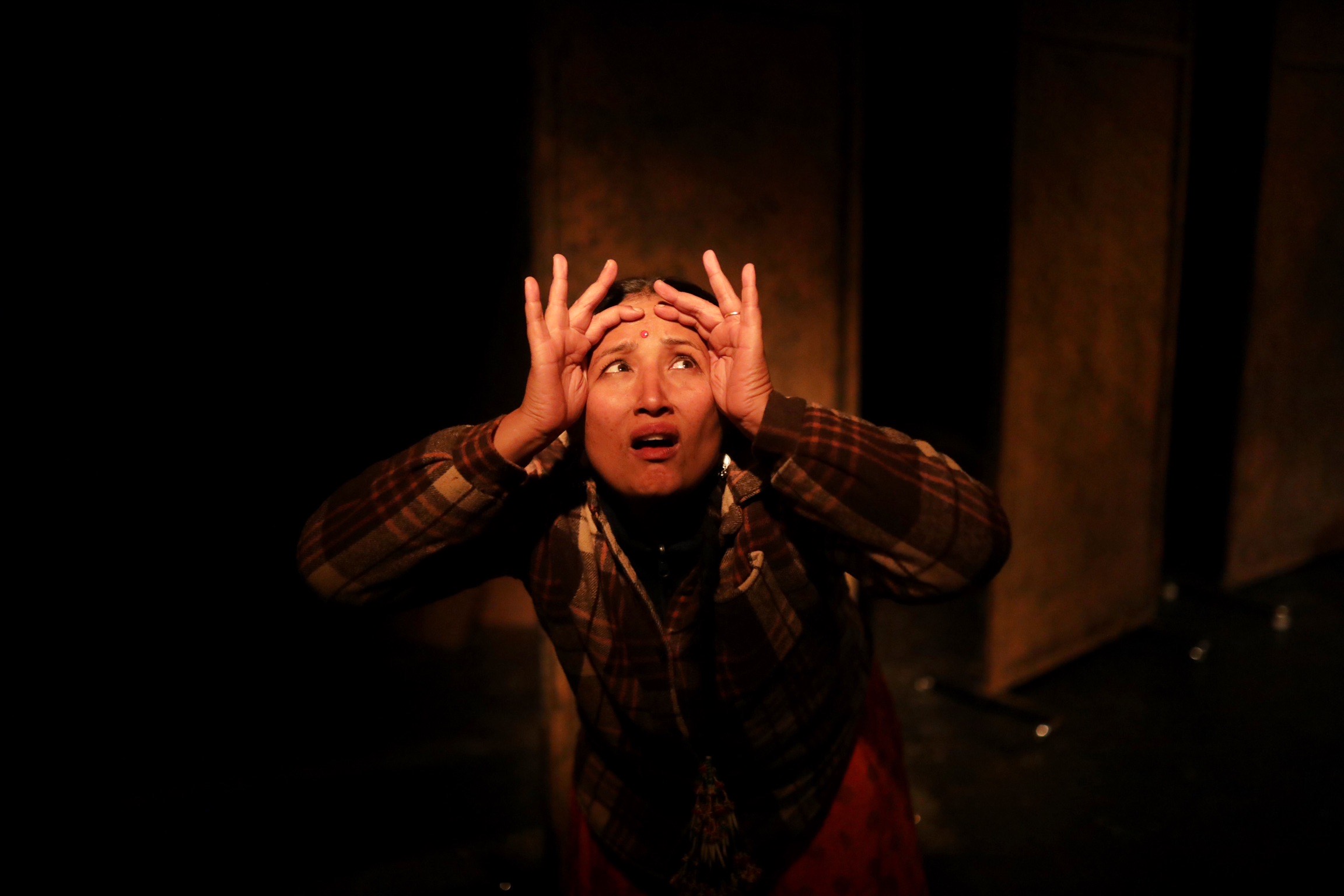
One World Theatre’s latest play Deurali Daandi, in collaboration with Actor’s Studio Nepal, begins in a kind of a musical trance, almost wordless, with a Genesis narrative of its own. And the audience immediately feels as though it has always been living in the fabric of its history and cosmology.
When the prelude ends and a new movement begins, the audience already knows the world: its hills and its mountains, the sounds of choppers and planes in the air that announce the arrival of goods and bodies. This village is, after all, already branded into our collective psyche through the media. We may not all live there, but we have heard of it and its people.
There are no men left here. A strange epidemic that manifests itself as parched and coarse sand made them all leave. The audience is not surprised -- there are repercussions now that are more biting and terrible.
Drawing from the elements of Sati Ghatu folk dance of the Gurung community of Nepal and performed mainly on the full moon of Baisakh Purnima, the play examines Nepal’s labour migration practices and its fallout. It explores a world of deafening absences, and how cultures, traditions and life are affected.
Read also:
Ghatu dance of Lamjung, Sewa Bhattarai
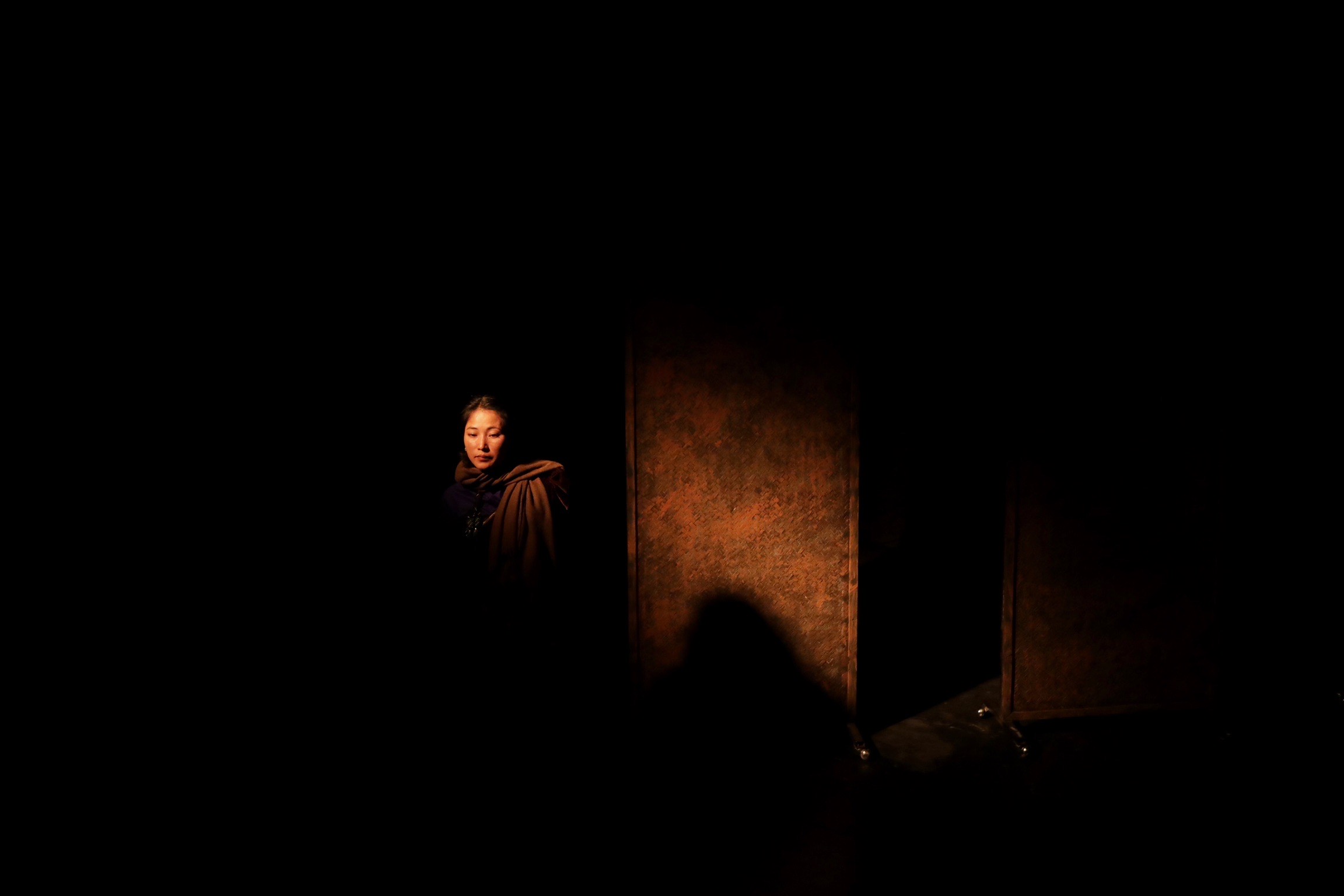
Springs dry up, birds do not sing, a baby deer dies in the forest, and the women are also getting sick. What is this disease? ask the characters, sometimes staring at the audience. We know this disease of the sand: we feel it in our bones, and are unsettled by this revelation.
For director Rose Schwietz, the metaphor is pretty direct and apparent. “The way labour migration spreads in Nepal is like an epidemic, through contact,” she says. “What we have is a bit of a poeticism and magic realism approach to the idea. And a part of what we are trying to do in the play is bringing the stories that are not heard or told.”
Indeed, the majority of the stories one hears about labour migration in Nepal centre on the men who either return or do not at all. “These stories are obviously very important,” Schwietz adds, “but I also wondered about their trickle-down effect.”
Schwietz norticed this effect during a Fulbright stint studying Ghatu at Nalma in Lamjung in 2014. She found that every family in the village had someone abroad, or planning to leave.
“I was really interested in this idea of people who are here and what they experience,” she says. “And, for the most part, it’s the women who are left behind.”
The women adjust their lives in this world, but what happens when the ‘epidemic’ resurges, like a new variant? The women realise they have to respond differently to it and take action to save themselves and their way of life from disappearing. But what actions can they take?