
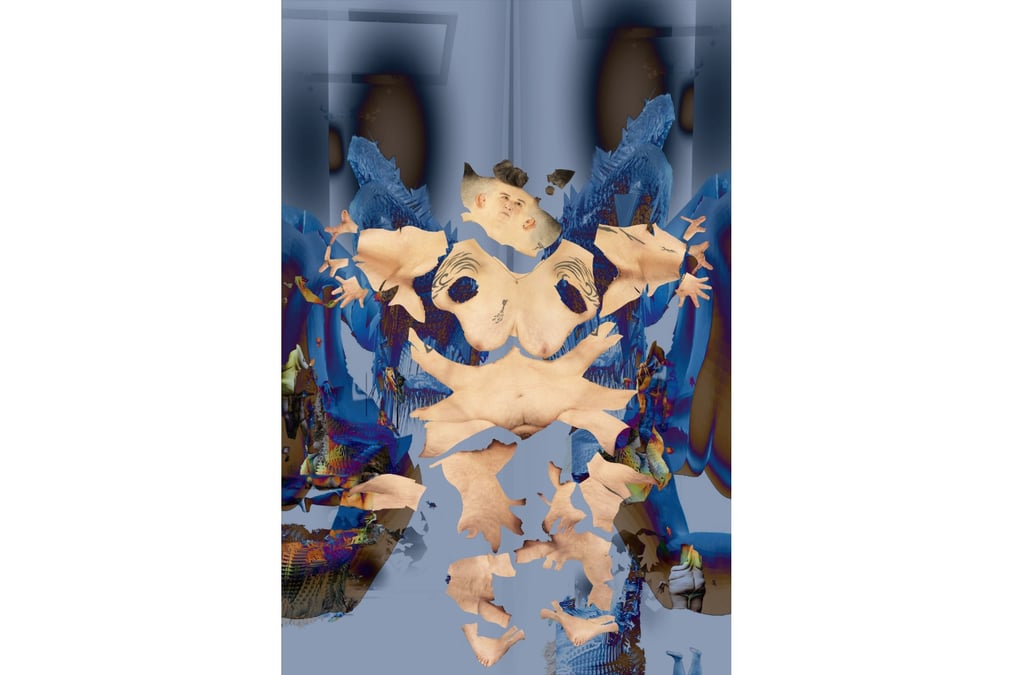
A concept popularised by Richard Morgan in his 2002 cyberpunk novel, Altered Carbon — set in a future where consciousness can be transferred between bodies — ‘birth sleeve’ is the body an individual is born with.
Using that ideological framework, Jonathan Armour, currently visiting Kathmandu as a resident artist with Space A, has created a series of artworks.
Transhumanism can be alarming, but I could connect the idea of sleeves to my own ongoing preoccupation with deconditioning as it relates to depth psychology — ‘a therapeutic process of dismantling deeply ingrained, unconscious patterns, limiting beliefs, and automatic behavioural reactions formed by early socialisation, familial upbringing, and cultural conditioning’.
Anyone can benefit from some deconditioning, but queer and/or disabled individuals might find instant resonance with approaches that support transcendence, whether mentally from narrow societal standards or physically from one’s birth sleeve.
Armour uses numerous cameras to scan an individual’s body from multiple angles and creates 3D images on a computer. Guided by conversations with participants, he then opens up the 3D image using software to create flat portraits of their sleeves.
Before coming to Kathmandu, Armour asked to be introduced to any Nepali artist who might also be working with the human body, and he corresponded with Kapil Mani Dixit online for three weeks in order to plan an immersive collaboration during his residency.
Dixit is known for pioneering nude figurative art in Nepal, a genre still considered taboo in this country, but he had never collaborated so closely with another artist.
As an art student in Dallas, he was uninspired by the Texan flatness. Used to drawing landscapes, he was at a loss. Then a professor invited him to his first class in life drawing: ‘the practice of drawing the human figure from direct observation of a live model, often nude, to develop skills in anatomy, proportion, and gesture’.
Armour’s exploration is a departure from this more traditional, representational art practice. Perhaps, being queer himself, he is mindful of the Gaze Theory and seeking to destabilise power dynamics between subject and object.