
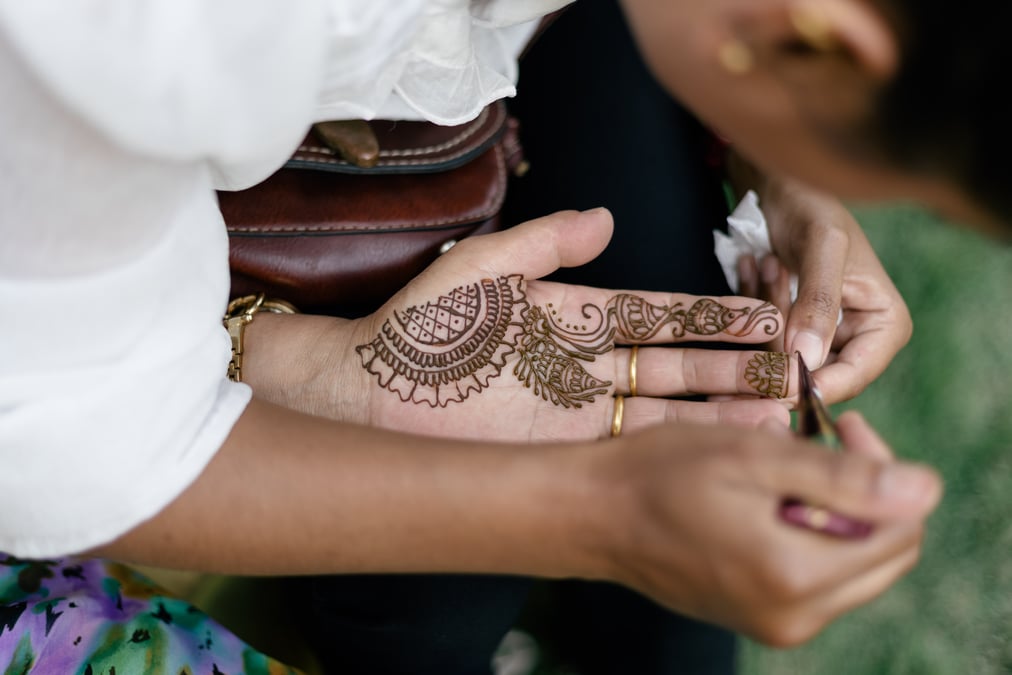
Green is the colour of the Nepali month of Shrawan. It is the middle of the monsoon, and the countryside is emerald green, the air is clean and there are sacred festivals every other day.
How appropriate, then, that green is the colour of this auspicious month. Women wear green bangles, don green sari and throng the temples.
For one, according to Hindu mythology, it is said that the gods and demons churned the cosmic ocean, yielding the elixir of life as well as a deadly poison. Lord Shiva then took it upon himself to save the universe – he swallowed the poison and his throat turned blue.
Goddess Parvati fasted during Shrawan, praying for Shiva as her husband. And that is the tradition observed to this day as women fast every Monday this month for a happy conjugal life.
During the month, they also decorate their hands with intricate designs made from mehendi, a special plant that leaves a temporary dye on the skin -- blending devotion, beauty and cultural identity. But the tradition of mehendi, the way it is made, applied, promoted and practiced, is changing with time.
“Women wear mehendi on their hands as a sign of good fortune, and to celebrate the auspicious state of their marriage,” explains Jhunnu Shah, a mehendi artist.
Women, whether fasting or not, decorate their hands with mehendi for the occasion with designs ranging from mandala and flowers to vines and names of loved ones.
Mehendi, also known as henna, goes with the scientific name Lawsonia inermis, and is a perennial shrub native to Africa, Australia and Asia. While the word ‘henna’ has Arabic origin, with the plant known as ‘Hina’ in Arabic, the word ‘mehendi’ originates from the Sanskrit word ‘mendhika,’ meaning a plant that releases a red stain. The plant contains a dye that leaves a temporary reddish-orange hue.
Henna has its history in ancient Egypt, with pharaohs and even Cleopatra using it on their skin. It was used in mummification rituals in Egypt and also to heal wounds as a natural antiseptic. As times changed, women increasingly applied henna for special occasions including weddings, festivals and other rituals.
The application method has also kept pace: from directly smearing it on the skin to mehendi cones, wooden stamps, stencils and stickers. Until recently, mehendi had to be applied by an artist, now there are DIY kits.
Wooden stamps in particular are popular -- it is simply dipped in colour and then applied on the skin with designs of one’s choice. Shah, however, frowns on this practice and uses homemade mehendi for customers as it has minimal side effects.
SAFE PRACTICES
Pure mehendi is usually safe to apply but can cause mild allergies such as skin dryness, staining, or temporary hair brittleness when applied as a hair dye. But chemical additives in the commercial market have caused severe allergic reactions including burns and permanent scarring. Ingesting mehendi is highly toxic and can cause kidney damage.
“Not many people come to apply mehendi these days,” Shah laments. “Earlier, people flocked to apply mehendi on their hands in Shrawan or during weddings, that is not the case anymore.”
Indeed, Kathmandu streets used to be lined with mehendi artists during this month until recently, equipped with hundreds of henna cones and designs. But stricter rule enforcements against street vendors from the Municipality forced artists to shift to other mediums -- including now on social media, especially TikTok.
Amita Baniya, a popular celebrity mehendi artist, used to have a street stall. Now she has opened a TikTok account where she promotes her mehendi art and has 15,000 followers. The platform has allowed her to also gain foreign customers. One of her videos, showing her applying mehendi on a foreigner, has over 4 million views.
As mehendi artists move with the times, artists also charge more. Customised bridal work can cost upwards of Rs40,000 in the premium market. Self-applied, or wooden stamps and stickers with moon and flower design are much cheaper.