
 |
Credited for sparking the Tunisian Revolution and bringing down the Mubarak regime in Egypt, 2011 has been the Year of the Blogger. In Nepal, blogs are transforming the way urban Nepalis get their information.
Nepal's blogging era has officially kicked off with king Gyanendra's coup on 1 February 2005. Newspapers were under direct military censorship, FM radios were not allowed to broadcast news, so bloggers stepped in to fill the information gap even while the ISPs were still closed.
Nepal's most popular Nepali language blogging site, My Sansar (www.mysansar.com.np), began at that time and has grown into a citizen journalism aggregator. Blogs usually have a credibility problem because of anonymous postings and gossip, but My Sansar is seen by many as an antidote to a mainstream media which are compromised by political and corporate bias.
My Sansar recently exposed the newly-appointed State Minister for Finance Lyarkar Lama, who turned out to be of Tibetan origin holding fake passports from three different countries. The mainstream media followed up on the news, and Lama was forced to resign.
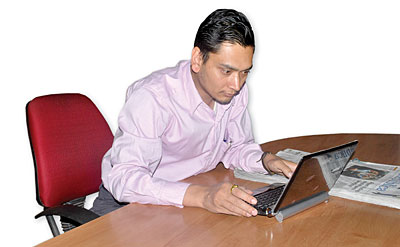
"I wasn't sure if the issue would be taken seriously," admits My Sansar's reclusive founder, Umesh Shrestha (above), "but we see the established press taking their cue more and more from the blogosphere."
Shrestha has earned a reputation for his nocturnal working habits, but says there are no time zones in cyberspace. He started blogging in 2005, when he was laid off from his job in Channel Nepal Television after the king's coup. Initially, he maintained personal musings on politics and current affairs under the nom de blog, Salokya, which he still uses.
Despite his non-technical background, Shrestha quickly established a Nepali niche on the Net. The number of unqiue visitors of My Sansar grew exponentially, reflecting the hunger in Nepal and abroad for a different perspective on current affairs. On a good day, these days, My Sansar gets 60,000 visitors.