
|
|
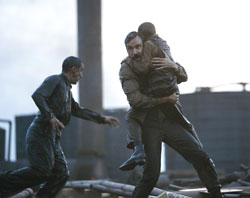
There Will Be Blood opens deep in American soil-literally. At the turn of the 19th century on America's western frontier, men toil doggedly in a subterranean setting, portentous contraptions looming around them. Our protagonist, headstrong prospector Daniel Plainview (Day-Lewis), emerges from this wordless world to become, over the course of the film, a monstrous oil baron. If you can't already guess what this will entail, then prepare for the original American drama.
The frontier-which is always the sparse, desert-like landscape of the southwest where the film was shot-is the ultimate American trope. This is the mythical place where American (capitalist) democracy is thought to have ingeniously evolved from a dialectic of wilderness and civilisation. This is the place which most thoroughly embodies the American Dream, a favourite of filmmakers narrating tales of the nation's success and identity.
If Blood reminds you of the hugely popular Western and gangster genres, it's because of the shared construct. Like a Western, it points us towards the fear and violence that was fundamental to the creation of the American identity, a precarious identity that is both savage and civilised at once. Like a gangster movie, Blood is about a tragic individual(ist) whose success is inseparable from his failure.
Director Paul Thomas Anderson (Boogie Nights, Magnolia) hits all the right chords, telling this story of greed and conceit with a masterly touch. What the film lacks is a sense of allegory. If the cowboy and the gangster have been the imaginary figures of modern American capitalism, the capitalist himself is far too literal. And unlike Citizen Kane, with whom some comparison will inevitably be drawn, Plainview does not have genuine mystery.