
|
|
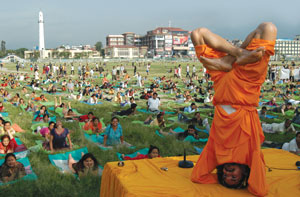
At six every morning, Salil Kumar Thakuri jogs slowly to Dhumbarahi's Sankha Park from his home in Mandikhatar. In the park, he runs laps. Each circuit takes him past other runners, people practising karate, people stretching, and the occasional couple holding hands.
Salil is training for the British Army entrance test. Others come to catch some exercise before their stressful day begins, or to get some fresh air before the traffic starts up. Over a hundred people crowd into this small space every morning-it's all they have.
Kathmandu's few parks and commons, hemmed in by high buildings and potholed streets, are the only legroom and free spaces for socialising most city residents have. Part of the problem is that Kathmandu has never been a 'green' society-our traditional public spaces were typically stone choks and courtyards.
In recent years, some neighbourhoods have begun creating and maintaining small immaculate parks such as that in Gyaneswor, or handkerchief-sized green patches with swings and benches in Maharajgunj and Ekantakuna.
Kathmandu's most famous commons, Tundikhel, has seen a revival in the last year. The middle-aged exercise junkies out are out in the morning, running laps, doing yoga, practising breathing exercises as suggested by Guru Ramdev on the Astha Channel. After school there are cricket and football games and the evenings are for amour-the crowd ensues a kind of privacy for couples to hold hands and swap kisses.
But though Tundikhel is still the largest open public space in Kathmadu, it's a shadow of its former self-it was once almost 5km long and 300m across and the biggest parade ground in all of South Asia, says architect and urban planner Prabal Thapa. Millions were spent erecting barricades around the grounds to prevent encroachment, but successive governments have themselves been responsible for trimming down Tundikhel. First land was taken for wider roads at Shahid Gate, then the army commandeered half, and finally, half of what remained became Khula Manch.
Sometimes the government gives back too-the Garden of Dreams at Thamel is a good example of a collaborative government-private effort to work together. You have to pay to get in, but the recently-renovated garden offers blissful respite from the heat, dust, and dirt of the inner city. It's also fast becoming the top choice for a cheap and sexy daytime date. There is ample cover behind the trees and bushes and the other visitors are too busy reading, playing with their children, or just staring into space.