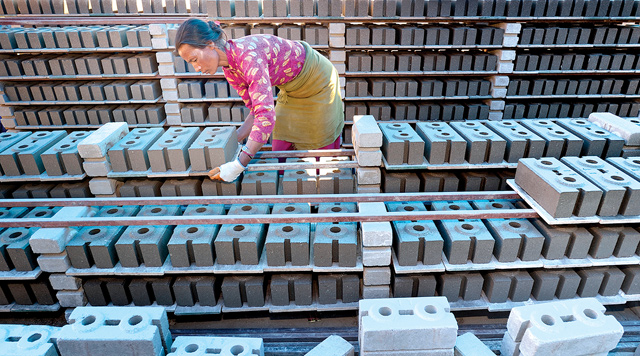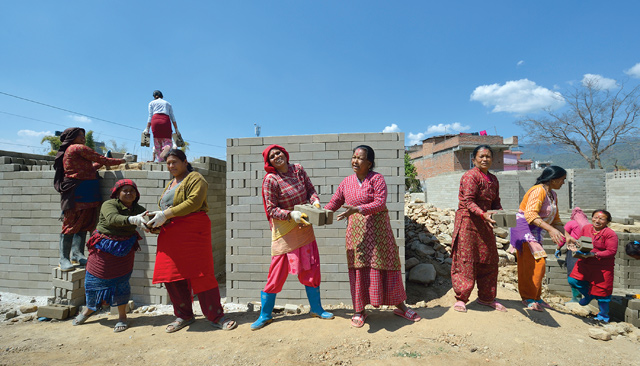
Sanogaun, a small Newar settlement on the southern fringes of Kathmandu was flattened by the earthquake last year. Now, the community is using an innovative technology to rebuild all its 49 homes so they are cheaper and resistant to future quakes.
The interlocking brick technique developed by Nepali inventor Gyanendra R Sthapit at the Habitech Center of the Asian Institute of Technology in Thailand combines the strengths of rammed earth and compressed blocks. It has been used in post-tsunami reconstruction in Thailand in 2008 and after Cyclone Nargis ravaged Burma in 2010 to build more than 1,000 homes, schools, and health clinics. In Bhutan, over 100 quake-proof houses and schools have been built using the technology.
Leading the rebuilding efforts are the women of Sanogaun who were trained to make the compressed bricks. The interlocking, sun dried bricks are made of one part sand, one part cement and up to eight parts clay. The bricks are compressed manually using a machine. Each brick weighs 9kg, is a fraction of the price of traditional baked bricks, and have been proven to be twice as strong.
The women have been working since December and have made over 80,000 bricks on construction sites with support from Act Alliance and Grassroots Movement in Nepal (GMIN). However, the need for post-quake reconstruction is so great that there is still a long way to go.
“The work is difficult but we know that if we want to rebuild our homes, we have to keep going,” says 52-year-old Purneshwori Shrestha, one of the brick makers.