
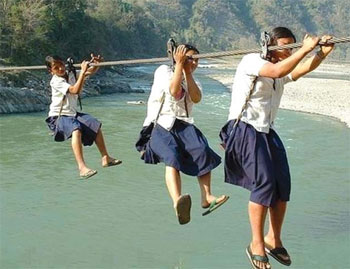
He had seen school children crossing a river by precariously hanging onto steel wires over the raging waters. The sight upset him deeply, and he couldn’t understand why the government couldn’t build bridges.
I gave him the usual answers: perhaps the bridge was bombed during the war and the local authorities didn’t have the budget to rebuild it, Kathmandu did not care, the topography may not be suitable to build a bridge at that particular spot and so on.
The question was rhetorical, of course, and there was no reason for me to be so defensive. Nepalis, I assured him, have nothing against bridges, roads or infrastructure, and derived no particular pleasure in putting their lives in danger.
But, there is really no excuse for failing to deliver basic services to the people when such a huge portion of the development budget is unspent at the end of every fiscal year. So, what is really stopping us from figuring a way out of our problems if money is not an issue, and when so much time and resources have been invested in development over the last 50 years?
Over time the same question has been asked in one form or another, occasionally with more tact, and at other times rather blatantly. While it might sound offensive to some, especially when coming from outsiders, most people mean well when they ask us why our country is so poor, or why we are not doing anything to solve our problems. We have become so used to thinking of ourselves as a permanently dysfunctional, corrupt and poor country that we don’t ask this question to ourselves anymore. We take it as a given that things can’t be any better. Our policy makers and opinion builders have brainwashed us with this notion.
The rise of India and China has done little to fuel our own desire for growth, instead fostering a sense of insecure helplessness that is reflected either in the cringe-worthy nationalism of the “Buddha was born in Nepal” variety, or in the total loss of self-respect and self-assertion vis-a-vis these two neighbour countries. This inferiority complex was most evident in op-eds that analysed the impact of the Narendra Modi landslide on Nepal.