 On 16 June 2006, when the Maoist leader Pushpa Kamal Dahal met Prime Minister Girija Prasad Koirala in Baluwatar, he was a leader of a party that had taken up arms against the Nepali state.
The Maoists had joined forces with their erstwhile class enemies to lead a street movement that transformed a monolithic kingdom into a secular federal republic. Two years later in 2008, Dahal led 229 of his party comrades to occupy 38 per cent of the first Constituent Assembly that was tasked with drafting of Nepal’s new constitution. History awaited, the world was a witness and the people that had overwhelmingly voted his party to power were in anticipation. The numbers and the sentiments were both on his side.
Seven years later, reduced to an opposition leader with less than 18 per cent in the same assembly, the Maoist Chairman is a bitter man who has nobody but himself to blame for allowing the history to pass him by.
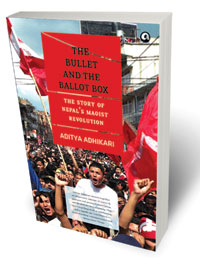
Aditya Adhikari’s recently published book, The Bullet and the Ballot Box: The Story of a Maoist Revolution, chronicling the days and nights of Nepal’s decade-long conflict, their dramatic ascendance to power and equally dramatic downfall, couldn’t have been more appositely timed.
Adhikari weaves a subjective account of the personal journeys of young men and women who participated in the war to give us a microscopic understanding of the Maoist movement as it happened, and the way it spread across the rural countryside.
Based on a mass of available literature on the Maoist People’s War including diaries, memoirs, interviews, articles, reports, poems and fiction writings, the author describes the backdrop of Nepal’s bloody civil war, its socio-political implications and its humanitarian consequences, on a population on the receiving end.
Many of the personal memoirs, essays, poems and stories sourced in the book were published at the peak of the ‘people’s war’,which also help us gauge commitment and confusion of young men and women who joined out of sheer conviction, curiosity, and sometimes also out of fear.
The excerpt from an essay by a Maoist activist about his brief encounter with the city and its dwellers, reveals his disappointment and anger at their selfishness and lack of empathy for the suffering of fellow citizens.