|
SHRAWAN DEV
|
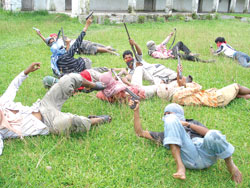
| ARMED: JTMM-J militants brandish their guns while
training in Saptari. |
Madhesi moderates need to wake up and confront some difficult choices.
Mainstream politicians, civil society activists, academics, journalists and
other opinion-makers are right when they blame the state's policies for fuelling
alienation in madhes, which in turn has weakened their position. But state
insensitivity can only be a partial justification for their silence.
Many moderates seem secretly pleased with the growing radicalisation. Recent
events have not only put the madhesi issue on the national stage, but have also
strengthened their bargaining position. They appear to be emulating the
Kathmandu intellectuals who welcomed the Maoist rebellion and lazily ascribed it
solely to the 'root causes theory'.
Of course, the anger in madhes is due to the crisis of identity and
exclusion. But there are several other aspects that have contributed to the
drift. The madhesi mainstream must tackle some of these issues if they want to
steer future politics.
For one, they need to take a stand on violence and help revive the primacy of
politics. While publicly maintaining a commitment to peaceful means, quite a few
madhesis are ambivalent in private. It is not uncommon to hear voices which
justify violence on the grounds that it helps keep the madhesi cause alive and
the state has left them with no choice.
But the January Madhes Uprising and subsequent heightened identity
consciousness has ensured that the madhes issue will not disappear. This defence
of violence by city-based intellectuals ignores the suffering on the ground and
legitimises criminal groups using a political cover.
Madhesi analyst Tula Narayan Shah has noted how most instances of violence
have a long personal history-of property feuds, caste rivalry, extortion money
not paid and or revenge for earlier killings, especially in the case of attacks
on Maoists. Madhesis are suffering the most, and all in the name of their
liberation.
What madhesi moderates need to do is connect politics in the plains to the
larger national picture, organise themselves electorally instead of bickering,
and make the most of the elections. As Chandrakishore, among the sharpest tarai
journalists, points out: "If April 2006 had not happened, January 2007 would not
have taken place."
Responsible madhesis recognise the elections as a national priority. Like the
Jana Andolan, they will open up the democratic space further and provide a
platform for madhesis to win more advantages. If the state is unwilling to give
concessions even then, madhesis would be within their rights to take to the
streets again and head for confrontation.
But this message is not being communicated effectively on the ground, leaving
room for the extremists to make the most of the vacuum and sense of alienation.
This can have long-term implications.
Even if the elections happen, there may be a fairly sizeable constituency
which is disenchanted with the process and will question the credibility of the
constituent assembly from the outset. Will such an assembly be able to deliver a
constitution sustainable for generations? The only way to counter this is by
beginning political campaigning, activating party district units-especially of
the NC-and by madhesi moderates asserting themselves.
In the longer term, there are two other critical issues on which madhesis
need to reflect honestly-their relationship with the Tharus and the federal
structure of government.
Madhesis claim Tharus to be their own. Indeed, many Tharus in the eastern
tarai, like Bijay Gachhedar and Kishore Biswas, identify themselves as madhesis.
But there are many others, especially in the west, who assert their distinct
identity.
Madhesi leaders may be right when they say that Mahendra's policies and
ruling elite engineered this divide. But that is not the point. The madhesi
insistence on a unitary identity is meaningless unless accompanied by a closer
engagement with Tharu activists.
The slogan 'one madhes, autonomous state' has become popular. Madhesis
understandably do not want a federal state split by borders running north to
south, which they fear would mean pahadi domination. But is one unit from east
to west across the plains feasible? Does it take into account the diversities
within the tarai? Will it not defeat the purpose of having smaller states by
breeding alienation among people at one end, distant from the state capital?
Would it make more sense to have sub-divisions within? What integrative
mechanisms with the hills could be fair and mutually beneficial? Madhesi
intellectuals need to start thinking hard about these questions if they want to
get the best deal and guide later events.
Once the moderates start to play a political role, they will ensure that
irrespective of the state's insensitivity and the weakness of protesting groups,
the essence of the madhesi cause-identity and representation-is not
lost.
