
 DPR |
Madan Bhandari's meteoric rise and equally sudden demise in the early 1990s left his widow Bidhya to ride the sympathy wave that followed his death. She has grown in stature since, but is not known particularly for her political convictions, even by the flexible standards of the UML.
When the anti-Maoist coalition of Madhav Nepal chose her to head the defence ministry, it was inferred that the government had decided to give the Nepal Army a free hand. Bidhya Bhandari, in confining herself to being an ardent defender of the sovereignty of the armed forces, has lived up to her prime minister's expectations.
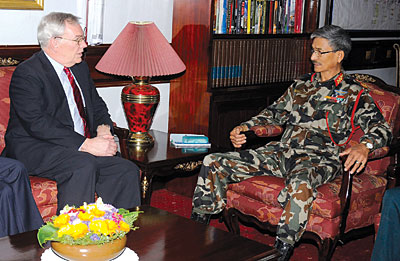
For the media and the international community, too, the Defence Minister is little more than a diligent spokesperson for the army. This could be why UN Undersecretary General for Political Affairs B. Lynn Pascoe decided to deal directly with Nepal Army Chief Chhatraman Singh Gurung. Surprisingly, the Nepali media paid little attention to what transpired at that crucial meeting.
The public relations department of the army released a picture of a defiant Gen Gurung sprawled on a gilded chair. His guest is all attention, hands suppliantly on his knees. Either the army didn't see fit to give the full story of the meeting to the media or the gatekeepers of the media in Kathmandu consciously decided to downplay the event. Other than the army chief's reluctance to admitting Maoist combatants en masse, nothing much appeared in the local press.
Reports in the Indian media were more thorough. With direct attribution to the army chief, Yubaraj Ghimire reported in the Indian Express that the Nepal Army couldn't remain confined to barracks indefinitely. Other Indian media too gave prominence to the position taken by the army chief. Few considered it necessary to get to the official position of the government, as if the media accepted that the government had no control over the Nepal Army anyway.