
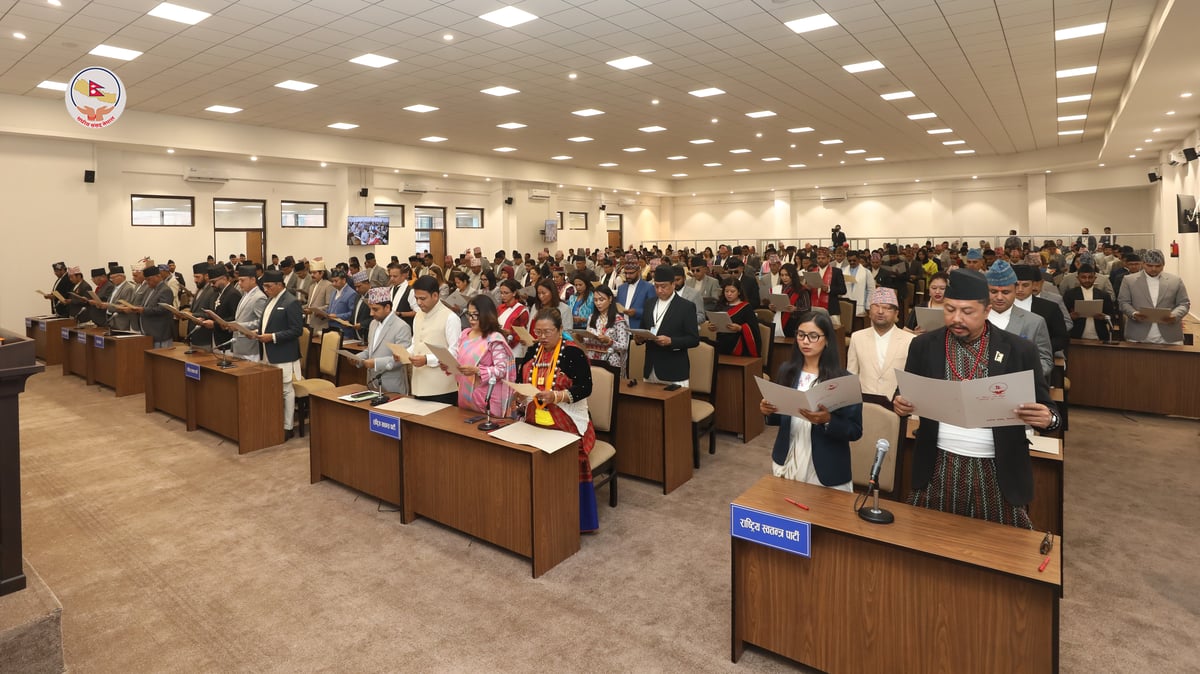
Something keeps coming back to me as I watch from afar Nepal’s new Young Turks in government.
Whatever the slips here and there — and whether open competition makes sense as a blanket mechanism for appointments like ambassadors — something rather consequential is being attempted.
Nepal’s political parties and government have long operated mostly through a ‘relational system’: who knows whom, who belongs to whose network, who owes whom. It is one of the ways the extractive politics of the past 30 years, and for many decades prior to that, worked.
The repeated push toward open competition for vice chancellorships and many other positions are almost an act of constructive destruction — an attempt to dismantle that relational system, popularly known as the politics of भागबन्डा, and gradually replace it with a more impersonal governing system, where rules and procedures matter more than personal access.
Ambassadorial appointments provide the latest experiment. More than 4,400 people applied after the government opened the positions to public applications, with 13 nominees emerging from the first round of selections.
Open competition is not magic. Nor am I convinced it is the right mechanism for every appointment. I offer a mixed hybrid method in my Nepal Unplugged essay.
Essentially, diplomacy requires judgment, experience, political understanding and interpersonal skills that cannot easily be captured by an application form. An open advertisement can also lead to a closed selection process if what happens afterward is less transparent.
But that is almost secondary. These young leaders may not always get the mechanism right. They are young, educated and energetic, but relatively inexperienced in the unforgiving business of governing.
Still, they deserve credit for daring to take on something much deeper than individual appointments: a governing habit built over generations. That may ultimately be more consequential than who wins any particular vacancy.
But daring to dismantle an old system and learning how to govern are two different things. They have done the first, but the latter is yet to be seen.
The recent 3% levies on private education and health offer an interesting example. The education levy and argued that its underlying equity principle was defensible, even if the instrument was problematic. The government introduced it, encountered strong public resistance, and quickly withdrew it.
Was that immaturity or responsiveness? A young government should be able to experiment, discover that an instrument is not working as intended, and change course. More worrying would be a government so invested in appearing decisive that it loses the capacity to learn. I am a big fan of learning by doing.
But that does not mean learning only after making avoidable mistakes. Experimentation is valuable if it gradually produces better consultation, better sequencing, better anticipation of unintended consequences — and fewer avoidable mistakes the next time around.
The qualities that help disrupt an old political equilibrium are not necessarily the same qualities needed to construct the next one. Breaking an entrenched system requires courage, impatience and a willingness to challenge convention. They did that. Or, more accurately, the youths who came on the streets on 8 September 2025 demanding this change forced that disruption.
Governing requires some rather less exciting virtues: institutional memory, administrative competence, consultation and occasionally slowing down enough to think. That includes sitting and planning and not rushing to enter the tunnels even though the intentions may be right.
And the clock may be running faster than they realise. The next thing they should understand is that public memory is thin.
We hardly need to travel very far for evidence. Since the restoration of multiparty democracy in 1990, Nepal has repeatedly experienced waves of extraordinary political hope followed by disappointment, and another search for change. The 1990 movement, the upheavals surrounding 2006, and most recently the Gen Z uprising all remind us how quickly apparently settled political equilibria can break or simply collapse.
History offers an even more dramatic reminder. In August 1792, the people of Paris rose against the old order and helped bring into being the National Convention. Less than three years later, an angry crowd invaded that very Convention demanding bread and political change.
Nepal is obviously not revolutionary France. But these lessons travel rather well: people who help create a new political order do not remain in a grateful mood forever.
The same citizens who gave these young leaders an extraordinary mandate will not spend the next five years congratulating them for defeating the old parties. At some point — and probably sooner than they expect — the reference point will change.
People will ask much simpler questions. Are schools better? Are hospitals functioning? Are jobs appearing? Is corruption declining? Does the bureaucracy work better?
This is also where Nepal’s media has an unusually important role to play. Neither cheerleading nor reflexive cynicism will help much. Perhaps what we need is optimism with skepticism.
When the government challenges an entrenched patronage network, give it credit. When an open process becomes shady, ask questions. When it makes a mistake, say so. When it corrects one, acknowledge that too. A young government needs room to learn. It does not need a free pass.
There may also be a quieter consequence worth watching. If these experiments begin changing what citizens expect from government, the effects will not stop with those currently in power. The older parties will face pressures of their own to self-reflect, reform and compete under those changing expectations.
That could ultimately be one of the more consequential effects of this political disruption: not simply replacing one set of political actors with another, but changing the standards against which all of them must compete.
The Young Turks have already disturbed a political equilibrium that many Nepalis had come to regard as almost immovable. But constructive destruction has two words: disrupting the old relational system may turn out to be the easier part, and constructing an impersonal system of rules, competence and accountability will be much harder.
In the end, politics promises no certainty at the ballot box. But leaving behind a legacy of norm entrepreneurship — raising the bar for how governance is conducted, even for those who come after them — might just be the most consequential outcome of all.
Read also: Win-win-win, Alok K Bohara
Alok K Bohara is Professor Emeritus of Economics at the University of New Mexico. He writes on Nepal’s political economy, governance, and development through his Substack, Nepal Unplugged.