
In 2023, Mira received a private message on her Instagram. It was from graffiti artist Aditya A, better known as SadhuX. Mira, who was 17 at the time and interested in graffiti, was excited to be contacted by an established artist.
The private message turned into a conversation where Aditya A, who was also connected to Mira’s ex-boyfriend, a fellow graffiti artist, gave her advice on rekindling her relationship.
“He had liked and shared a picture I had posted. Then, he sent me a DM, calling it cool,” Mira recounted. “I was interested in graffiti, and when he offered to teach me art, I was excited.”
Aditya A then invited Mira to visit his Lazimpat studio, promising art lessons and advice on the relationship with her ex. She arrived at the studio between 8PM and 9PM, but was unnerved to find him much older than she expected.
Her unease grew when she realised his ‘studio’ was a bedroom. Sensing that something might go wrong, she wrote a note on her phone, ‘If something happens to me tonight, I am at SadhuX studio,’ and secretly began an audio recording.
First, Aditya A asked Mira her age and when she told him she was 17, he replied that that could be a “problem” for him. She jokingly asked him if he was a pedophile and he replied that he was “a good pedophile”.
He then asked her to take off her jacket and tried to touch her inappropriately. After she protested, he stopped and said that he wouldn’t do it anymore. Aditya A then offered her lavender tea and an unknown substance to smoke, after which she felt dizzy. Then, Aditya A raped her.
“He tried to forcibly kiss me, and I couldn’t breathe,” she told me, her voice trembling. “He held my hands firmly, pinning me down. I felt weak and unable to move. I said no over and over, but he forcefully did what he wanted.”
Mira alleges that Aditya A took nude photos of her that night, and she met him again a few days later to demand that he delete them. Aditya A deleted the videos, but continued contacting her on Instagram, inviting her back to his studio.
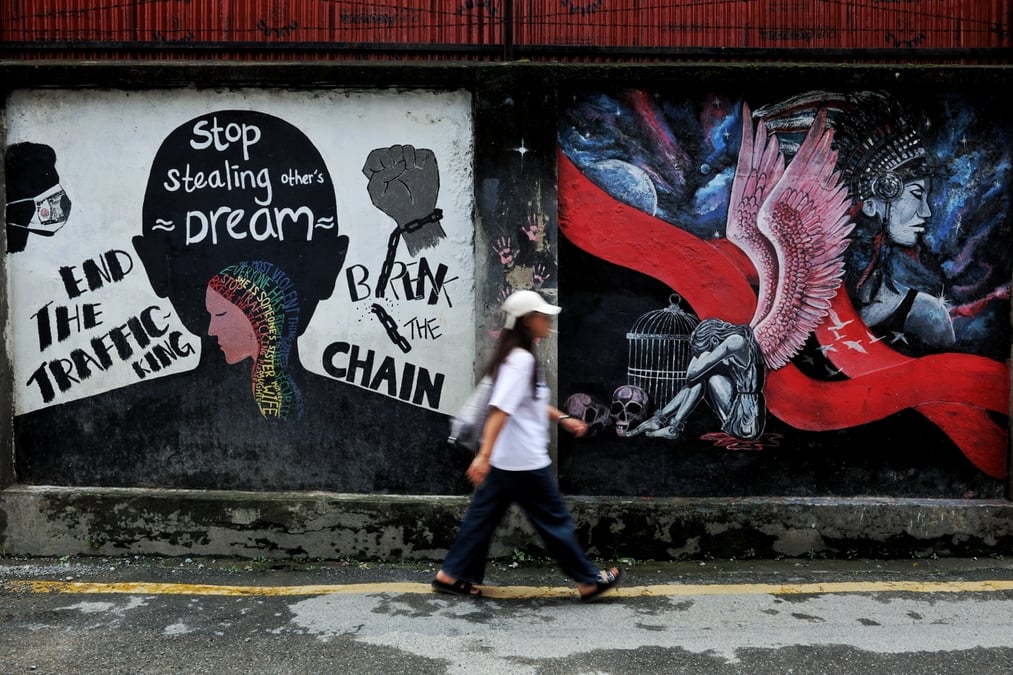
Aditya A, 42, is a well-known graffiti artist whose work can be seen across the Kathmandu Valley. His art, including murals of sadhus alongside cartoon-like figures with spray cans, is part of a broader spread of street art that includes stencils, paste-ups, and tags.
A former co-founder of an art gallery, Aditya A has exhibited in galleries such as the Millerntor Gallery in Hamburg and St+ART in India. His work claims to interrogate social taboos, including ‘rape culture’. His stencil work of the Kumari with the words ‘Rape Me’ underneath attracted significant media attention in 2015. It was portrayed as a bold statement against the contradiction of pervasive rape in a society that reveres girls as living goddesses.
Despite his public stance against sexual violence, Aditya A himself has been accused of rape, sexual abuse, and physical violence by at least four individuals – three women and one man. Their accounts, taking place over multiple years, include harrowing experiences of brutal rapes and beatings.
Sara is also in the art field and says she endured repeated abuse and violence during her eight-year relationship and marriage with SadhuX who she accused of repeatedly physically assaulted her. She was reluctant to end the marriage because of her immigration status.
“I had broken ribs, and my face was bruised, I was bleeding all over, and there were bite marks in my ear,” she recounted.
Two friends corroborated Sara’s account of her ordeal. One told me: “There were bruises all over her face. Her ears had bite marks, and she told us Aditya A attacked her and locked her.”
Anna, a 38-year-old hospitality worker, said Aryal raped her when they were dating in college in 2004 when she was 15. “We frequented clubs and pubs in Thamel, where Aditya A smoked weed and used heroin,” she said.
One night, she said an intoxicated Aditya A took her to a hotel. “I was unconscious and couldn’t really move, but it was a different era so I didn’t understand what had happened. I liked him and if he had just been nice to me, I would have slept with him,” she said.
They dated for two years, and it took a long time for Anna to realise that Aditya A had raped her when she was too impaired to consent. But she was young and it was Nepal before the MeToo era. “Had I filed a [police] complaint then, nobody would have believed me,” she said.
Aditya A was arrested in January 2026 when police raided a party at a resort in Godavari. Nine individuals, including six foreign nationals and three Nepalis, were detained with six pieces of LSD, 22.240 grams of cannabis, 61 grams of charas, one piece of MDMA, and four grams of magic mushrooms from the site.
Aditya A did not target just women, he also preyed on men. Rahul, a 31-year-old gay man, described Aditya A’s predilection towards violent sexual encounters. After meeting Aditya A at a club a few years ago, they went to Rahul’s home to “hook up”.
The sex was consensual, but it was rough and violent. “I had bite marks from my neck to my upper body, I was badly scarred. I still have a permanent mark under my nipple,” Rahul said. “I also found that he had urinated on my room’s floor.”
Only one of the survivors, Sara, reported Aditya A to the police. But she was told to resolve the matter mutually since they were in a relationship. The others did not because of social stigma and fears of targeted retaliation.
Aditya A’s uncle is a former high-ranking police officer, and survivors feared the police would favour him and disregard their complaints, opening them up to counter-persecution.
For Mira, who was 17 when she was raped by Aditya A, going to the police was never an option. Coming from rural Nepal, she feared her family would blame her for the assault, potentially forcing her to return home.
“I am very scared that my parents will find out. My village is very male-dominated and it's always the fault of women if something goes wrong,” she said. “If they find out, they won’t pay for my education anymore.”
We called Aditya A on the phone and he strongly denied the accusations, saying he was being framed: “What is the validation for these accusations? Just because a woman said something doesn’t mean that something like that happened, it's not fair. I’m in favour of women. Anything that causes injustice to women is not something that would happen from me.”
He added that he was familiar with the accusations against him, but did not know why they were being made: “This is some feminist group who I don’t know. On what basis are they accusing me? They are making accusations against me just because I talk to them nicely.”
INSULTS AND THREATS
When women do pursue legal channels for redress, they pay the social cost. In 2022, when Gaushala-26 accused the cricketer Sandeep Lamichhane of rape, her identity was leaked online, and she faced a barrage of insults, mockery, and threats.
Although the Kathmandu District Court initially convicted Lamichhane of rape, the verdict was overturned by the Patan High Court on appeal. Gaushala-26 declined to appeal the decision at the Supreme Court, citing her deteriorating mental health after years of abuse and harassment by the cricket star’s supporters.
Earlier this year, artist Sujan Chitrakar, a faculty at the Kathmandu University School of Arts, was accused of grooming and unethical behaviour in pursuing a relationship with a student. Chitrakar sued the student, but the case was dismissed by the Kathmandu District Court in February.
In 2019, two Tribhuvan University students accused lecturer Krishna Bahadur Bhattachan of sexual harassment. In 2024, sculptor Gopal Das Shrestha ‘Kalapremi’ was accused of sexual abuse by former students. In 2025, former attorney general Yubaraj Sangroula was accused of sexual misconduct and harassment by dozens of students at the Kathmandu School of Law, where he is a teacher and executive director.
None of the individuals faced any real consequences for their actions, even as the survivors still suffer social ostracisation and stigma.
The emboldening of perpetrators and silencing of victims is both a societal issue and a systemic problem. Nepal’s law has set a statute of limitation of only two years for adult woman to report cases of rape while minors are provisioned a period of three years after they turn 18.
But advocate and criminologist Astha Dahal says: “The three year statute is not sensible from a global perspective, it is not enough time for a victim to process what had happened to them.” Neither India nor China, for instance, place a statute of limitation in rape cases, allowing victims to speak out at any point in their life.
“Investigation systems should bear the burden of solving cases rather than burdening victims with a deadline,” says Dahal.
Last year, Nepal Police launched its Gender-based Violence Investigation Piloting Program under which 10 district police stations have started investigating gender-based violence. In collaboration with the United Nations, the program trains female police and have reportedly built 58 gender-friendly police units across 30 districts.
Only 12% of the police force is women despite a national target of 33%. Nepal Police set up its Women, Children, and Senior Citizens Centre (WCSC) in 1996, but Kriti Thapa, a Gender and Social Inclusion Officer at UNOPS, says it does not carry out investigations and is only a frontline unit to provide primary care to survivors, some with mental health support training.
“But the services they provide is only short term and cases are transferred to Crime Investigation Department and other units,” says Thapa, adding that the new piloting program only investigates domestic violence cases and serious cases are forwarded to the Nepal Police.
SOFT POLICING
Advocate Dahal welcomes the progress, but says soft policing on gender-based violence reflects problems within the value system of Nepali society at large.
“The police receive little training to tackle the complex policing required for gender-based violence and instead themselves affirm stereotypes,” she says, describing the pervasive view about fake cases.
Manju Kumari Pokharel at the National Woman’s Commission (NWC) says there are survivors who have reached out when the police refuse to register their case: “The collective response from representatives of government and law enforcement was that they could not trust someone to be a victim and open an investigation based on allegations and until there is proof they can only view it as a case of inappropriate behaviour.”
Being based in Kathmandu limits NWC’s ability to help.
Dahal says the NWC is hostile and unserious: “When victims go to follow up on a case, the Commission states that there have been staffing changes and no handover has been carried out. The commission has the power to hold the police accountable so why don’t they use that power?”
She raises similar concerns about the National Human Rights Commission: “Victims that go to the NHRC are asked to do all the work, she is made to feel undignified and violated as she is asked to present proof as if it’s the court of law and nothing comes out of it.”
If the initial position begins with mistrust, the system is fundamentally flawed and creates more barriers for survivors. She adds, “Victims feel interrogated and the trauma of being disbelieved is just as large as the trauma of being violated”.
Dahal stresses the need for a specialised police force dedicated to policing gender-based violence which would enable it to respond in trauma-informed ways and adopt victim-centered approaches.
Nepal’s court system was reformed in recent years but better implementation is required before victims feel empowered to seek justice. Section 4 of the Crime Victim Protection Act 2018 ensures the right to secrecy and anonymity of the victims of harassment. Section 10 protection of witnesses.
“In most cases, judges don’t preside over witness examinations which is a problem as sexual harassment and rape are sensitive issues and crucial part of evidence for criminal trials but they treat it like witness protection is not important,” says Dahal.
As a criminal lawyer, Dahal also sees the need for new policies in evidence preservation, confidentiality safeguards. Despite all this, she is hopeful that the political shift brought by the GenZ movement will work in favour of victims.
“Younger men are starting to understand power differentials, women are forcing society to reckon with the amount of abuses they have suffered over the years,” says Dahal, who says there are pockets of resistance in the GenZ movement against entrenched patriarchy.
“When a person experiences sexual harassment, not rape, it is entirely her choice whether to go to court,” Dahal said in a recent discussion with Jho Media. “But once she decides to go, she must hire a lawyer, bear the legal costs, and comply with a rigid limitation period … the institution should go to the victim, not the other way around.”
Speaking out publicly or pursuing legal action against powerful and influential men comes with social costs. Aditya A’s behaviour has been common knowledge in the Nepali graffiti art scene for years, survivors say, yet he continues to be invited to events where young women are present.
“Abusers like SadhuX are enabled because people give them social credit,” Rena, one of Sara’s friends who corroborated her account, said. “Despite rumours, his work is still showcased in galleries and events. People need to ostracise such individuals.”
On Instagram, Aditya A brands himself as a ‘shaman’ who offers individual and group ‘healing sessions’. Survivors fear he is doing the same thing to other women and men under the guise of healing.
For lawyer Astha Dahal, the root of the problem is societal: “We still do not believe victims, we doubt them. We silence them.”
All names of survivors have been changed for their safety.