
As a new student at Kathmandu University's Bachelor’s in Fine Arts in 2014, Mukta, 25 then, thought she must be doing something good when her teacher singled her out for attention.
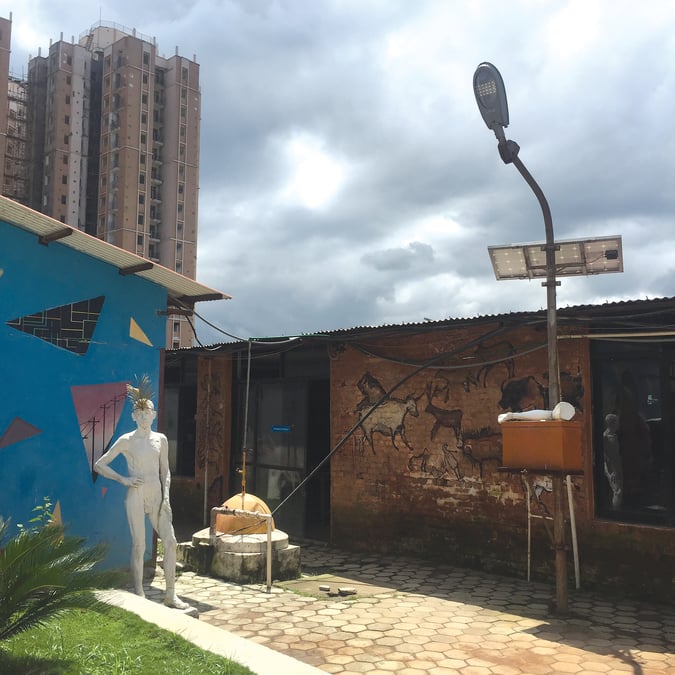
Her teacher was Sujan Chitrakar, then 40, the senior-most faculty, and a celebrated artist. Chitrakar has taught many contemporary Nepali artists and played an important role in establishing what is now KU’s Department of Art and Design (pictured).
In between messages to Mukta about schoolwork, he texted to say he missed her or that she looked beautiful. She recalls being taken aback by a particular text that said: ‘I’m going for a bath. Do you want to see me?’
This was immediately followed with a cartoonish drawing with ‘Nude’ written next to it.
Mukta awkwardly replied with a laugh, unsure how else to respond to such a message from her teacher, whom everyone placed on a pedestal.
During Mukta’s first year in school, she says Chitrakar continued to shower her with gifts, asked her out for coffee, and insisted on driving her around. Once, when she was on his motorcycle returning home from university, Mukta remembers Chitrakar asking her to kiss him on his shoulder.
When she refused, he apologised profusely, then asked if she was trying to seduce him. Seeing how shocked Mukta was, the teacher grabbed her hand and rubbed it against his chest, saying it was just a joke.
A few weeks later, Chitrakar told Mukta that he couldn’t live without her and that they should be in a relationship. Having only looked up to him as a teacher, Mukta was uncertain about her feelings.
When the earthquake struck in 2015, Chitrakar came to check on Mukta, and with her guards down, she felt perhaps his love was genuine. She didn’t doubt if she was safe with him.
A decade later, still reeling from psychological trauma and career setbacks because of the relationship, Mukta is breaking her silence, accusing Chitrakar of abusing his power and grooming her. He had the duty of teaching and evaluating her, instead, Mukta says he used her for sex and emotional support from 2015 to 2019, while she was a student at KU.
DEFAMATION SUIT
She has been urging KU and art institutions to safeguard its students against sexual misconduct, but Chitrakar slammed a defamation lawsuit against her in January 2025 stating she damaged his reputation over what he described in court filings as a "consensual relationship”.
Earlier this week, the Kathmandu District court ruled that Chitrakar’s defamation claim could not be proven.
We asked Chitrakar after the verdict about his conduct. His reply: “I’m sorry for the students who felt uncomfortable, but I did my duty well and good. It is ungrateful of the students to say that. Not everyone has to like me.”
In answer to a query about his stance on intimate relationship between staff and student, he said: “For me it is a big no to date a student. Consequences arise and I am facing them now. Many staff-student intimate relations, including in my department, have ended in happy marriages. It’s a choice based on their personal and social ethics, and something to be determined by university policy.”
Chitrakar said he now draws personal and professional boundaries with students, and says his relationship was not planned. He added, “Regardless of being a teacher I should not have dated a student because I'm a married man. If I was unmarried it would have been ok.
While there is no definitive data on sexual misconduct in Nepal, interviews with more than 23 faculty and students from KU and TU for this story reveal that intimate staff-student relations are normalised, and in some cases even encouraged.
Studies also suggest that sexual harassment is rampant in higher education in Nepal. The lack of university policies, power imbalance between staff and students, fear of retaliation, breaches of confidentiality, and the protection of perpetrators all contribute to impunity for sexual misconduct.
Indeed, after students alleged sexual harassment, bullying, and homophobia against Yubaraj Sangroula of Kathmandu School of Law, and other faculty members in March 2025, the university filed slander lawsuits targeting a student whistleblower and alumni. Sangroula is contesting as an independent candidate in next week’s election from Jhapa-2.
Seven years after complaints surfaced against retired lecturer Krishna Bhattachan for sexually harassing women students, Tribhuvan University, the government run institution, is still drafting its own policy and complaint procedure.
And noted sculptor and former KU faculty member Gopal Kalapremi is yet to appear at Kathmandu District Court, after he was issued a summon on sexual harassment charges in 2024.
Nepal’s Sexual Harassment at Workplace (Prevention) Act (2014) and the National Criminal (Code) Act, 2017 both forbid sexual relations with anyone under one’s care or receiving one’s professional services, such as in education. These laws are binding on all educational institutions, even if they do not have internal policies.
While sexual misconduct can constitute harassment, inappropriate comments or gestures, unsolicited sexual advances, adult ‘grooming’ often goes unrecognised because of its subtle nature. It occurs between individuals with unequal power, such as a faculty and students. This not only compromises on genuine consent because of the traditional respect for teachers in Nepal but also violates professional ethics of academia.
Adult grooming involves a series of ‘boundary-blurring’ behaviour that starts with building the victim’s trust through attention, flattery, or sharing personal details. It gradually escalates to testing how they respond to sexual communication. Once perpetrators are confident the victim will not speak up, they initiate sexual contact and maintain control.
“Had he said outright, ‘I want to have sex with you,’ it would’ve been easier to identify his actions as red flags,” says Mukta, now 36.
Mukta alleges that Chitrakar took her to his studio in his home and made sexual advances. She shoved him away but she recalls him saying, “Even if you’re saying no, I know you’ll like it. Trust me.” Not wanting to make a fuss, she gave in.
This set a pattern for their relationship for the next four years, during which Mukta said he frequently made her comply with his sexual desires. Chitrakar is said to have confided in Mukta about how he was sexually frustrated in his marriage. Every time he argued with his wife, Mukta says he made her listen in on the call.
Chitrakar would urge Mukta to spend all her time with him, and recalls: “He would be upset for days if I went out for lunch or to exhibitions with friends.” Feeling guilty, she would then spend all her free time with him. If anyone enquired about their relationship, Mukta repeated what Chitrakar had instructed her to say: “This is my personal life. I’m an adult and I make my own decisions”. This kept others from interfering. Over time, Mukta’s friends started avoiding her, calling her “Sujan Sir’s girlfriend”.
When faculty sleep with their students, Amia Srinivasan, author of the book Right to Sex, states that the student is transformed in the eyes of the academic community as a whole: “She can no longer relate to other professors as her teachers but as her boyfriend’s judgmental colleagues.” Peers then attribute her achievements to the sexual relationship with the teacher.
Right after completing her undergraduate, Mukta joined KU as a visiting faculty on Chitrakar’s request so they could continue to spend time together. But soon after, in August 2019, he abruptly ended their four years long relationship.
Mukta felt Chitrakar needed space because of his marital problems and tried to support him as he had asked in the past, and sent him consoling messages. But when she learnt that Chitrakar was involved with another undergraduate student, she started to understand what he had done to her. Unable to face anyone, she described feeling suicidal.
Many student survivors have shared that it takes years for the full impact of those intimate relationships to reveal itself. “Even if they felt it was consensual at that time, as they gain some distance, they often become aware of the power imbalance, and realise that the situation was harmful for them,” sexual harassment researcher Anna Bull of the University of York told Nepali Times.
Another student who graduated in the early 20s said Chitrakar caressed her back and thighs whenever he sat on her scooter. She was 20 at the time, and recalls: “He would ask me to give him a ride because he had back pain and couldn’t drive his motorcycle. But he would be very touchy-feely throughout. I ignored the warning signs because he’s a respectable person and couldn’t possibly have bad intentions.”
Another survivor, also a former student in her early 20s then described Chitrakar as “dangerously manipulative”. She said he sent her inappropriate texts and offensive photos. Despite saying she was not comfortable with it, Chitrakar is said to have continued pursuing her, affecting her mental health and professional life.
Mukta’s classmate, now 32, says there were other teachers at KU involved in sexual misconduct. “Since he was senior-most faculty, what he did gave license for other teachers to do the same,” he said. “It made us feel very uncomfortable to watch him date our classmate but we had no one to complain to.” He added that older male teachers dating younger women students was a pattern in the university.
A former teacher at the KU art department said, “Several faculty members dating students would message me to say that their girlfriends, who were also my students, were running late for class. This meant I couldn’t mark them as late.” However, the teacher said it was pointless to complain.
Speaking to Nepali Times, a current faculty of the KU art school said he sees no issue if a teacher-student relationship ends in marriage. “If they truly love each other, I don’t have any problem with that, many students and teachers are married. But if the teacher is married and is lying, flirting or hurting the student then it’s wrong,” he added.