
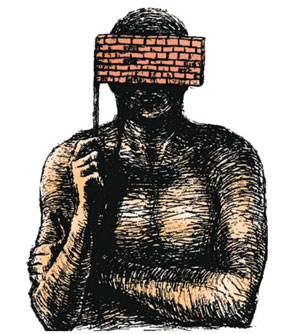
To be fair, the netas do have a point: Whatever one thought of the dead crook, he did not deserve to be chased down and shot. An investigation should be launched to bring out the truth behind what really happened in the encounter.
But the public is not buying the politicians’ fury. If you care so much about rights, they ask, where were you when a girl was raped in a bus in Nepalganj recently? Where’s your concern for the Bhote Kosi survivors who are still fending for themselves, three weeks after the landslide?
In any other democratic country, politicians channel public outrage. In Nepal, when politicians channel their outrage, the public is cynical. When politicians are widely seen to have much in common with alleged criminals, they lose touch with the everyday concerns of ordinary Nepalis who have electoral representation but no real political voice. And our leaders want to keep things this way: yes, on nominal representation; no, on voices for all. What those who wish for political change fail to appreciate is, with no constitution and no regular competitive elections for years, it is structurally difficult to change the way political parties exercise unaccountable power over us.
Meanwhile, the cost of doing party-politics in all the 75 districts is getting costlier and costlier. Every party needs big money to get going. They either raise funds by the tedious means of calling people up, asking for donations and hoping they give it to you without being forced, or by using generally accepted shot-cuts to siphon money from the national treasury.
If you are a small-time politician, you try to earn extra by fibbing on your receipts. You hope that over the course of your tenure, you get to accumulate a fortune. If you are a medium-to high-level politician, you ask the government for huge sums of money so that you can go to foreign countries for medical treatment. Again, do you need to submit your receipts? Who’s to tell you?
But what if you are a national-level senior politician who has aspirations to head the government someday? You may exude gravitas, but you need the money too. You quietly outsource all the unsavory aspects of your fund-raising work to supporters who are known criminals. You provide them with protection so that they don’t have to worry about the law enforcement authorities. On the other side of this equation is Nepal’s positive social progress and anemic economic growth: With millions of healthy young people reaching working age (without dying early due to diarrhoea, cholera, etc), and then not finding gainful employment in Nepal, some of them turn to crime to sustain themselves.
Unaccountable politicians who need money for their parties and young men who can loot, rob and extort thus become familiar bedfellows in our colourful political landscape. When one dies, the other feels hurt. How to change this arrangement? There is no easy answer and the ones that come up have a chicken-or-egg problem.
Still, continuous yet strategic campaigns by independent civil society institutions for good governance, and an enabling environment for private sector companies to be born, grow and create jobs and bigger tax base remain two ways through which the state can provide political accountability to all.
Read also:
Adrift, Damakant Jayshi
All politics is local, Ashutosh Tiwari
Cleaning up our act, Suraj Vaidya