
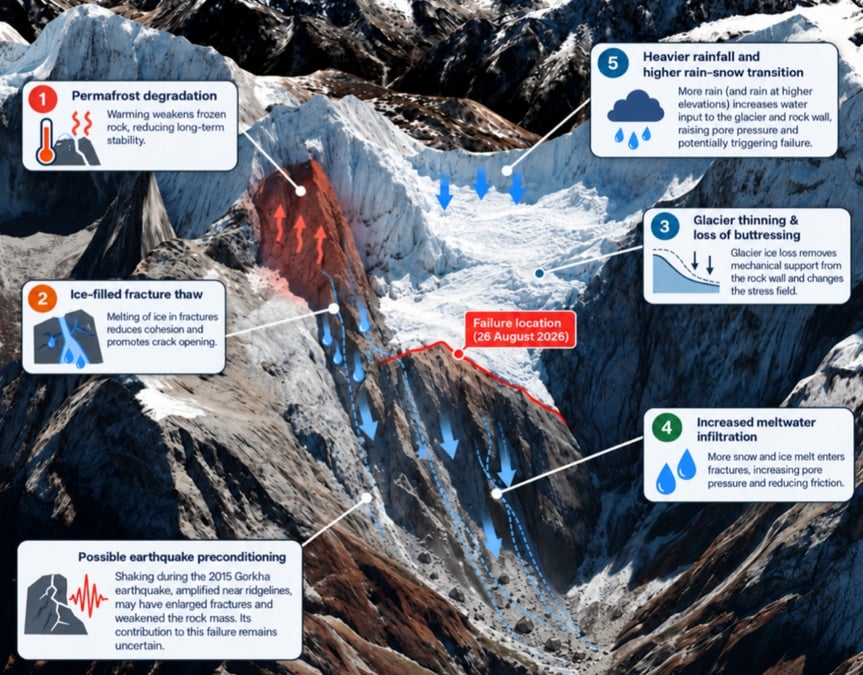
Three weeks after a catastrophic collapse on Langtang Lirung in Nepal, scientists have pieced together satellite images and weather data of the mountain to conclude that climate breakdown was one of the culprits.
The rapid report was released by World Weather Attribution (WWA), a consortium of international scientists which analyses extreme weather events to find possible influence of climate breakdown. Although it mainly deals with heatwaves, cloudbursts, and droughts, the group also analysed the September 2024 flash floods in the Lele and Rosi Khola of Nepal.
‘The catastrophic rock and ice collapse … was influenced by a range of climatic and geological factors, most of which are worsened by the impacts of climate change on the high altitude landscape,’ says the report by a team of glaciologists and climate scientists.
As of Thursday afternoon, 1,400 bodies have been found with more than 5,000 people still missing in China and Nepal after a chunk of Lantang Lirung fell into the Lhende Khola on the border unleashing the deadly ice, rock and debris flow.
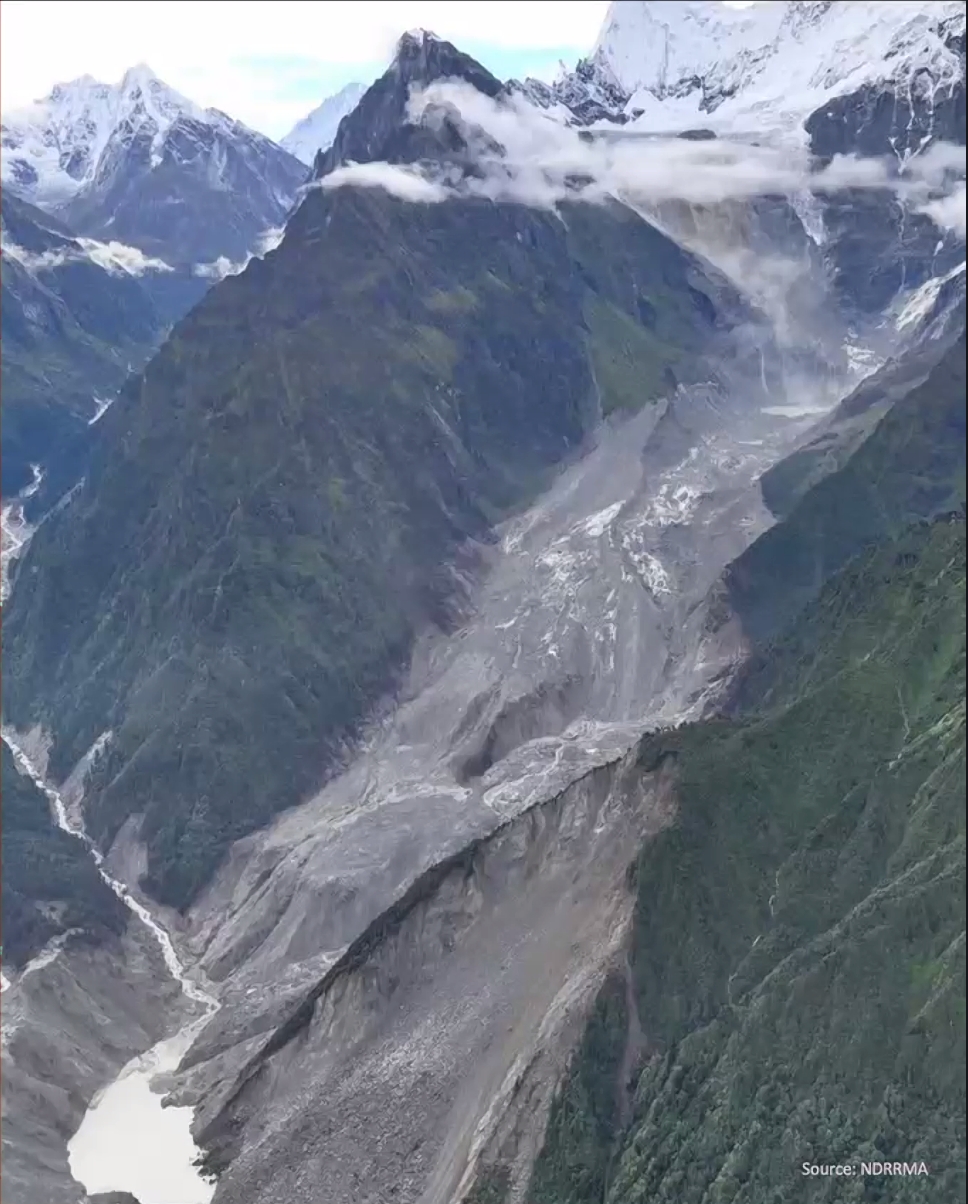
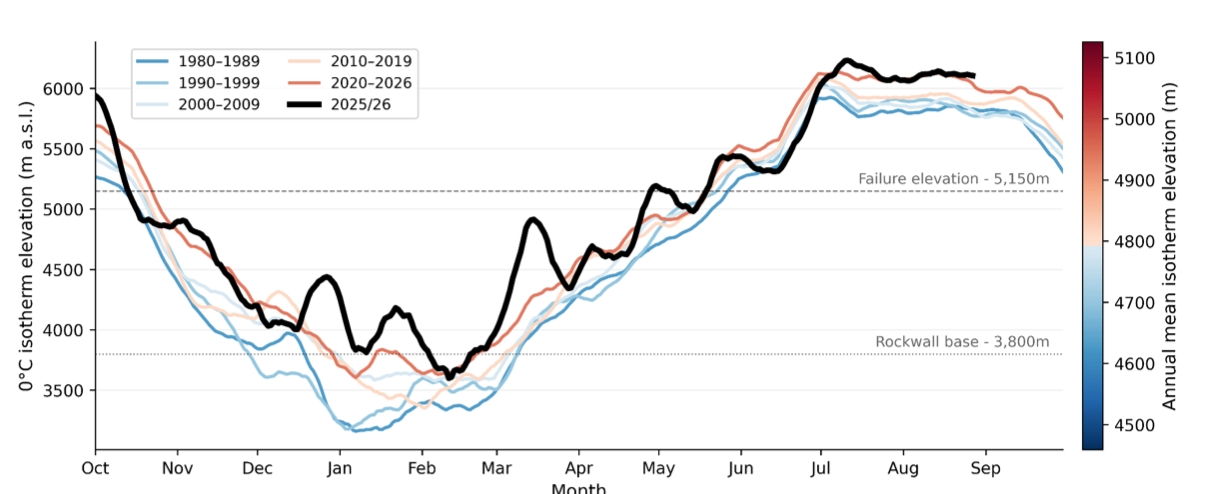
The report found that this was a compounded hazard chain that started with the collapse of the rock face due to tectonic and temperature causes. Decades of atmospheric warming due to fossil fuel burning raised the temperature above the freezing threshold of 0°C isotherm at above 5,000m on the mountain.
As elsewhere in the Himalaya, this had pushed the glacier up the slope by 100m per decade and thawed the permafrost in the rock fractures holding the bedrock together. The melting, plus long-term instability of the face after the 2015 earthquake, destabilised the slope and led to the collapse, the report concludes.
The scientists also examined temperature data for the region around the Langtang massif and found that July and August temperatures were the warmest ever recorded. There was also unusually heavy snowfall in October and November last year, which increased the snow load on the melting ice shelf.
Climate change has caused about 1.5°C of warming since pre-industrial times. At the Climate Summit in Paris in 2015, world governments had agreed to cap global average temperature at the 1.5°C, but that threshold has already been reached. In addition, the Himalaya also experiences ‘altitude induced warming,’ which makes the region 0.7°C hotter than the global average.
The report says that Nepal has exceeded its capacity to adapt to such impacts of climate change. It adds, ‘The scale of this tragedy exceeded physical adaptation limits, highlighting the difficulty in adapting to worsening disasters and risk for greater loss and damage.’
The scientists also add that glaciers and high altitude permafrost respond over decades to temperature rises, and past warming has already locked in future destabilisation increasing the urgency of fossil fuel phase outs to prevent future catastrophic collapses.
“This disaster was not an extreme weather event, but the fingerprints of climate change are still clear to see in long-term changes,” said Ben Clarke , Extreme Weather and Climate Change Researcher at Imperial College London.
Mountain hydrologist Walter Immerzeel has researched in the Langtang area, and was one of the scientists contributing to the WWA report. He said: “We are witnessing fundamental, irreversible shifts in Himalayan mountain environments. When you combine high-elevation permafrost degradation with glacier retreat and record summer heat, the structural integrity of these mountain walls is compromised.”
Nepal’s climate activist Manjeet Dhakal has been warning of the growing risk to downstream areas form floods exactly like this for a decade. He is convinced that rising temperatures are transforming the mountain environment, creating increasingly complex and cascading hazards.
“The magnitude of this disaster is testing Nepal’s response capacities and the limits of adaptation,” he says.
WWA says this report on the Bhote Kosi-Trisuli Flood is different because it is not looking at a single extreme weather event, but a a multi-stage mountain disaster. The report is expected to bolster Nepal’s case for climate justice and its appeal to the Loss & Damage Fund to pay for rehabilitation and reconstruction.
“In addition to the human tragedy on an unimaginable scale, the cost of recovery for this disaster is substantial. For a nation that’s done virtually nothing to contribute to this problem, it underlines the need to find fairness in helping climate vulnerable nations cope with the problems they have not unleashed," says Madhab Uprety of the Red Cross Red Crescent Climate Centre.”
Nepal's Prime Minister Balendra Shah is addressing the UN General Assembly on 23 September where he is expected to highlight Nepal being at the frontlines of climate disasters despite its decarbonisation contributions.
Scientists say this is not just a Nepal disaster, but a warning to the world at large. They also point out that High Mountain Asia is the third largest repository of water stored as ice after the norther and southern polar regions. As such, if the ice caps melts, it will affect all of Asia’s large rivers and ultimately about 2 billion people living downstream.
Says Friederike Otto, Professor of Climate Science at Imperial College London: “Without much faster action to transition to zero fossil fuel emissions we will inevitably see more disasters of this scale occurring in the years to come.”