
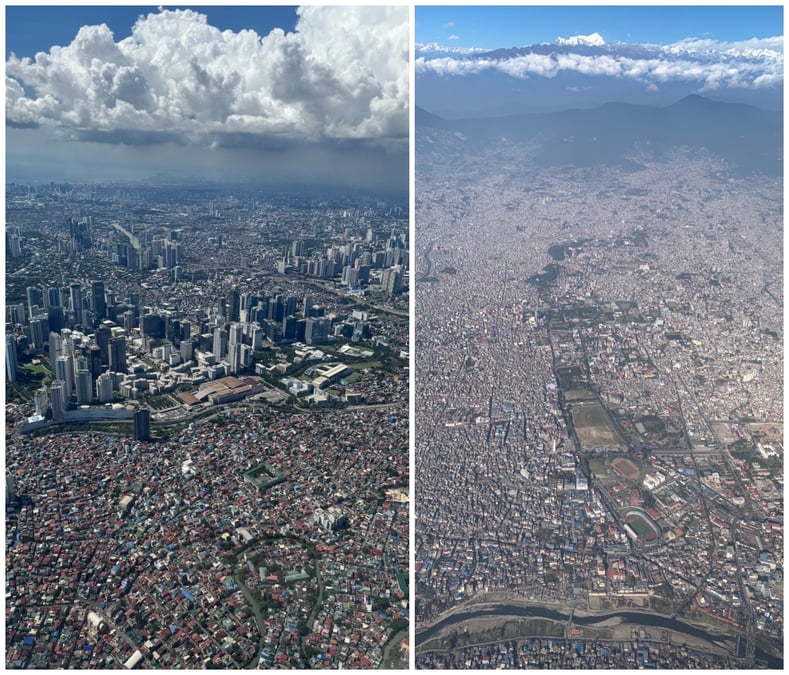
A Nepali travelling through Metro Manila or Cebu City in the Philippines will notice a strong cultural similarity to Kathmandu.
Filipinos are famously laid back, just as Nepalis are. The pace of life can be slow, and daily operations run in a form of ‘managed chaos’ that feels very familiar for someone from Kathmandu.
Like Nepal, the Philippines also relies on exporting migrant workers. In 2024, personal remittances from Overseas Filipino Workers (OFWs) reached $38.34 billion, about 8.3% of their total GDP. Nepal is much more dependent on remittances which account for nearly 25% of its GDP.
However, the Philippines has an economy multiple times larger than Nepal's, yet the level of visible inequality and intense consumerism is striking. This presents a clear case study for Nepal as the new government charts a national development strategy.
On paper, the gross economic output and individual income averages in the Philippines are much higher. The archipelago's GDP per capita is about three times more than that of landlocked Nepal, so one might expect better urban living conditions. Instead, the inequality is inescapable and highly visible.
Directly adjacent to high-rise corporate offices of Bonifacio Global City (BGC) in Manila or the Cebu Business Park, the urban poverty is glaring. Slums, dilapidated streets, and families living in shacks exist right next to modern financial centres.
This observation is backed by data. The Philippines has a high Gini coefficient (a metric used to measure income inequality) of around 39.3. A higher number means greater inequality. Nepal’s Gini index stands at around 30.
UNIFORMLY POOR
Nepal may be statistically poorer, but its income distribution is more balanced. The average Nepali often enjoys a better economic baseline. Yes, poverty is widespread in Nepal, but it is more evenly distributed.
In the Philippine model, hyper-wealthy pockets exist side-by-side with severe urban deprivation. The level of retail capitalism in the Philippines is higher than in other Southeast Asian countries like Thailand, Vietnam, or Indonesia.
In Manila and Cebu, mega-malls, cafes, and restaurants are constantly packed. The urban population is visibly much more influenced by Western-style consumerism, where life revolves around purchasing goods and services. There is a strong sense that people are earning primarily to spend on immediate consumption rather than building long-term assets.
This behaviour is a major driver of the Philippine economy. Household consumption accounts for over 70% of the country's GDP. This is heavily funded by external income from overseas Filipinos sending money home.
In Nepal, remittance cash is used differently: it generally goes toward buying rural land, paying off family debt, education, health, and basic household survival. In the Philippines, it is injected directly into the urban retail sector, fueling a fast-moving consumption cycle that keeps dependency on imported consumer items high.
The Philippines is noticeably more expensive for tourists and residents alike compared to other Southeast Asian nations, and there are three three structural reasons for this inflation: