
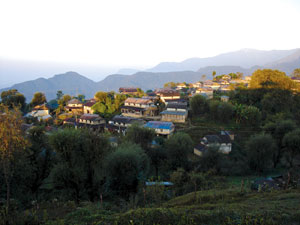
 BADRI PAUDYAL BACK TO THE PEOPLE: The home-stay program in Ghalegaun in ACAP has injected money into local conservation and community development. |
Nepal's Annapurna Conservation Area Project (ACAP) survived a war, upheavals in Kathmandu and the tragic death of its founding members in a helicopter crash six years ago. But it may not survive the interference of short-sighted politicians during the country's present fluid transition.
The future of Nepal's largest protected area is in jeopardy after the Cabinet's surprising decision in July to terminate the management of the internationally acclaimed eco-tourism project by the National Trust for Nature Conservation (NTNC) which had been running it for the last 25 years.
The NTNC had asked the government for an extension of its management for another 10 years to facilitate the handover of resource administration to local councils. But the Cabinet ignored the endorsement of the NTNC mandate by the Ministry of Forest and Soil Conservation (MoFSC), and instead directed it to find an alternative arrangement.
ACAP was pioneered by late conservationist Chandra Gurung and it is internationally recognised as a role model for sustainable tourism development that injects tourism income directly into the village economy. Gurung and five of Nepal's top conservationists were among 25 killed when their helicopter crashed in November 2006 during a visit to the Kanchenjunga area to replicate ACAP's accomplishment in eastern Nepal.
"It shocked us all," recalls ACAP's Lal Gurung of the Cabinet's decision. "In the absence of a legal framework and skilled grassroots conservation leaders, the abrupt exit of NTNC will jeopardise late Chandra Gurung's conservation legacy." ACAP is NTNC's largest undertaking and covers an area of 7,629 sq km. It is inhabited by over 100,000 people of various ethnic groups, and it includes Upper Mustang and Manang.
Conservationists admit that many of ACAP's strict rules on energy use, forest conservation and infrastructure development may have to be modified given the spread of roads into the high mountain areas. But they say the Cabinet's decision seems to have been influenced by the 35 companies who have hydropower licences in the Annapurnas.
Like the controversy over resorts inside Chitwan National Park and changes in the regulations governing community forestry, the Cabinet's decision on ACAP could have far-reaching impact on model conservation efforts for which Nepal is internationally recognised.
Juddha Gurung of NTNC says it is unlikely that the government will completely scrap ACAP. "The government doesn't have the resources nor the capability to take over ACAP, and there will be an international hue and cry," he adds optimistically, "I think the government will eventually decide to extend the NTNC's mandate over ACAP's management."