
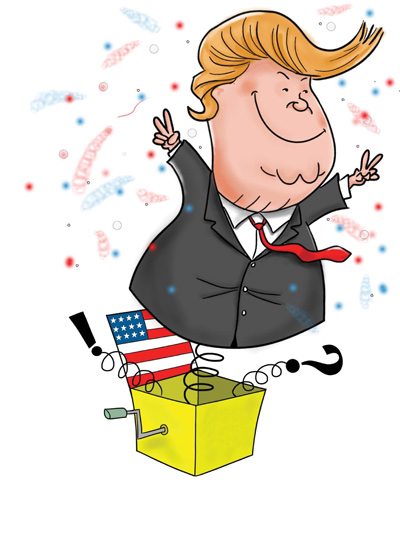
As the shock of Donald Trump’s victory in the US elections gives way to dismay over his choice of White House staffers and the new cabinet, the rest of the world is reminded that western democracy has a design defect which tends to throw up demagogues at regular intervals. In our own neighbourhood, we have seen the rise of the Indian alt-right three years ago in a similar backlash against established dynastic parties in the world’s largest democracy. This year’s election in the Philippines elevated a self-confessed death squad gang leader to the office of the country’s president. Turkey’s elected president has unleashed a draconian crackdown on dissidents. After Brexit and the rise of the wrong right across Europe, it has become difficult to figure out whether it is America that is following Europe’s lead or vice versa. Probably both.
Much of the blame for the election upset in the US has gone to the media: a post-truth mass media out of sync with the masses, and a social web hijacked by fake news sites. Facebook in particular has come under intense scrutiny for doing nothing about its toxic ecosystem of falsification. Mark Zuckerberg has countered this week with a feeble defence that his social network promotes a diversity of voices, and is a technology company and not a media one. That is a convenient untruth. It is like cinema hall owners saying they are not responsible for screening movies with incendiary content.
As Trumpism takes hold, the mainstream media in the United States is questioning its adherence to the doctrine of false equivalence — the journalism rule under which reporters are required to give equal weight to both sides in an argument even when one side is deliberately lying to rabble rouse. The mantra of objectivity is being challenged with the argument that it is more important to be truthful than neutral.
This bit of soul-searching comes at a time when media everywhere is under siege. It has either been forced by commercialisation to abandon its public service remit, or it is being seriously challenged by hate content on the social web. In a parody of economic globialisation, much of the content of these US-based fake news sites have been outsourced and are manufactured in Macedonia or the Philippines.