

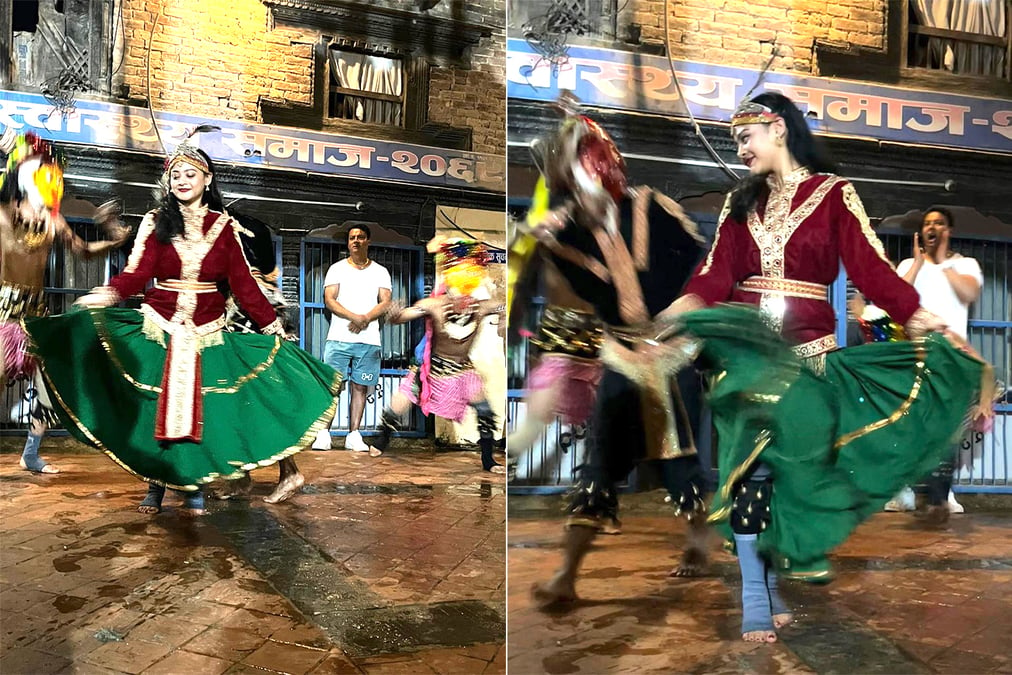
On the night of 10th August 2025– technically the 11th – I got out of Kathmandu airport and rushed to Thimi, where Prajita Shrestha was performing the Nagacha Pyakhaan. Woven around the story of Hindu mythological characters, Bhasmasur and Mohini, the dance is exclusive to Thimi in Bhaktapur.
Prajita is only the fourth girl to dance as Mohini. In the past, male members of the community played the role. In a move away from the traditional mode where men perform female roles in religious dances, women are now being inducted in some performances.
When Prajita was first asked by the guthi to perform as Mohini, she instantly said yes, before even asking her parents’ permission. “My heart leapt with joy the moment I was asked. I knew I was meant to do this,” she says.
She first performed in August 2022 and was nominated again in August 2025 to perform. Social media reels of her dancing that gained wide popularity seems to have endorsed her as the crowd’s choice, even though she was actually stepping in to fulfill a sudden vacancy due to unforeseen events.
When I arrived in Thimi that night, Prajita had already been on her feet for a long while. Her face lit with mischief, she went from alley to alley, flirting and motioning at Bhasmasur, the antagonist of Nagacha Pyakhaan.
The story has it that the Hindu god Visnu, disguised as the enchantress Mohini, enamours and prompts the demon Bhasmasur to self-destruct. The old dance form, exclusive to Thimi, was revived in 2019 and women dancers were gradually introduced. Some other cities like Bhaktapur and Kirtipur have also introduced women in religious dance and music, recently.
Prajita had seen Nabina Prajapati perform as Mohini ahead of her and says it worked as an inspiration when she was asked. Her parents did not disapprove of her intent because her brother, Kiran had already been performing the Bhaila dance and they were familiar with the processes. The Bhaila, dedicated to Hindu deity Bhairav, was revived about a decade ago, and is performed by young boys in Thimi.
All religious dances in the Kathmandu Valley were traditionally done by men. Prajita is one of the few women who have stepped into unchartered territory. The 24-year-old, a student and communication worker, has also set the stage for more girls to follow in her steps.
“I know they say that Newa women do not have freedom, but we have to understand that not letting women participate in these dances was also a way of protecting them,” she says.
As Prajita and the troupe stepped up on the raised stone platform daboo at Thimi thoroughfares that night, men in the audience cheered: “Wala, wala!” It’s here!
Unfazed, Prajita maintained her smile and her composure, her arms flailing in the night air, her feet tapping the ground. “When one performs as Mohini, the crowd jeers and teases. It might be because in the past men disguised as women to perform and they got teased. So when our grandmothers were saying no to this, they were trying to keep us from that exposure, which they did not think was safe or appropriate.”