
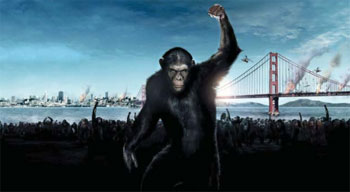
For those who need a bit of a catch up: the main character in both films is Caesar (played and voiced by the wonderful Andy Serkis), a highly evolved ape who was lovingly nursed and treated as a family member by a human family in the first film. As Dawn starts, human kind has been mostly eradicated by a virus. The only real form of civilisation is the highly sophisticated ape community that has taken over the famed Muir north of San Francisco.
The apes live in peace, content that they will never again be mistreated or experimented upon by people (Caesar and his fellow hyper intelligent apes are the result of laboratory testing), but frequently speak of the horror of having lived under humans. Imagine, then, the reaction when two of the apes come across a bellicose human in the forest and are subsequently shot at. Thus begins a horrific war between the apes and humans, both factions of which harbour hawks, doves, savages, and savants.
This film is difficult to watch for the thinking viewer. It drives home, with efficiency, great skill, and feats of technology, the horror of living in a modern world where humans think of themselves as the superior species and the rightful inheritors of the earth even while we simultaneously monger wars, commit genocides, and shoot down civilian planes.
Ours is a planet now ridden with industrial waste, a planet where evolved humans still include those of us who gleefully kick dogs, spit on the street, and rape, murder, and pillage. The Dawn of the Planet of the Apes, even though difficult to stomach, is perhaps necessary viewing.
It is a mirror that reflects the ugliest aspects of humanity right back upon us – watching it, therefore, requires quite a bit of bravery.
Watch trailer