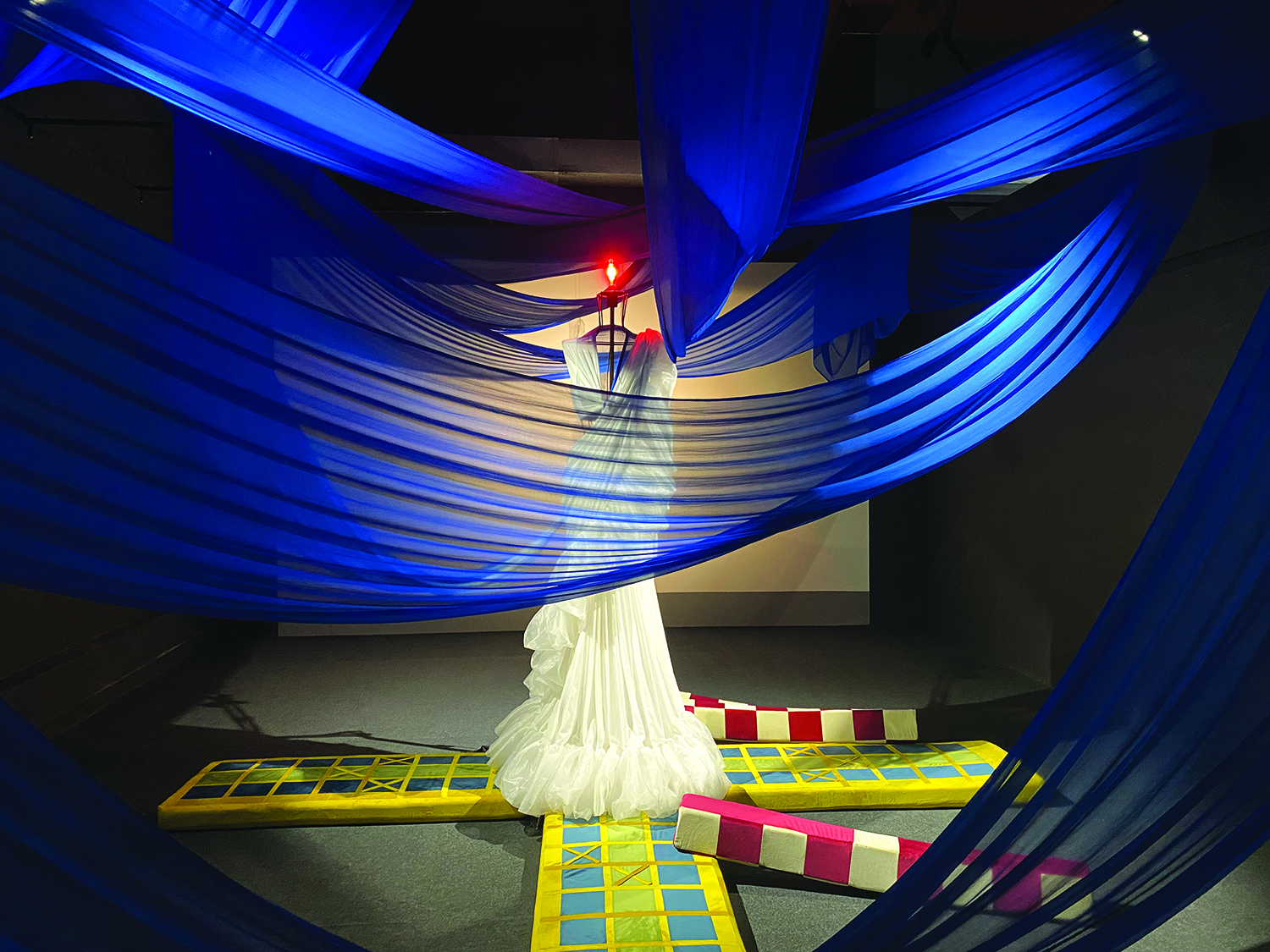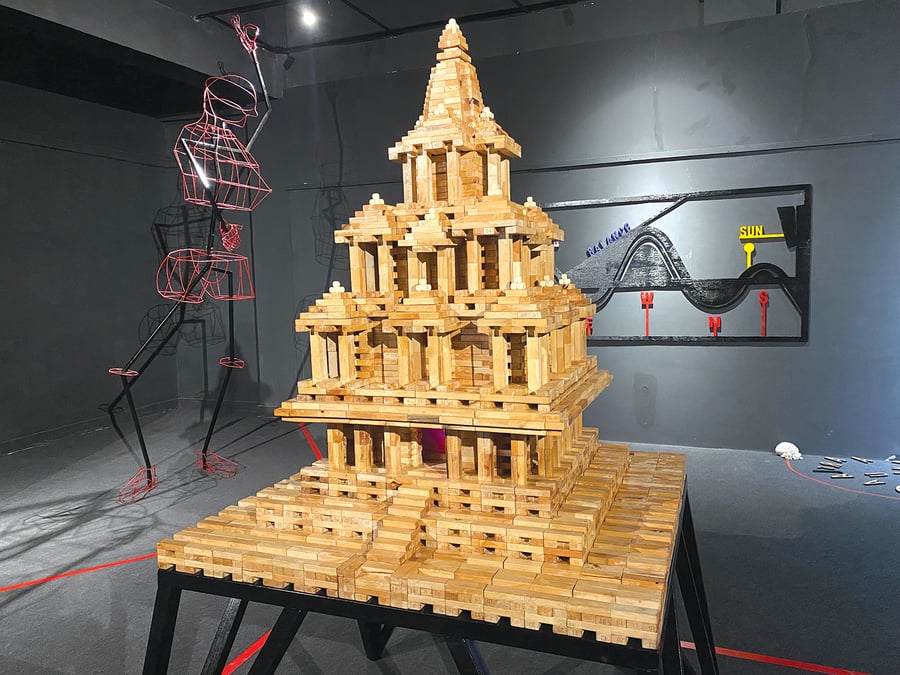
In the middle of the first floor of the Rasa Lila exhibition at the Nepal Art Council is a model of Patan’s Krishna Temple made of Jenga blocks (pictured above). Inside the temple is a red holographic Radha, dancing.
The temple here represents Vraja, a realm that lies far away from the universe in the heights of paradise. This mystical place is the setting of the Rasa Lila: a long lyric poem in the 10th book of the Bhagavata Purana that describes Krishna’s circular dance of love with his female devotees.
So the choice of material makes sense: Vraja, much like buildings made out of Jenga, is more an impermanent zone where players dance with focus and balance.
Read also: My Sweet Lord, Sewa Bhattarai
Rasa Lila is put together by Priyam Pradhan and team and is made up of various media, including paintings, sculptures, songs, and films.
The exhibit spans two floors of the Bagmati Art Gallery atop the Nepal Art Council in Baber Mahal. The first floor is about the Rasa Lila (Rasa: divine dance, Lila: divine play). The start of the exhibit plays with the story of Shiva being stopped from entering the Rasa Lila, because he is nine feet tall and not a woman. So he takes a dip into the Yamuna River and emerges a beautiful lass ready to take part.
Referring to this story is Gopeshwar Mahadev, a sculpture made out of concrete hands and feet joined by rods of carbon steel. The pre-dip hands are masculine, and the post-dip feet, adorned with ghungroo beads, are feminine.
Next is a river of letters that represents the Yamuna River and contains the initials of the team who worked on the project. Explains Pradhan: “I want visitors to the exhibit to feel like Mahadev, crossing the river into Vraja." A description reads, "The Yamuna is a bridge spanning the celestial and physical realms, and bathing in its waters is the final act after which the Gopis return to everyday life."
Read also: Swasthani lecture
Next to this piece are two large wiry structures of Gopis in dance. They have black metal rod skeletons and wire bodies: one red, and one yellow.
Inside an alcove in the gallery is a five minute film on loop titled ‘There is no perfection, only life’ made by Urza Acharya. It depicts the life of a Gopi after participating in the Rasa Lila. She is initially struck by depression and lethargy, but slowly finds the motivation to dance and be creative again.