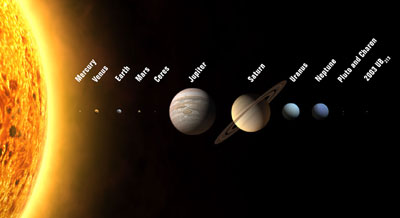
 The last decade has been exciting for planetary astronomy, in large part because there are powerful new telescopes positioned on the ground and in space. For thousands of years, very little was known about the planets, other than that they were objects which moved in the sky against a background of fixed stars. The very word 'planet' comes from the Greek word for 'wanderer'.
But today, hosts of newly discovered large objects in the outer regions of our solar system are presenting a challenge to our historical definition of a planet.
The International Astronomical Union, at its conference in Prague in August, decided that Pluto is no longer a planet, downsizing the solar system from nine planets to eight. When Pluto was discovered in 1930, there were controversies about whether it should be considered a planet or an asteroid captured by the Sun.
Pluto hasn't changed now, but the definition of a planet has, after rigorous debate among astronomers. A planet is now 'a celestial body that is in orbit around the Sun, and has sufficient mass for its self-gravity to overcome rigid body forces so that it assumes a nearly round shape, and has cleared the neighbourhood around its orbit.'
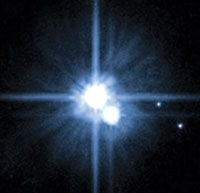
Much-maligned Pluto is automatically disqualified under the new criteria because its oblong orbit overlaps with that of the eighth planet, Neptune. Instead, Pluto along with Xena (2003 UB 313) and Ceres (an 'asteroid' between Mars and Jupiter) will be reclassified in a new category of 'dwarf planets', similar to what have long been termed 'minor planets'. These are a third class of lesser objects that orbit the Sun, 'small solar system bodies', a term that will apply to asteroids, comets, and other natural satellites. School and college textbooks around the world will have to be changed.