
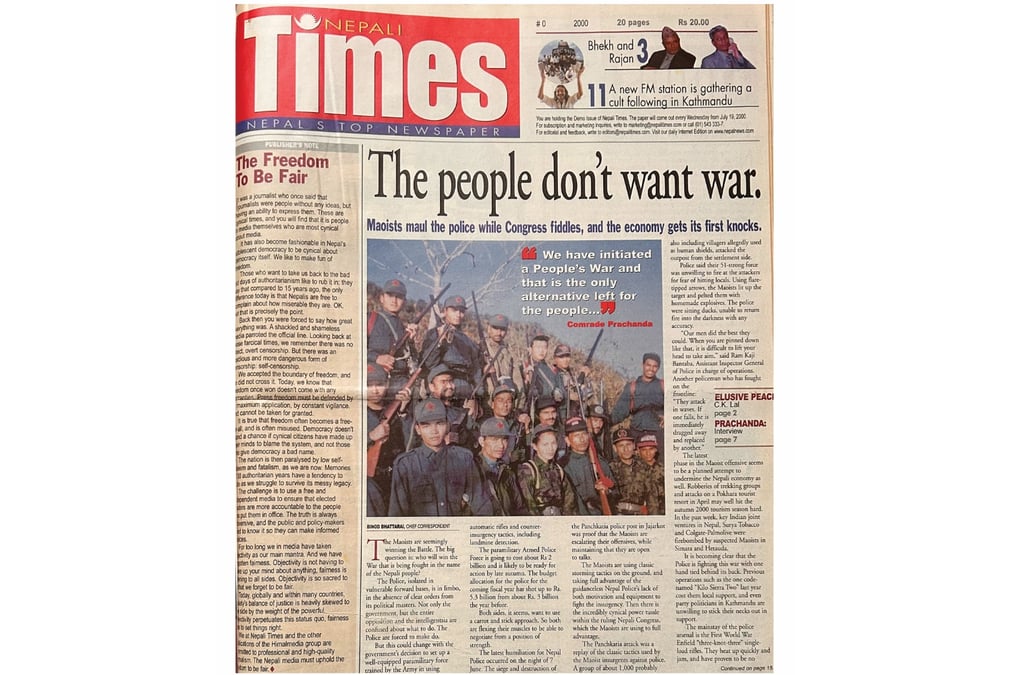
2026 marks the 20th anniversary of the Comprehensive Peace Accord that ended the Maoist conflict, and 30 years since the rebels launched their armed struggle.
Yet, two decades after it ended, there is almost no collective national memorialisation of a conflict that ended up killing 17,000 Nepalis. More than 1,330 people are still listed as missing. The perpetrators of heinous war crimes walk free in broad daylight — some have even served as ministers in government.
The transitional justice process, which was a part of the 2006 peace accord, is in limbo. History text books do not mention the war, an entire generation has grown up with no recollection or knowledge of the violence.
The goals for which so many lives were lost are now covered in the dust of history. It is a long list of promises not kept, pledges not honoured, sacrifices forgotten. The 2015 federal republican Constitution was the war’s end-point. The monarchy was abolished, political devolution from Kathmandu to the seven provinces, and an inclusive, just society was promised.
But then it was Animal Farm all over again. Napoleon, Snowball and Squealer started resembling Farmer Jones until no one could tell them apart. Today, some ex-guerrillas still believe in the revolution, many have migrated to the Gulf or Malaysia, child soldiers now have children of their own, survivors and families of the victims struggle with their loss, but memories are fading. International support for human rights organisations to pursue justice is drying up.
Yet, many of the objective conditions for revolution are still present in Nepali society. Politics and party structures are more centralised than ever. Federalism did not replace feudalism. The Constitution stipulated quotas for women and marginalised groups, but parties found ways around them to favour relatives and cronies. Socio-economic inequities are wider than 30 years ago. Corruption became a given.
None of the promised revolutions since 1950 attained their ultimate aims, as Sudiksha Tuladhar’s analysis in this edition (page 9) concludes. The Shahs were not that much better than the Ranas, and acceded to popular demands for change only to dismantle democracy. Young Nepalis took to the streets in 1980, 1990 and 2006 in pro-democracy movements, but rulers regressed and perpetuated the status quo.
RIPE FOR REVOLUTION
From 1996-2006 the Nepali people were held hostage by a war fought in their name. The Maoists used the borrowed and ill-fitting ideology of ‘The People’s War’ waged by ‘The People’s Liberation Army’. The labels were tragically appropriate because it was the people who died and suffered.
Nepal had not seen armed conflict in its territory since the 1814-1816 Anglo-Nepal War. Since then, Nepalis have been fighting in other people's wars. But by the 1990s, Nepal was ripe for revolution because of the feudal ruling structure, the apathy and neglect of newly-elected parties that left millions of youth without jobs and opportunities. Public exasperation was building up.
Nepal went from absolute to constitutional monarchy, parliamentary democracy and even endured the royal-military coup of 2005. But it did not make the rulers more accountable, they were mostly preoccupied with personal or partisan greed and ambition.
The same pattern was repeated following the 2017 election, after which Nepal had five coalition governments in six years. Serial prime ministers played promiscuous politics and recycled themselves over and over again.
Again, all it needed was a spark. That came on 8 September 2025. The slogans and demands, the outrage and impatience of the GenZ protesters were nearly identical to the young students who marched to the palace gates in 1980, 1990 and 2006. Some of those students went on to join the parties they were affiliated with, and are now themselves in their 50s and 60s.
They were all angry and young once. They may no longer be young, but some of them are still angry. Ever since 1990, the political parties which could not get their act together to spur investment and create jobs decided to encourage outmigration of youth. Thus, the rulers exported outrage, while they themselves played musical chairs, oblivious to the fate of the country.
After every half-revolution the new dispensation has emulated the despots they replaced, or thrown the baby out with the bathwater. The danger with the run-up to the March election and beyond is that we will repeat that mistake. Not everything old is bad, not everything new is good.
As the old and the new battle it out, let us learn from the Maoist conflict so that in 2026, the new will not start resembling the old.
Kunda Dixit