
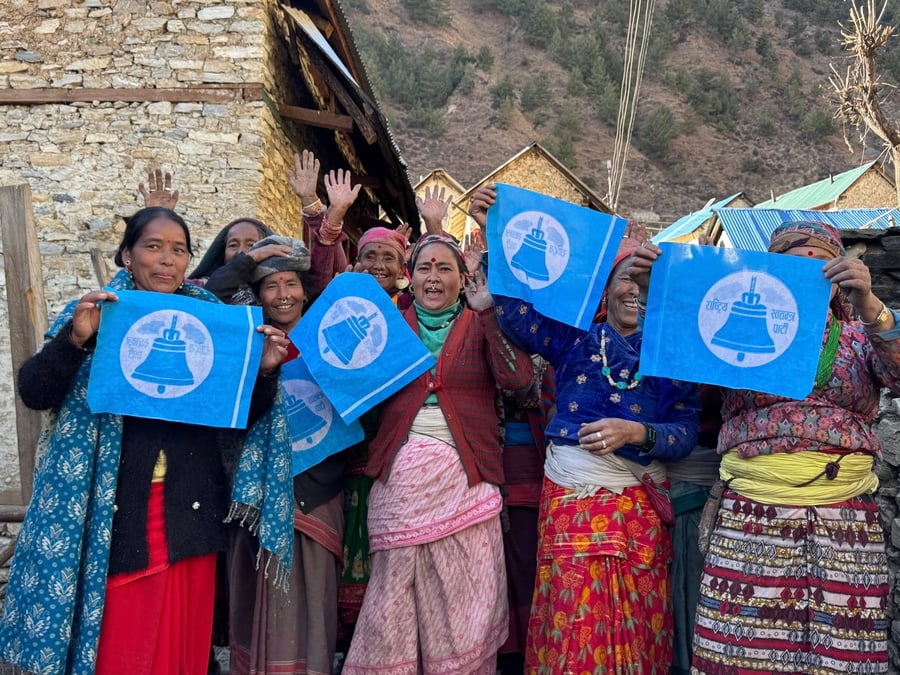
After Thursday’s election, Nepalis are in a wait-and-watch mode. The Election Commission says counting ballot papers will be expedited this time, and the results for the First-Past-The-Post (FPTP) will start being declared within days. In 2022, it took three weeks for the final results to be tallied.
But winning an election is only half the challenge for the parties, forming a government under parliamentary politics is like a complicated mathematical equation.
In 2022, the Nepali Congress (NC) emerged as the biggest party, winning 89 seats. But the UML with 78 seats and the Maoists with 32 formed a minority government. In fact, Sher Bahadur Deuba did not become PM then despite leading the biggest party in Parliament.
This time, there is an unmistakeable Rastriya Swatantra Party (RSP) wave led by its prime ministerial candidate, Balendra Shah. Besides his own popularity, Shah represents change which most Nepalis are clamouring for after decades of corrupt and feckless coalitions that did not deliver.
The past months of campaigning has seen massive youth engagement on social media through memes, AI clips, and viral images. Digital content that appeals to emotion rather than policy debate between candidates shape electoral outcomes in Nepal and elsewhere.
Shah represents GenZ aspirations, and was their candidate for prime minister. It was only when he declined that Sushila Karki was nominated. None of the political parties in the recent past -- new, old, or revolutionary — have won enough seats to go it alone.
The most recent majority government was formed by the short-lived Communist Party of Nepal after the UML-Maoist merger in 2022. But that rare two-thirds majority collapsed after a power struggle between K P Oli and Pushpa Kamal Dahal. The only party to have won a majority was the NC in the 1991 and 1999 elections. But it is near impossible for it to repeat this success now, even with Gagan Thapa's rebranding of the party.
We have compiled these possible scenarios for election outcome in order of likelihood:
RSP gets a majority
RSP hits the magic 138 to form a government entirely on its own. Balendra Shah wins Jhapa-5, and becomes the new prime minister at 35, the youngest ever to hold the office in Nepal. But danger lurks: there could be a personality clash between Shah and Lamichhane who are both equally ambitious. History could repeat itself.
RSP wins but does not get a majority
RSP is likely to sweep the most votes, but what if it does not secure enough seats for a majority? It would need a coalition partner and Nepali Communist Party (NCP) under Pushpa Kamal Dahal could fit the bill, but only if it has the numbers. The RSP is not likely to team up with the UML or NC.
The NCP is relatively untainted by the 8 September events, and also has former UML defectors like Madhav Kumar Nepal and Bhim Rawal who could bag their rural vote banks. After all, there are no permanent foes in politics. If the royalist RPP and Tarai-based Janata Samajwadi have enough seats, those could be options for the RSP.
NC is second
The NC under the new leadership of Gagan Thapa could become the second biggest force and form a government with RSP in a power-sharing deal with Shah. This would be the most stable scenario since the RSP and NC have competent and idealistic young technocrats. Thapa himself embodies a strong combination of both old and new politics to navigate the system for more efficient government. But then Thapa and the RSP's Rabi Lamichhane do not get along.
NC and NCP form a majority
If the NC becomes the largest party but not by a big margin, it could join up with the NCP and Ujyalo. Teaming up with the UML would likely face backlash with the party and outside. If Gagan Thapa becomes prime minister he will face internal pressure from both Deuba loyalists. Same old story.
Minority coalition of NC, UML and NCP
RSP becomes the first party but does not get a majority, paving the way for the three legacy parties to cobble together a minority government. While this is possible in Nepal’s parliamentary system, such a scenario is likely to lead to more instability and dissatisfaction among young Nepalis demanding change, and even trigger street unrest.