
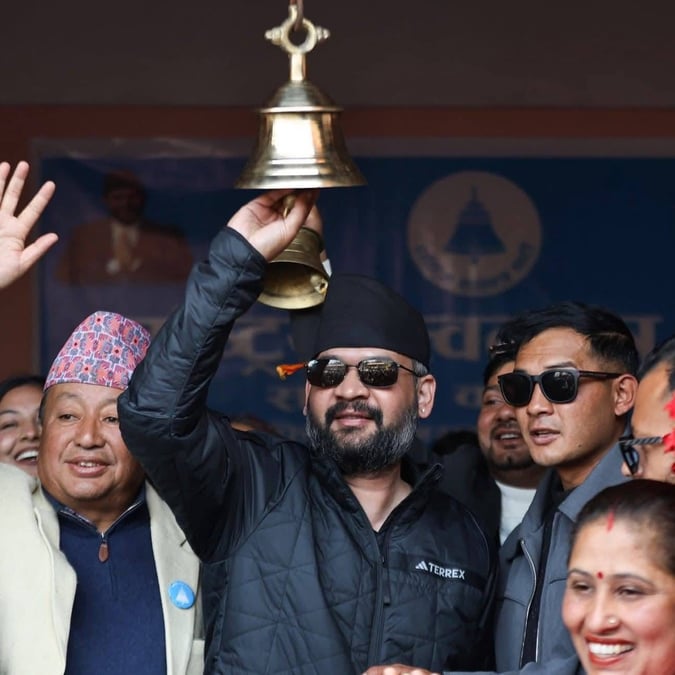
As this report is uploaded, the latest results in Nepal’s election show that the Rastriya Swatantra Party (RSP) is headed for an even bigger sweep than most had predicted.
The RSP was leading by large margins in 49 of 165 constituencies, with the UML, NC and NCP trailing far behind. Prominent political figures from the old parties like K P Oli, Minwndra Prasad Rijal, Ishwar Pokhrel, Bishnu Prasad Poudel, Bimalendra Nidhi all seem headed for defeat.
It does look like the RSP’s bell election symbol is ringing right across Nepal — from cities to the remotest districts in the mountains and plains. The party’s blue colour is sweeping the land.
The Nepali people seem to have sent a clear message that they were throughly dissatisfied with the chronic failure of the three main parties to work in the national interest to create jobs and deliver development. It was also an expression of lingering outrage over the the 8 September massacre outside Parliament.
It now looks almost certain that Balendra Shah will get to be Nepal’s next, and youngest, prime minister. Hopefully he will be leading a cabinet of competent and honest technocrats. It remains to seen how the power equation between Shah and the RSP’s leader, Rabi Lamichhane will play out.
Lamichhane is out of jail on bail for fraud cases which he has called political vendetta by the previous regime. Both he and Shah are charismatic and ambitious. Their working relationship will determine Nepal's political stability and whether it can avoid the political cronyism of the past.
This election was not just about casting votes. It was about standing up to principles and a value system, and respecting the hopes and aspirations of Nepal’s youth. It to push for transparent government and against impunity — including for the gunning down of young Nepalis in cold blood.
CAN DO MAN
Shah got mixed reviews as mayor. He was impulsive and ad hoc, but most people inKathmandu and beyond liked his can-do attitude and unconventional style which stood in sharp contract to the legacy leaders. Over his three year mayorship he showed more maturity and planning capacity.
But he always ran headlong into opposition from the federal government over his urban planning and other initiatives to make Kathmandu more liveable. Coming from a civil and structural engineering background, he was involved in building low-cost housing after the 2015 earthquake.
But his public persona is more tied to his irreverent rap lyrics that stood up for the marginalised underprivileged in society, while exposing the high-handedness and apathy of the state. But this also exposed contradictions because he also used his own municipal guards to beat and chase away street vendors and squatters.