
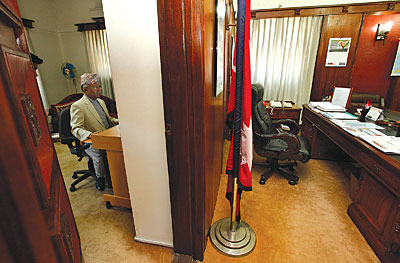
 GEMUNU AMARASINGHE CHECKING OUT: Prime Minister Madhav Kumar Nepal checks his mail next door from his official chair in May. |
Resigning is the best thing Madhav Nepal has done since he took office. He had done little to deserve the position in the first place; his ministers were relics from the past, with little faith in the post-2006 political framework; and the government was the biggest insult to the electorate.
Madhav Nepal succeeded in keeping the Maoists out of power till 28 May, for there were other plans lined up after that (including the dissolution of the CA), which were fortunately foiled. Some may feel that the anti-Maoist coalition helped save democracy, but it has also done enormous damage to the legitimacy of the democratic system, and public perception of the political parties.
But there is no guarantee that Nepal's exit will indeed break the political stagnation. In the next few weeks, we will witness all kinds of permutations.
The ideal, though unlikely, scenario is a national unity government. Till all parties have a share in the formal state apparatus, they will have little incentive to cooperate. One could argue that even an opposition party can collaborate with ruling parties on constitutional issues, or the peace process. But the past year has shown this does not happen.
India, and its Nepali proxies, will not accept Pushpa Kamal Dahal as PM. Dahal will try to block Baburam Bhattarai, even if it means sitting in the opposition again. But the balance of power in the party has shifted and Bhattarai today is in a stronger position than he was six months ago. Let us assume, for a moment, that the Maoists agree to present him as an alternative candidate. Will the other parties, and India, accept a Maoist-led government? Or has his name been thrown in only as a card, to stoke the existing divisions within the party?
The fact that the Maoists hold on to their coercive apparatus will be held against them by the others. The Maoists will offer to bring the PLA under the Special Committee in practice (the decision was taken in principle ages ago). Will that be enough for the other parties? Today, PLA commanders are with Bhattarai, but it is likely that Dahal will try to block any movement on integration if he thinks moving on the peace process will enable Bhattarai to become PM. The official party decision to move on the peace process and constitution-writing simultaneously remains. Many Maoists genuinely believe that if they give up their army, the other parties will back out of writing a 'progressive' constitution, and want to keep the PLA until they are entirely secure.