

Open any Balendra Shah Facebook post. Before the caption even finishes loading, Facebook has already chosen the first voice users will see in the comments section.
Nearly 8 in 10 people read comments online, and comment engineering is the most effective form of narrative setting on social media. Researchers from the Center for Media Engagement national survey in the US manipulated the first comment under 100,000 posts and found that it sets the tone of every response after it.
Facebook knows this, which is why its ranking system elects one ‘top comment’ to stand at the head of each thread. We scraped that ‘elected’ comment from Balen’s posts. It is the face Facebook has decided his fans should wear. Ironically, Facebook elected the comments that got Balendra Shah elected twice, first as mayor then as PM.
Under a reel from 21 June, that face says: ‘If Balen thinks, I agree.If Balen speaks, I listen. If Balen orders, I obey.’
The prime minister did not write it. A Balenista performed it under his post, and 919 people liked that expression of devotion. Facebook’s ranking system picked it out of thousands of comments and placed it first.
Balen’s Facebook page is a stage with three performers on it: a politician who posts, an audience that performs, and a platform that arranges the scene and decides who stands where.
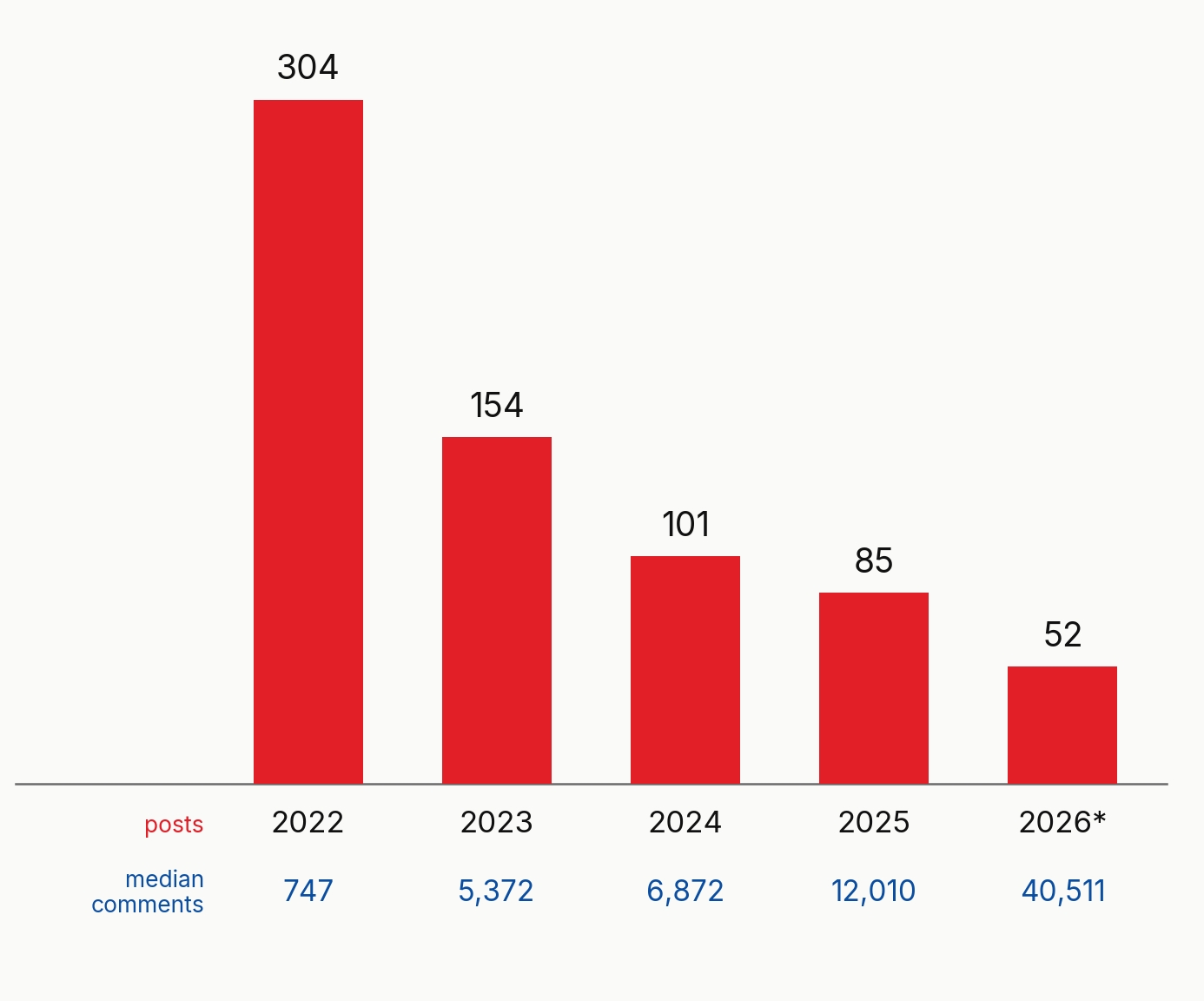
Nepali Times analysed 696 of his posts from January 2022 to June 2026 to see what each of the three has been doing. Because his audience exploded across those years, raw numbers can mislead us, so every post was measured against Balen’s own median for that quarter and that format. That median is his baseline, and it moved from 747 comments per post in 2022 to 40,511 in 2026.
The audience’s preference is pretty straightforward: posts that stage a conflict like open letters to ministers, accusations aimed at a named opponent, demands with 3-day deadlines draw 39% more comments and 66% more shares than his ordinary output after accounting for period and format.
More than a quarter of the posts reach triple his baseline. Among governance posts, fewer than one in ten do.
While mayor, Balendra Shah posted against this grain. Governance updates filled 45% of his feed and performed below his own median. The great exception was the October 2023 Shram Bank employment video. It promised 15,000 trainings and 5,000 jobs a year, and it became the biggest post of his life with 3.78 million reactions and shares at 59 times his baseline.
Announce a concrete benefit at national scale and the audience does the distribution for free. Facebook is the megaphone he never has to pay for, and the crowd holds it to his mouth.
CONFRONTATIONAL
Prime Minister Balendra Shah posts differently. Since March, governance content has fallen to 9% of his output. Personal posts have risen to 43%. Twenty-three posts is a thin sample, and the office plausibly changed what he is free to say.
The numbers still show a feed drifting toward what its audience rewarded all along: confrontation, shitposts, and aurafarming.
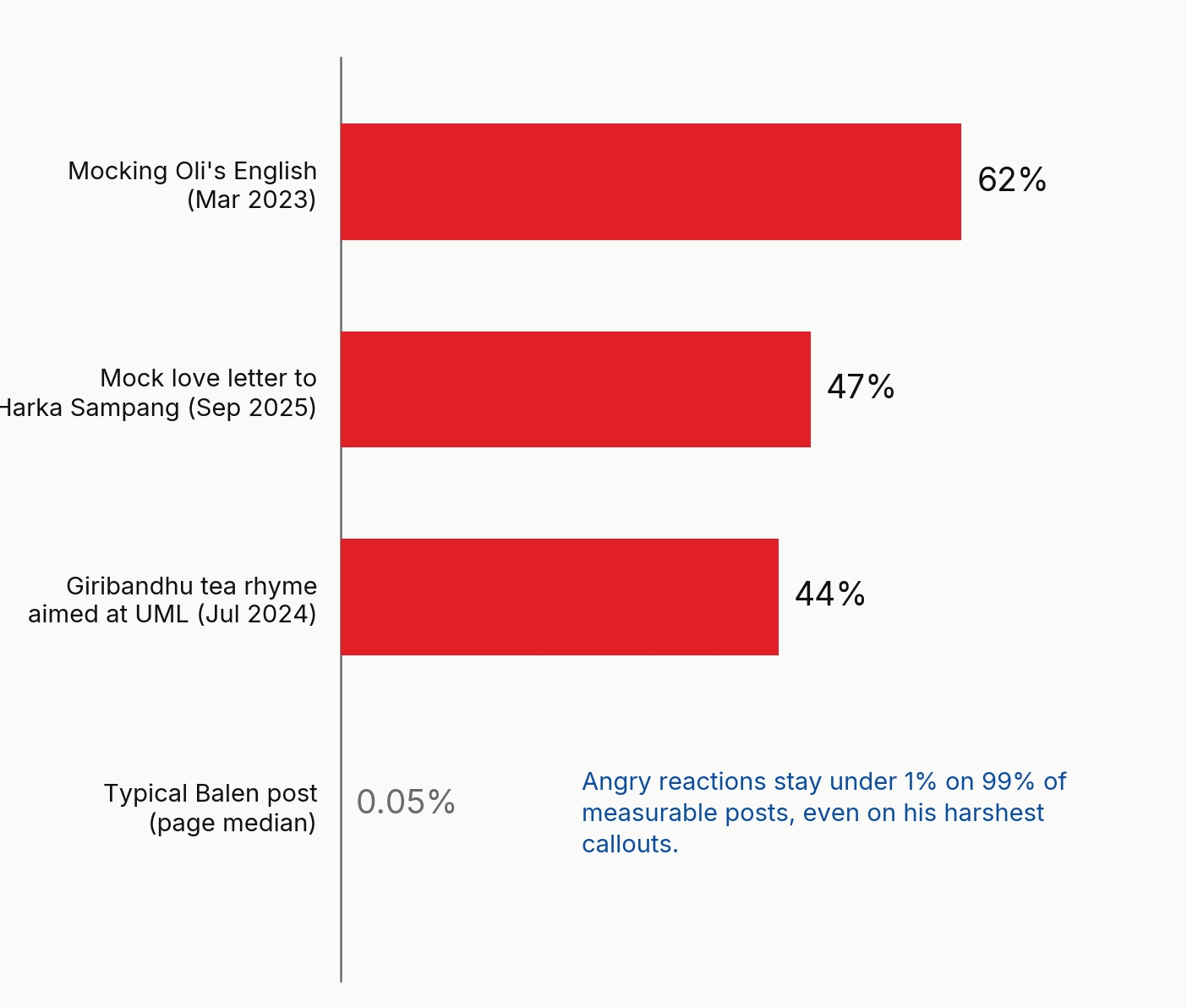
The reaction buttons record where feelings go. On Balen’s page, anger goes nowhere. Median angry reactions sit dangerously low across all posts with reliable counts, on his harshest callouts as much as his birthday wishes.
Laughter, though, has an aim. His haha-heaviest posts are all mockery of named targets: 62% haha on the exam jab at Oli’s English, 47% on the mock love letter to Harka Sampang, 44% on 'यो समय गिरिबन्धु चियाको हो। काले काले मिलेर खाऊ भाले।'
That last post explains nothing and assumes everything. Humour is end-to-end encrypted. The joke transmits in public and decodes only for people fluent in the Balen-adjacent meme economy, and the content that economy produces, remixes, and subtitles is some of the most incisive material we have for reading his brand. Decoding it is the membership card for the Balen fanbase.
British-Australian scholar Sara Ahmed, who studies how emotions move through public, argues that feelings do political work by circulating and sticking to figures outside the community. The data agrees with her.
On this page hostility only ever exits, landing on K P Oli, Harka Sampang, a minister, never in the house that hosts the joke. Balen names the target and Balenistas supply the laughter and the memes.
Balen posted 304 times in 2022, but only 52 times in the first six months of 2026. His brand was built on constant, unmediated presence, the mayor who answered ministers from his phone at any hour. The data cannot say why the presence thinned.
Maybe the prime minister’s posts are filtered. Maybe the man who once posted because he wanted to now posts because it is useful to his politics.
The median post on Balen’s profile drew 747 comments in 2022, it draws 40,511 now. In 2022, his top ten posts carried 70% of everything he got shared, which is the profile of an account living from viral spike to viral spike.
During the election campaign and since he was elected prime minister his half-year, that figure is 32%. The ordinary post now does the work a megahit used to. Whatever Balen publishes, at whatever frequency, the crowd arrives at scale. Scarcity in posting did not cost him attention, but concentrated it.
Open Balen’s Facebook profile, and go back to one of his reels. Scroll through the comments and the reaction. Everyone in the social media stage triangle is doing his work for him.
The fan performs obedience for an audience of other fans. Balen supplies the scarcity of posting + the aura and, when he wants laughter, the target. Facebook decides which one performance greets every visitor, on all posts where it elected a top comment for us to scrape.
That selection is both the limit of our dataset and its subject. What the machine chose to stage, we can measure. Devotion up front. Laughter aimed at Oli. Anger that never lands. Somewhere below the fold sit the thousands of comments per post that Facebook ranked and buried, the doubts, the disappointed former fans, the jokes that flopped. The data holds one comment per post. The country holds the rest.
The page reads as his. The numbers read as the audience’s. And the first voice users hear belongs to neither of them.
METHODOLOGY
Nepali Times analysed 696 public Facebook posts published by Balendra Shah (facebook.com/balenOfficial) between 1 January 2022 and 24 June 2026, collected via the Apify Facebook Posts Scraper on 15 July 2026. Each record includes caption text, media format, reaction totals and per-reaction breakdowns, comment and share counts, video views where available, and one Facebook-selected top comment for 631 posts.
Because Balen’s engagement grew sharply over the period (median comments per post rose from 747 in 2022 to 40,511 in the partial 2026 period), raw counts are not comparable across years. Each post was therefore measured against the median of posts from the same calendar quarter and media format. Claims in the article are phrased “after accounting for the period a post was published and its media format.” The dataset contains no historical follower counts, so no claim is made about follower growth.
Data caveat: Facebook returned rounded reaction totals for a portion of older posts, including 204 records listed at exactly 10,000 reactions (Jan 2022–Sep 2024). Reaction-level findings exclude these 204 posts; comment and share counts show no rounding and carry the cross-year analysis.
Content categories (governance, conflict/adversarial, personal, internet-native) are exploratory keyword-based codings, manually spot-checked on the top outliers. Depending on strictness of definition, roughly three to four in ten posts stage a conflict or identifiable obstacle.
The Facebook-selected top comments are algorithmically elevated single comments, one per post. They show what the platform stages beneath each post, not a representative sample of audience opinion. Engagement measures visible attention, not voter support.