
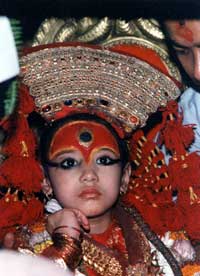
 Tourists eager to catch a glimpse of the Kumari have not been allowed near the living goddess this year because of a festering row between her caretakers and the municipality over how tourist fees should be shared.
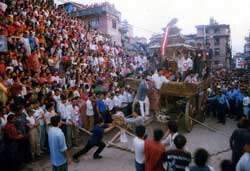
With less than two weeks to go for Indra Jatra, when the king pays homage to the five-year-old Kumari before thousands of people at Basantapur, the dispute is keeping tourists away from one of Nepal's most-enduring traditions.
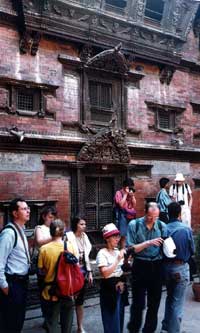
The Kumari's famous window has now been shuttered for months, and the official attendants at Kumari Bahal don't let tourists catch even a glimpse of her. The caretakers are angry that the municipality is not sharing part of the Rs 200 fee collected from every tourist visiting Kathmandu's historic heart. The fees were instituted two years ago, and the caretakers say they will keep the Kumari out of bounds until they get half of the Rs 100,000 that the municipality collects on average every day.
The caretakers stopped letting tourists into Kumari Bahal six months ago when the municipality refused to share the fee income. The issue had not become public as the caretakers and municipality officials are strictly forbidden to speak to the media by palace priests. "Speaking against the caretakers means insulting the living goddess and we don't want to get into trouble," one municipality official told us.
The Rs 200 tourist tax allows visitors to visit the entire Durbar Square, a World Heritage Site. The municipality says the money has already been used to build a two km pavement from Teku to Chhetrapati and from Machali to Thahiti. This 'Heritage Walk' will make it easy for the ritual annual jatra of the Kumari and Seto Macchendranath.
 The municipality says it has offered Rs 15,000 per month as dakshina to Kumari Bahal, and even proposed to cover maintenance and other necessary costs. The Chitaidhar, Newari for the Kumari's hereditary caretaker, reportedly turned down the offers.
Oblivious of the controversy, a group of European backpackers this week gazed intently at the balcony windows for a view of the Kumari. Their tour guide explained the situation, but the tourists are unconvinced and demand to see her. "We've already paid our money and travelled here just to see the living goddess," fumes one Spanish tourist.
Siddhartha Shrestha, a local guide who makes a living narrating the story of the Kumari for tourists, has been out of a job for months. "This is really sad. I hope the Kumari will find a way to help us and show herself," says Shrestha.
Inside the Kumari Bahal local devotees line up to receive blessings from the living goddess. With school books scattered in her room, the Kumari is almost finished with homework assigned by her personal tutor from White Field School where she studied before she became goddess. The little girl flips through a few newspapers and magazines. After a while, she sits on her throne and puts tika on the foreheads of the devotees. She greets them solemnly and nods. Then she goes back to her homework.
The tourists may be worried but locals, especially among the Sakya and Bajracharya communities, express quiet satisfaction with the absence of tourists. They are tired of the speculation, insults and the prying that the Kumari has long been subjected to, especially in the West. Some even presented the Kumari tradition as cruelty towards young girls who are "locked up for years in a hidden palace", losing "all the privileges of a normal childhood".
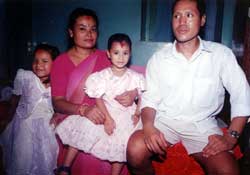 When Dyo Maju Preeti Sakya was enthroned as the new Kumari in 2001, the global media made a mockery of a revered Newari tradition. Perhaps one of most objectionable headlines was in the London Guardian: "Calls to kill off living goddess". It went on to describe the "horrifying ritual involved in selecting the Kumari and the bizarre lifestyle the new goddess is expected to lead". The ethnocentric bias was aggravated by a handful of Nepali activists who called for an end to this 300-year-old custom.
 Dyo Maju Preeti Sakya has a personal tutor so she can continue with her regular classes after she is no longer the living goddess. Her friends come and play with her inside the Kumari Bahal. Her mother, Rina Sakya and nine-year-old sister visit Preeti every week. Sitting beside her mother, Preeti doesn't show any signs of homesickness. "Even when she was three, she never talked about coming home. She already knows that she is not an ordinary person but a holy figure," Rina Sakya told us. When she grows up, she will be free to marry anyone.