
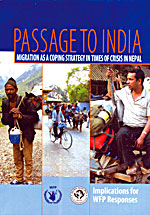
 Passage To India Migration As a Coping Strategy in Times of Crisis in Nepal WFP and Nepal Development Research Institute, 2008 Available online at: www.wfp.org |
When Lil Bahadur Chhetri wrote the classic Nepali novel, Basain, in 1958 Nepal's population was only 8.5 million, and there was an exodus of Nepalis going to India in search of work.
Today the country's population is touching 30 million and hundreds of thousands of Nepalis still migrate to India for the same reasons as Basain's protagonists: lack of food and indebtedness. For centuries, out-migration has been the way Nepalis have coped with poverty, injustice and lack of opportunities back home. And when the war came in 1996, it was just another hardship that became a push factor.
Nearly 15 per cent of Nepal's population is now working abroad and this represents more than a quarter of the country's young adult male population. The 1.5 million Nepali workers in the Gulf, Malaysia and East Asia get all the attention in the media because of the remittances they send home but there are an estimated two million Nepali migrant workers in India at any given time. The money they send home represents half of Nepal's remittances but never seems to be counted in official statistics.
The UN's World Food Programme (WFP) and the Nepal Development Research Institute have tried to set this right with a new report, Passage to India: Migration As a Coping Strategy in Times of Crisis in Nepal. The reason WFP is involved is because the reason for migration to India has historically been the lack of food, especially in western Nepal. The average rainfed farms grow enough food to feed families for only 150 days in a year. Migration is the only way to survive.
Nepal's chronic food shortage has increased in recent years. In 2008, the food deficit got worse and was compounded by the global rise in the price of grain. The food situation for nearly four million Nepalis is very precarious and if it continues there could be another dramatic spurt in migration to India in the coming year.
The report has some remarkable findings. For example, nearly all the respondents surveyed in western Nepal said they would not migrate if they had enough food or if they could earn just Rs 1,200 per month in Nepal. This isn't asking for much, and it is a mystery why successive governments have failed to provide even this bare minimum.