
‘A lways read the footnotes,’ someone once told me. If I hadn’t followed that advice I would not have learned that in 1965 an American/Indian spy mission lost a nuclear-powered sensing device in an avalanche in the Himalaya along the Nepal-India border. Five pounds of plutonium were gone: ‘When its container someday splits open, it will contaminate much of north India’s water supply.’
So writes March Liechty in Far Out: Countercultural Seekers and the Tourism Encounter in Nepal, a history of the evolution of the country’s visitor industry. Other facts in the book that might surprise those with just a passing knowledge of Nepali history:
Read also: Two new books on conflict and conservation, Kunda Dixit
The legendary and immensely well-connected entrepreneur and Royal Hotel owner Boris Lissanevitch, sometimes called the ‘father of tourism in Nepal,’ died penniless in a public ward in Bir Hospital on 20 October 1985.
Everest pioneer Tenzing Norgay almost made it to the summit with a Swiss expedition in 1952, which turned back just 300m from the peak. But Norgay’s first summit attempt was in 1947 with an unauthorised ‘ultra-light’ Canadian climber, Earl Denman, from the Tibet side.
A rivalry of sorts existed between hippies living in Boudha and those in Swayambhu. ‘It was a little like the Hatfields and the McCoys’, Liechty quotes one author writing in reference to the infamous American feuding families, ‘except that the Westerners in Bodha were too drunk and the Westerners in Swayambhu were too stoned to ever do anything about it’.
Read also: Circumambulating with Swayambu Billy, Lucia De Vries
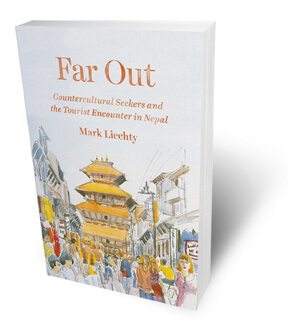
Far Out: Countercultural seekers and the tourist encounter in Nepal
Mark Liechty
Martin Chautari 2019
387 pages
Rs900
On 16 July 1973 the Nepal Government banned the sale of pot. The next day a fire started in Singha Darbar that burned for three days and destroyed half of the seat of government. Lord Shiva was not happy, observers noted.
Much more than a collection of entertaining facts and anecdotes, Far Out situates tourism in Nepal in a global context. It starts with the trickle of wealthy (mostly) Americans who flew in after royal rulers eased open the country’s doors in 1955, followed by the well-told story of the hippies.
Disillusioned with western society and seeking a deeper meaning to life, they journeyed overland from Europe to India then northward, congregating first in Maru Hiti, in later years Freak Street, and then Thamel. Finally, came the trekkers, who jetted in on increasingly larger and cheaper flights, seeking an adventure experience just as Nepal’s leaders realised that tourism could be a game-changer for the economy.