
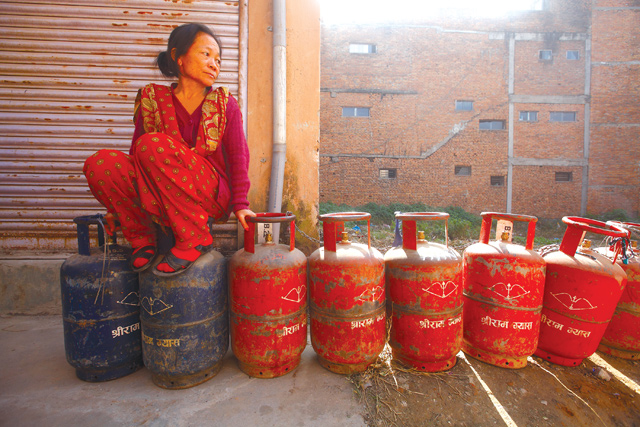
“I wish I had not survived the earthquake,” said a middle-aged woman with whom I struck up conversation at a local tea stall this week. She looked upset, and didn’t speak for several minutes. I didn’t push her to explain her statement.
Then she spoke up again. “I have run out of cooking gas, the dealer is asking Rs10,000 for a new cylinder. That is half of my husband’s salary. How can we continue to live this way?”
In his first address to the nation last week Prime Minister KP Oli tried to sell Nepalis a utopian dream of an end to load-shedding within a year, introduce electric public transport in Kathmandu immediately and attain self-sufficiency in agriculture by 2017.
Oli’s words sounded hollow, unrealistic and even nonsensical – proven by none other than his own finance minister Bishnu Pooudel when he released a White Paper this week. Poudel’s figures about the combined impact of the earthquake, Madhes movement and India’s blockade on Nepal’s economy were beyond dismal.
Since Madhesi protesters began blocking the Birganj border days after Nepal’s new constitution was promulgated on 20 September, revenue collection from the country’s biggest customs point in terms of trade volume has been nearly nil. The Department of Customs had set a target of Rs 7 billion from Birganj during October. It didn’t even manage 1 per cent of that.
India’s not-so-tacit support for the cause espoused by Madhesi leaders in enforcing a blockade has certainly complicated transit problems, but customs revenue collection was badly hit even before the Indian blockade.
Already reeling under damage caused by the April-May earthquakes, Nepal’s economy began to dip when the Madhesi parties launched their anti-constitution movement in the Tarai 100 days ago.
Nearly 2,200 factories have been shut along the Tarai’s industrial corridors, more than 200,000 people have lost their jobs and inflow of tourists has gone down by half. The country’s economic growth rate is expected to be restricted to two per cent – or even less if the crisis continues for a few more months.