

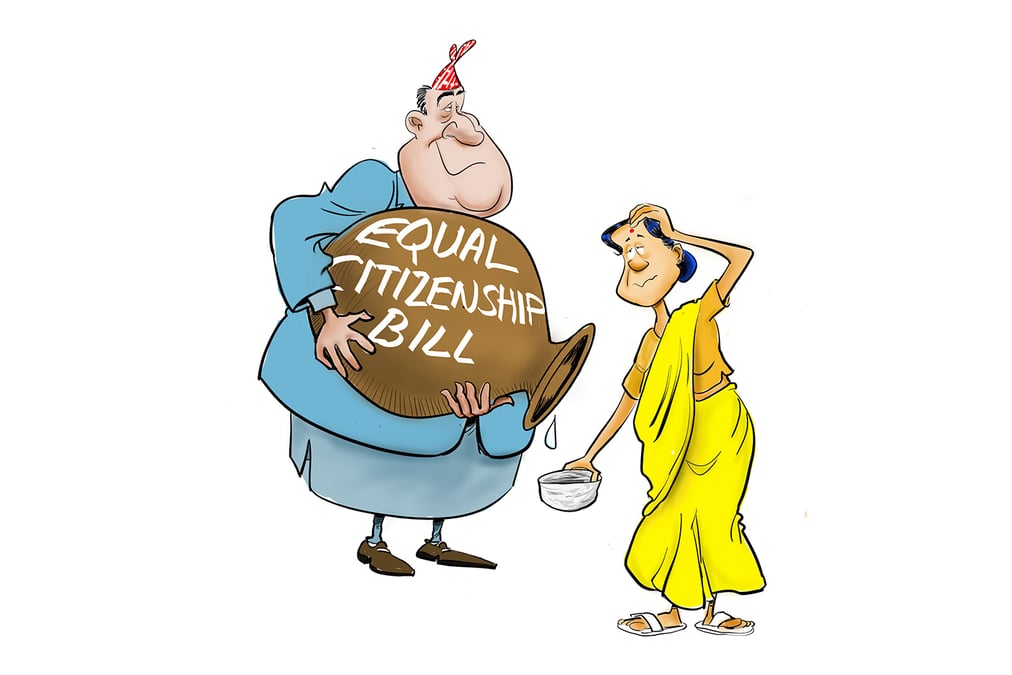
The news headlines this week said: ‘The House of Representatives passed the Nepal Citizenship (Second Amendment) Bill that now makes acquiring citizenship through the mother as equal as through the father.’
Could it really be true? There is genuine confusion or deliberate misunderstanding in the public about the Bill. Here is an explainer:
What is the Bill?
The Second Amendment to the Nepal Citizenship Act 2006 was tabled by the government on 11 March, 2024. The lengthy list of amendments underwent a detailed discussion within the State Affairs and Good Governance Committee of the HoR which presented a shortened list of agreed amendments.
The HoR passed this amended list of amendments on 28 June. While the original Bill contained eight amendment proposals, only three major amendments were presented by the Committee, and approved by the HoR.
Has it become law now?
No. It is yet to be passed by the National Assembly and endorsed by the President.
What exactly is contained in the amendments?
- Addition to Section 5 of the Act: ‘For citizenship applications, a father’s identity is deemed unknown if the applicant and their mother both provide a self-declaration stating that the father is unidentified, as per Section 5, even if his name is listed on the person’s birth registration, educational qualifications, or other certificates, yet his other identity is not available and is currently out of contact.’
This simply provides a definition to what the Act means by ‘father unidentified’ or ‘father untraceable’. Section 5 derives its authority from Article 11(5) of the Constitution that grants citizenship by descent to children whose mother is a Nepali citizen, but father is unidentified or untraceable.
The Nepal Citizenship Act 2006 and Regulation 2006 (both promulgated prior to the present 2015 Constitution) was amended in 2023 to incorporate the provisions of the new Constitution. In doing so, it included the procedural rule requiring both the applicant and their mother to sign a self-declaration form.
The result: a lot of people who claimed citizenship under this provision were still denied access, simply because their educational or other documents mentioned the name or address or some information about their father. The officials interpreted the presence of such information as father’s identity being known and assumed the applicants were hiding facts.
Read also: No state for women, Neha Gurung
The Supreme Court in one of such cases had clearly interpreted the meaning of ‘father unidentified’. In its overarching decision, the court stated the following:
‘It seems neither lawful nor just to compel an individual to accept someone as an identified father merely because their biological father’s name, surname, or address is claimed to be known or mentioned in educational or other documents. It would be just to consider the father’s identity as “unidentified”; if the individual has not received paternal affection or care, and the alleged father has never taken any responsibility, borne any obligation, or been physically present before the children, leading to a situation where the children haven’t even seen their face. Such an alleged biological father should remain “unidentified” for these children until they formally acknowledge them as their son or daughter, or, in their absence, their family provides reasonable proof to confirm the fact and identifies the relationship through a process acceptable to the children, or until such a confirmation becomes impossible.’
Based on this decision, multiple implementation challenges, and growing advocacy around this concern, the government included the above-mentioned addition in the Bill.
Is it new?
The proposed addition is neither an introduction of the new right, nor does it provide anything beyond what the Constitution mandates. Since the Constitution itself uses the term ‘father untraceable or unidentified’, the most a legislation can do is to ensure that the constitutional provisions are interpreted and implemented in its true meaning. Therefore, the current Bill only serves to clarify the existing misinterpretation of the phrase ‘father unidentified’.
In a country where about 17% of the population are single mothers, this clarification may provide certain relief for those whose fathers name was mentioned in the document and the father is now unidentified. However, the addition does not grant anything new.
The gender discriminatory citizenship where the citizenship or legal identity of a person is always dependent on one’s husband or father still remains.
Additionally, the current addition does not completely incorporate the Supreme Court’s decision which is broader and more comprehensive, requiring that the father be considered unidentified irrespective of the knowledge of the father’s name, surname and address, if the applicant/person has not felt the paternal affection or care, and the alleged father has never taken any responsibility, or borne any obligation or been physically present before the children.