
Two years after the earthquake, the first sight that one sees when entering Basantapur Darbar Square is the half destroyed Gaddi Darbar standing on its own debris. But the earthquake not only destroy the city’s manuments, it also damaged centuries-old residences in inner city Kathmandu.
Today, these alleys are covered in a fog of dust as damaged houses are being demolished to build new ones. Many have got tired of waiting for the Rs 300,000 government compensation, and at any rate that money would just about pay to build one room.
Since the earthquake mostly damaged brick and mortar buildings, the new buildings are mostly multi-storey ferrocement blocks. The danger is that the carved wooden windows, doorways and columns will be replaced.
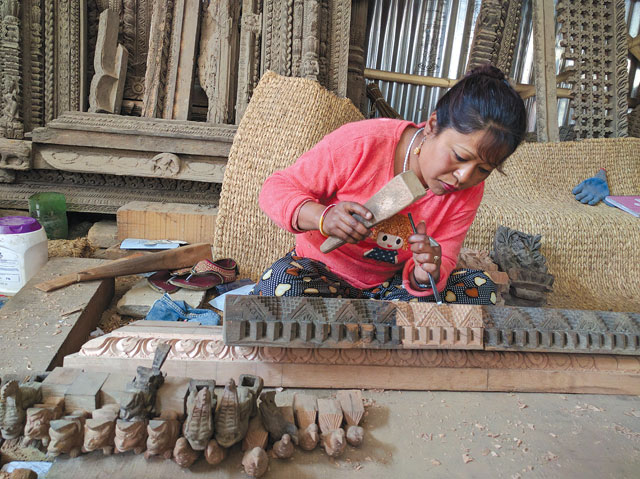
But here in Itumbahal, a restoration workshop conducted by the Kathmandu Metropolitan City (KMC) and Handicraft Association of Nepal is trying to preserve the ancient carved wooden windows. The 45-day pilot project allows 12 trainees to work with three master artisans and to learn the endangered craft.
Singh Raj Tuladhar, one of the trainer craftsmen conducting the workshop, is from Bungamati, an ancient town famous for its woodcarvers. With 35 years of experience in the field, Tuladhar felt the need to pass on and conserve the skills he had. Every morning, instead of opening his workshop at home, he makes his way to Kathmandu to train the young apprentices. Apart from teaching the novices the art of carving intricate designs on blocks of wood, Tuladhar makes sure they know the value of heritage and the need for its conservation.
The team will repair as many structures as possible, preserving the traditional woodcarving craft of Kathmandu along the way. The repaired window frames are then returned to their owners. However, a similar wooden carved window today would cost anywhere up to Rs 3 million. This is why Shriju Pradhan of Kathmandu Metropolitan City is concerned about its preservation.