
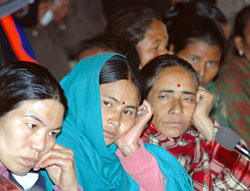
 "He would be 25 today sitting beside me. I so long to hold my son," says 42-year-old Shanta Bhandari. For the last three years she has devoted her life to searching for her only son, Bipin, who disappeared when a group of police came to their house in Balaju and dragged him to their van accusing him of working for the Maoists.
It was during the 2002 emergency when police were given sweeping powers to arrest anyone under the Terrorist and Disruptive Activities Act (TADA) introduced by Sher Bahadur Deuba's government. Bipin became one of its first victims.
He belonged to the Maoist-affiliated All Nepal Students' Union (Revolutionary) and soon after he was taken in, Bhandari pleaded with the police chief at Hanuman Dhoka to reveal her son's whereabouts. He promised to call her back within a week. Nearly three years have elapsed, she never heard from them.
"I know he is alive somewhere," says Bhandari hoping against all odds like the mothers of three other students who were arrested with Bipin. The mothers went everywhere, from human rights activists to the NHRC, the ICRC, the UN, the Supreme Court and even the Royal Palace. But there was no word of their disappeared sons.
Frustrated by the silence, the mothers decided to fast unto death three years ago. As news of the hunger strike spread other parents whose sons were disappeared joined the campaign. That finally pushed human rights groups to put pressure on the government, which revealed the status of 18 out of 132 disappeared persons. This resulted in the formation of the Rajya Dwara Bepatta Pariyeko Pariwar Samaj (Society of Families of Persons Disappeared by the State).
Last month, members of the Society locked up the NHRC for five hours to pressure it to urge the government to locate the disappeared. "NHRC only raises its voice against Maoist activities but hardly says anything about the human rights abuses of the state authorities," says Bhandari.