
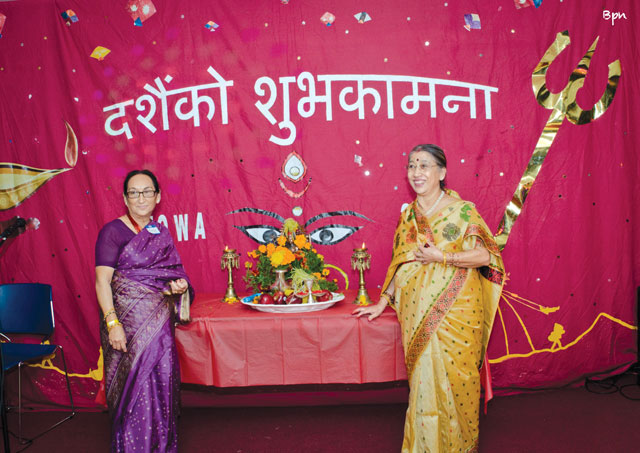
Dasain, the festival that unites Nepalis all over the world, is upon us. With about 3.5 million Nepalis living outside Nepal, it is also the season when families who cannot physically get together make a special effort to be in touch through social media. There are an estimated 60,000 Nepalis in the United States alone, and because it is not a holiday here most Nepalis have to juggle festivities with their busy schedules.
Says Kusum Pradhan of Iowa City (pictured at left, right) : “I try my best to follow our culture, but the difference with celebrating in Nepal is to get time off from school and work." Whatever precious time is set aside for Dasain is used to the fullest by Nepalis abroad. Most have to wait for the weekend to dress up, grow jamara, put tika and re-enact what they would do back home.
In Cincinnati, IT professional Suraj Adhikari says Nepalis use a weekend close to Dasain to gather. Another organisation in Iowa uses the occasion to hold its annual blood drive in Des Moines.
Born in Kathmandu but raised in America, Alpesh Chapagai is a high school senior in the suburbs of Chicago. Feeling a disconnect from his heritage, he uses Dasain to reconnect with his Nepali-American identity.
“The experience of Dasain events has left an indelible mark on my consciousness about my Nepali cultural identity,” Chapagai told Nepali Times.
Fond Dasain memories of flying kites and playing cards have inspired Chapagai to share his Nepali heritage with his peers. “In future I will invite non-Nepali friends to these events so they also learn about Nepali-American culture,” he adds.
Not everyone is making that effort. Whether they are recent diversity visa arrivals, students or undocumented workers, life is just too hectic and Nepal too far away to make the connection.
Despite the distance, Dasain holds a special meaning in the hearts of Nepalis across the world. Here in the US, some are making an extra effort to revive the joys of being with family and friends.
Chapagai sums it up: “Dasain is important because it is an annual reminder for me and other Nepalis that we are still connected to the traditions of our forebears back in Nepal.”
Shawn Thacker in Iowa City
The pile of shoes by the front door kept growing outside the house of Jennie Sheldon’s ‘Ama’ during Dasain, as relatives came to Kathmandu in great numbers to celebrate the 15-day festival. She had arrived just weeks before, in the fall of 1983, a young American commuting on bicycle to work as an intern at an erosion-control project. She recalls most the generosity of her hosts, who invited her to pass the holiday with them.
“It was a big family event,” Sheldon recalls. “So I felt so lucky to be there with them.”
Dasain offers Nepalis abundant time to spend with family members and in some cases, return to their hometowns. Expatriates in Nepal, however, spend the festival in a range of destinations: from domestic to international locations and from trekking to chilling out at home. The lucky ones get to celebrate Dasain with Nepali friends.
Sheldon remembers well the annual traditions, such as the appearance of temporary swings made of bamboo above ridge lines, the kite-flying, and the giving of the tika on the 10th day of the festival. But she most vividly recalls, “overwhelmingly, their generosity of including us”.
She says the animal sacrifices were at first difficult to witness, but remembers watching a goat sacrifice in which water was sprayed until the animal shook, which was taken as a sign that it was submitting to sacrifice its life. She says: “For a newly arrived westerner, animal sacrifices were hard to understand, but at some level, I felt like it was celebrating life by offering life.”