
Global warning about global warming

For Nepal, preparedness for future climate disasters begins at home after the COP31 jamboree

EditorialEditorial

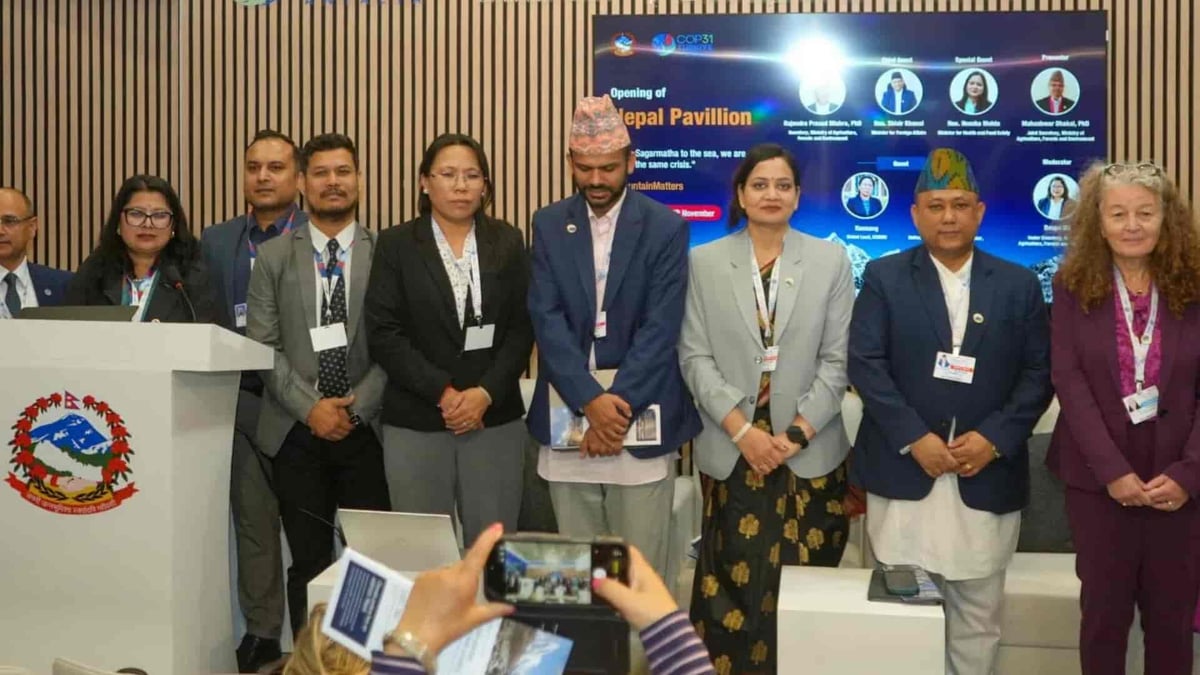
Photo: MOFA NEPAL
Photo: MOFA NEPAL

The Antalya Climate Summit has been called the ‘Overshoot COP’ because the world has warmed beyond targets set 11 years ago in Paris. Nepal also overshot its attendance with five ministers and dozens of lawmakers flying out.

Nepal had a lot riding on this year's COP31. The country wanted to use the two deadly Himalayan catastrophes this year to sound a global warning about global warming. But its jumbo delegation to the jamboree could not push the UNFCCC to include the mountain agenda.

Climate breakdown has destabilised the cryosphere in the earth’s mountain regions, adding to preexisting geo hazards. The Trisuli Valley flood in August, the disasters on the Budi Gandaki and the glacial lake outburst in Bhutan last month were proof. About 7,000 people died and the destruction cost Nepal nearly $5 billion.

Ahead of the summit, Nepal and Bhutan jointly highlighted the extreme impact of global temperature overshoot to the mountains. It asked for research on the impact of further warming on the Himalaya, an annual high-level dialogue and grant-based climate finance including loss and damage.

This proposal failed to pass as a separate formal agenda item. Kyrgyzstan’s proposal on mountains and climate change as a standalone subject was also set aside.

Although the governing RSP was blamed back home for its overattendance and underperformance in Antalya, the lack of consensus on the mountain agenda was due more to the UN’s own rules on consensus, as well as resistance from some countries to take the blame and foot the bill for climate-induced damage.

PARAGRAPHS AND BRACKETS

Even so, Nepal, Bhutan and Kyrgyzstan, jointly submitted a broader mountain climate proposal. It has been partially incorporated into Paragraphs 31 and 32 of the draft cover decision in the final document on Friday.

Partially, because only the first three demands (scientific research, high-level dialogue and a dedicated work program) were included. As expected, grant-based climate finance and loss and damage support were left out.

Now, mountain delegates need to be vigilant that the text remains intact during final midnight negotiations before COP31 closes on Friday, 20 November.

Unlike previous COPs which set targets, Antalya was supposed to be an ‘implementation summit’. Nepal’s presence this time was also high profile because of the worldwide attention following its catastrophic floods.

Nepal was earlier allocated $21.6 million from the Fund for Responding to Loss and Damage. This is a mere 0.4% of the $4.7 billion damage, and even this money will materialise only after the government submits a detailed proposal on how it wants to spend it.

In short, even as global temperatures rise, funds for climate action fall. The pittance that is available is grossly insufficient to cover the loss, and will be too late for the families along the Trisuli.

There are some pointed questions for the Nepal government about how settlements and infrastructure along culnerable valleys was the real reason for the high death toll and destruction. And although Nepal’s search and rescue was prompt, rehabilitation and resettlement have been much slower.

In Nuwakot and Rasuwa, the 33,000 people who lost their homes are not waiting for the government anymore, and are moving back to damaged houses or have occupied land belonging to the Nepal Electricity Authority.

Such delays have raised questions about where the Rs18.48 billion pledged by donors to the Prime Minister’s Disaster Relief Fund is being spent. Some have posted on social media they regretted their contribution. Others have said direct cash disbursement to survivors would have been more effective.

Despite a new government that promised better delivery mechanisms, the disaster response has been highly centralised, leading to crucial delays. Instead of waiting for international climate finance to materialise, if ever, the real test will be swifter rescue and better-informed relief.

Wards and municipalities have a more crucial role both as first responders and in post-disaster rehabilitation. Nepal is holding local elections in March 2027, so this is the right time to strengthen and empower local institutions for pre- and pos-disaster management.

Despite its powerful federal majority, the RSP must devolve decision-making and trust local representatives for better performance, including in disaster preparedness and relief.

Prime Minister Balendra Shah is off to New Delhi next week, and he may want to follow up on his proposal at the UN General Assembly in September for a Himalayan Climate Resilience Mechanism involving Nepal, India, and China.

Any new Nepal-India river deal must also factor in climate hazards that are predicted to be bigger and more frequent infuture.

Sonia Awale