
 BORIN NOUN |
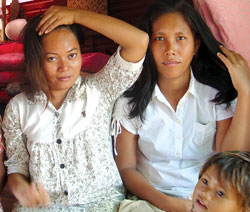
Touch Kanha, 30, watches her children play in a slum here in Phnom Bat, 50km from Cambodia's capital. The residents were evicted from homes to make way for apartments in the centre of the capital earlier this year, and conditions are so bad that women like Kanha are selling their hair to buy food.
"Sometimes my children go to bed hungry at night," says the 30-year-old Cambodian mother. "You can't do without food, so I had to sell my hair." Kanha cut her hair in January and sold it to a broker for $20, who sells it to an exporter. By the time Kanha's hair makes it to a wig shop in the United States or Europe it will fetch anything up to $3,000.
Once the hair is sold, the middleman brings it to a collection centre in Phnom Penh where they are cleaned, gathered into ponytails, rimmed to make them at least 20cm long, and secured with a plastic band. The United States alone imported $1.3 million worth of raw human hair last year. Other importing countries are the UK and China.
China is also an exporter of human hair, with India, Philippines, and Cambodia. People in the West prefer human hair over synthetic to make wigs, extensions, and hair pieces because it can be dyed, heated, styled, washed, and treated like natural hair. In North America, human hair extensions can cost up to $500, and a wig can cost as much as $3,000.