
 The monsoon is not a particularly good time for stargazing. But, when there is a cloudless night sky, you see sharper images of stars and planets due to increased humidity in the atmosphere.
In July, you have a chance to observe Saturn and Venus in the western sky, while the giant planet Jupiter will be high above in the east. It's a good time for stars too, with the Great Summer Triangle (Vega-Deneb and Altair) in the east dominating the night skies for several more months. This will become a familiar sight to the stargazer. The bright star Archuturus will be just overhead in the constellation of Bootes the Herdsman.
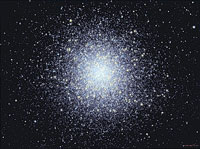
A highlight for July is the Great Hercules Star Cluster (also called M-13) in the constellation of Hercules. Located at a distance of 25,000 light years, this object is, without a doubt, one of the finest deep sky objects you'll ever come across. It is extremely accessible using amateur telescopes as it has close to naked eye visibility. (See picture).
Most people are surprised to learn this, but our world is farthest from the Sun in mid-summer. The earth reaches that position in its orbit, the aphelion, on 7 July.