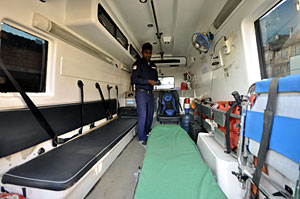
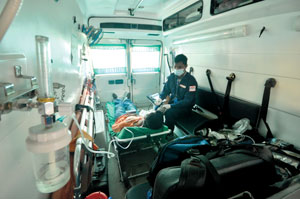
 PICS: BIKRAM RAI |
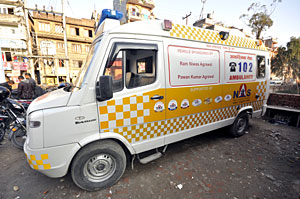
The Americans have 911, the British have 111, Kathmandu residents can now dial 102 in an emergency, and a state-of-the-art ambulance with life-saving medical care will appear on the street outside.
Private hospitals have mushroomed in Kathmandu over the past decade, but many do not have professional and well-equipped ambulance services. Even ambulances that are on the roads do not meet minimum requirements like cardiac equipment, oxygen or emergency medicines.
A recent study by Patan Hospital revealed that only 10 per cent of patients use ambulances in emergencies. Getting the sick to hospital in private cars or taxis not only increases trauma in patients, but often leads to dead-on-arrival cases.
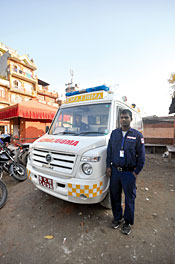 |
It was to address this crying need that a group of Kathmandu-based professionals established Nepal Ambulance Service (NAS) in April 2011. "We strongly felt Nepalis themselves can initiate professional ambulance services without seeking foreign donor funding," explains Ranjit Acharya, a founding member of NAS.
Acharya, whose full-time job is at Prisma Advertising, says NAS is an independent non-profit initiative which offers ambulances equipped with specialised life-saving equipment and trained emergency medical technicians in Kathmandu and Patan. NAS's dispatch center provides emergency pre-arrival instructions and there are 14 on-call emergency physicians for medical consultations.
 |
Emergency personnel on NAS ambulances are trained to treat everything from spinal chord injuries, excessive bleeding, attending to breathing problems, starting IV fluids for patients in shock. NAS's general secretary, Mahesh Nakarmi, says his ambulance attendants have received specialised training in emergency medicine.