
Leaked letters from Korea’s Unification Church have revealed its extensive involvement in buying political and media influence worldwide, including links to Nepal’s parties and politicians.
Documents obtained by the Korean Centre for Investigative Journalism (Newstapa) and Dunia contain correspondence to and from the controversial religious movement whose leader, 82-year-old Hak Ja Han, is currently on trial in Seoul for allegedly bribing the wife and associates of disgraced former president Yoon Suk Yeol.
The letters and direct messages referenced in the investigation mention three former prime ministers: Madhav Kumar Nepal who has now joined the Nepali Communist Party, K P Oli of the Communist Party of Nepal UML (Unified Marxist-Leninist), and former Maoist ideologue Baburam Bhattarai.
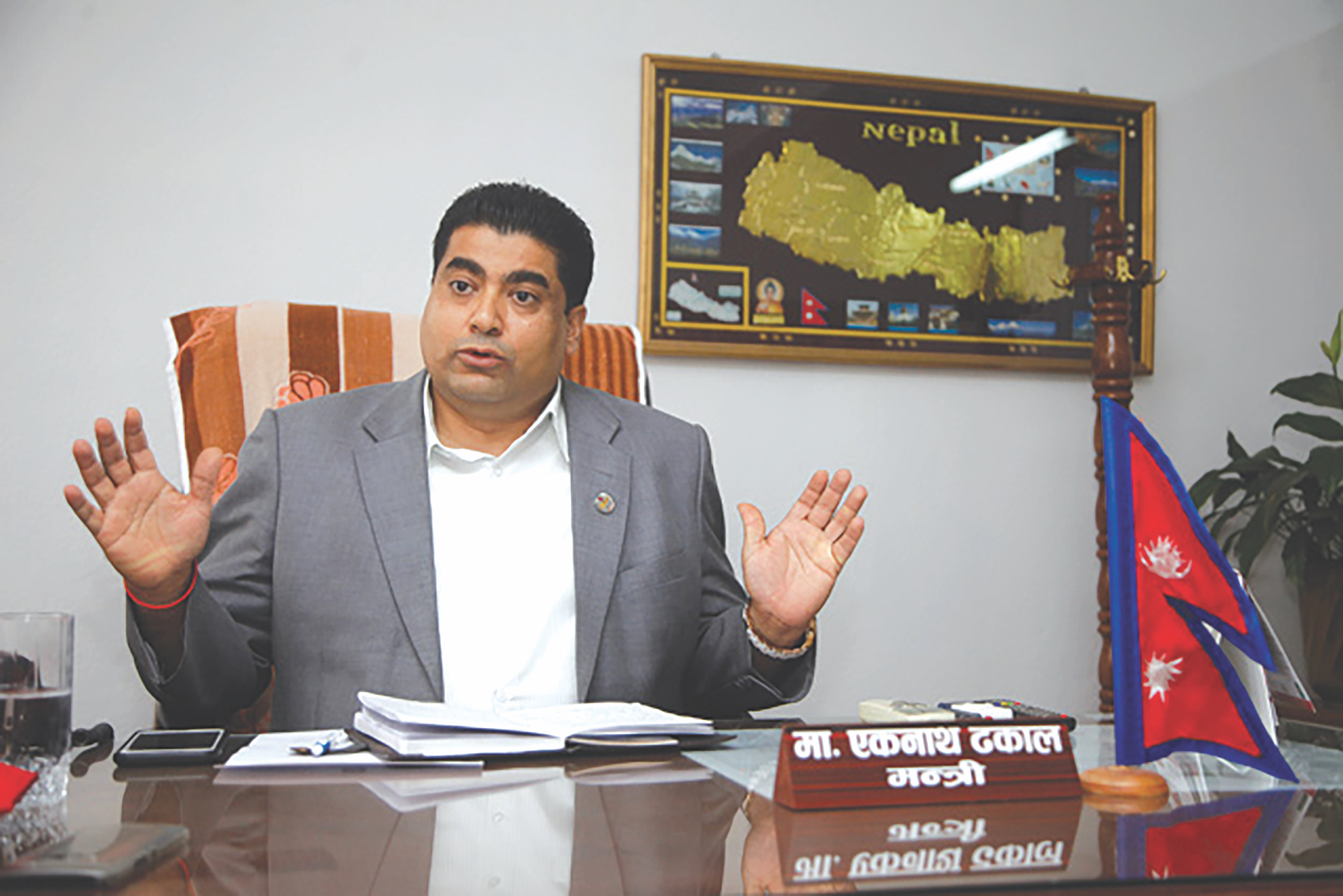
The documents detail financial support from the Unification Church (now known as Family Federation for World Peace and Unification) to Nepal Paribar Dal (Nepal Family Party) and its founder Ek Nath Dhakal, who is a staunch ally of the UML. On Sunday, Dhakal signed an MoU with K P Oli of the UML to cooperate in the March election and beyond.
The leaked correspondence concerning Nepal spans the period between the first federal elections in 2017 till the 2022 polls and contains emails between Dhakal and Yong Jeong Shik, Regional President for Asia of the Unification Church, with urgent requests for funds for campaigning and to support the UML.
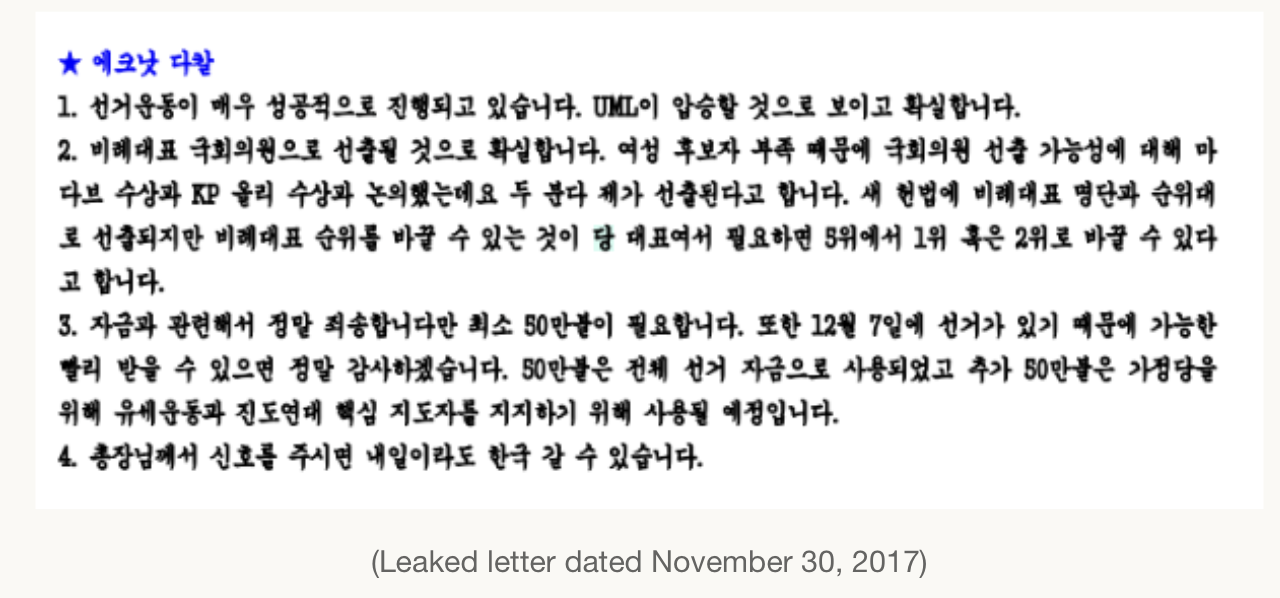
‘Regarding funding, I am truly sorry, but a minimum of $500,000 is required,’ one of the messages to Yong in the report says. ‘Furthermore, as the election is scheduled for December 7th [2017], I would be very grateful if I could receive it as soon as possible. The initial $500,000 was used for overall election expenses, and the additional $500,000 is intended for campaign activities for the Family Party and supporting key leaders.’
In addition, there are also letters requesting an additional $20,000 per month in ‘maintenance costs for the Nepal Family Party and preparations for the 2022 election’.
Asked for a reaction to the allegations, Govinda Nath Mishra of the Nepal Paribar Party said: “This is an unnecessary smear campaign against our party. Parties doing good work are always linked to some foreign powers in Nepal to discredit them.”
Ek Nath Dhakal has also denied that his party’s affiliation with the UML has anything to do with Unification Church donations. He told Nepali Times in an interview in 2016: “The party has links to all faiths, as it has with the unification movement. The Nepal Family Party is a kind of conservative party with a manifesto that promotes family values, interfaith dialogue and harmony. There are 11 political parties supporting Prime Minister Oli. Nepal Family Party is just one of them.”
In another update to Yong, Dhakal describes the UML’s election campaign in 2017 as ‘proceeding very successfully … it appears certain the Unified Marxist-Leninist will achieve a landslide victory’. Dhakal was not contesting directly as a candidate, but piggybacking on the UML which had put him on the proportional representation list, ostensibly in return for campaign financing.
He continues: ‘It is certain that I will be elected as a proportional representation member of the National Assembly due to a shortage of female candidates. I discussed the possibility of my election with Prime Minister Madhav and Prime Minister K P Oli … both have confirmed that I could be moved from 5th place [on the PR list] to 1st or 2nd if necessary.’
Ek Nath Dhakal became Minister of Poverty Alleviation and Cooperatives under Prime Minister Baburam Bhattarai in 2012 and in 2016 Minister of peace and Reconstruction under the K P oli government.
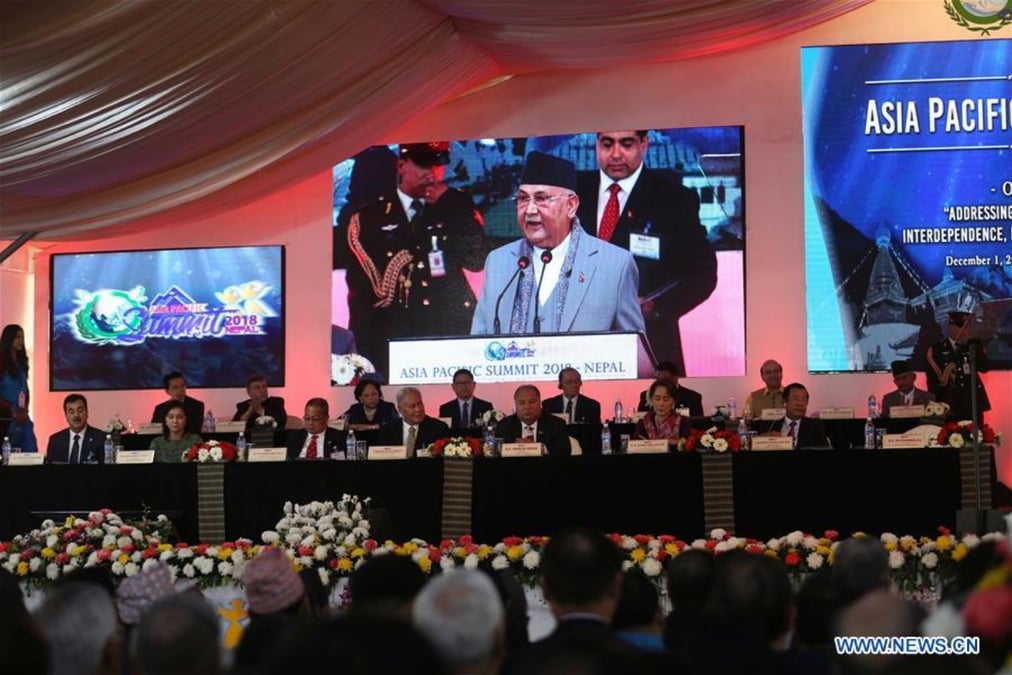
During his tenure, Dhakal organised an ‘Asia-Pacific Summit 2018’ in Kathmandu presided over by Hak Ja Han, wife of Rev Sun Myung Moon, founder of the Unification Church and Universal Peace Federation (UPF). The couple are known in the movement as ‘True Parents’ and Hak Ja Han is referred to as ‘True Mother’.
Oli addressed the Kathmandu summit which was attended by 1,500 delegates, including Burmese leader Aung San Suu Kyi and Cambodian Prime Minister Hun Sen. The gathering drew criticism for being a proselytisation exercise, prompting Oli to decline attending a ‘blessing’ ceremony by Hak Ja Han.
Ever since, the ‘Holy Wine’ has entered Nepal's political lexicon, and is still used derogatorily to label politicians involved.
Nepal Paribar Party’s Govinda Nath Mishra says: “Ek Nath Dhakal has become a member of the House of Representatives twice, and our party has since its inception been close to the UML. We are just continuing that cooperation for this election as well.”
The Unification Church has said that the leaked documents are not authentic and were unofficial records created by former Director General of the Unification Church’s International Headquarters Yun Young Ho to ‘flaunt his influence’. The Japanese branch of the Unification Church said in a statement this week: ‘After reviewing the documents believed to be the report in question, we have found factual inaccuracies were added or content modified.’
Milan Kumari Rajbanshi, deputy General-Secretary of the Nepal Paribar Party and former MP denied her party was funded by any outside source, and she was no aware of any correspondence between Dhakal and anyone else.
She told Nepali Times: “After the September street protests we spoke to many political parties, including GenZ activists, but the UML was the closest to our values.” Rajbanshi will be campaigning in Jhapa-5 on behalf of K P Oli who will be contesting against former Kathmandu mayor Balen Shah.
The Newstapa leak show Dhakal and the Unification Church worked behind the scenes in the 2017 election to influence the elections. One email from Dhakal references this: ‘(If) we can secure a majority in next year’s general election … our wish is to educate all parliamentarians for two years until 2020 and create a constitution centred on Cheon Il Guk.’
Cheon Il Guk (천일국) means ‘One Heavenly Kingdom’ and is the vision of a spiritual nation proclaimed by Sun Myung Moon and his Unification Church, and emphasises family values instead of individualism for global unity under a ‘Heavenly Parent’.
The emails reveal that the Church was planning to convince Madhav Nepal and K P Oli to take all 150 coalition legislators to Bangkok to introduce them to its beliefs. That trip did not materialise, but the Church had earlier taken 20 Communist MPs to the Philippines and Thailand for ‘principle education’.
In another email to Yong Jeong Shik, Dhakal describes Baburam Bhattarai as being ‘disillusioned with communism’ and that he proposed ‘gathering all minority parties to join the Family Party’. Bhattarai left the Maoists and is contesting from the Pragatisheel Loktantrik Party from his Gorkha constituency in March.
Despite its connections with Nepal’s Communists, the Unification Church is known to support conservative politics around the world including through ownership of media like The Washington Times newspaper.
Founder Sun Myung Moon was deeply involved in pushing for Korean unification, and the Church has worked with Asian countries that have ties with North Korea.
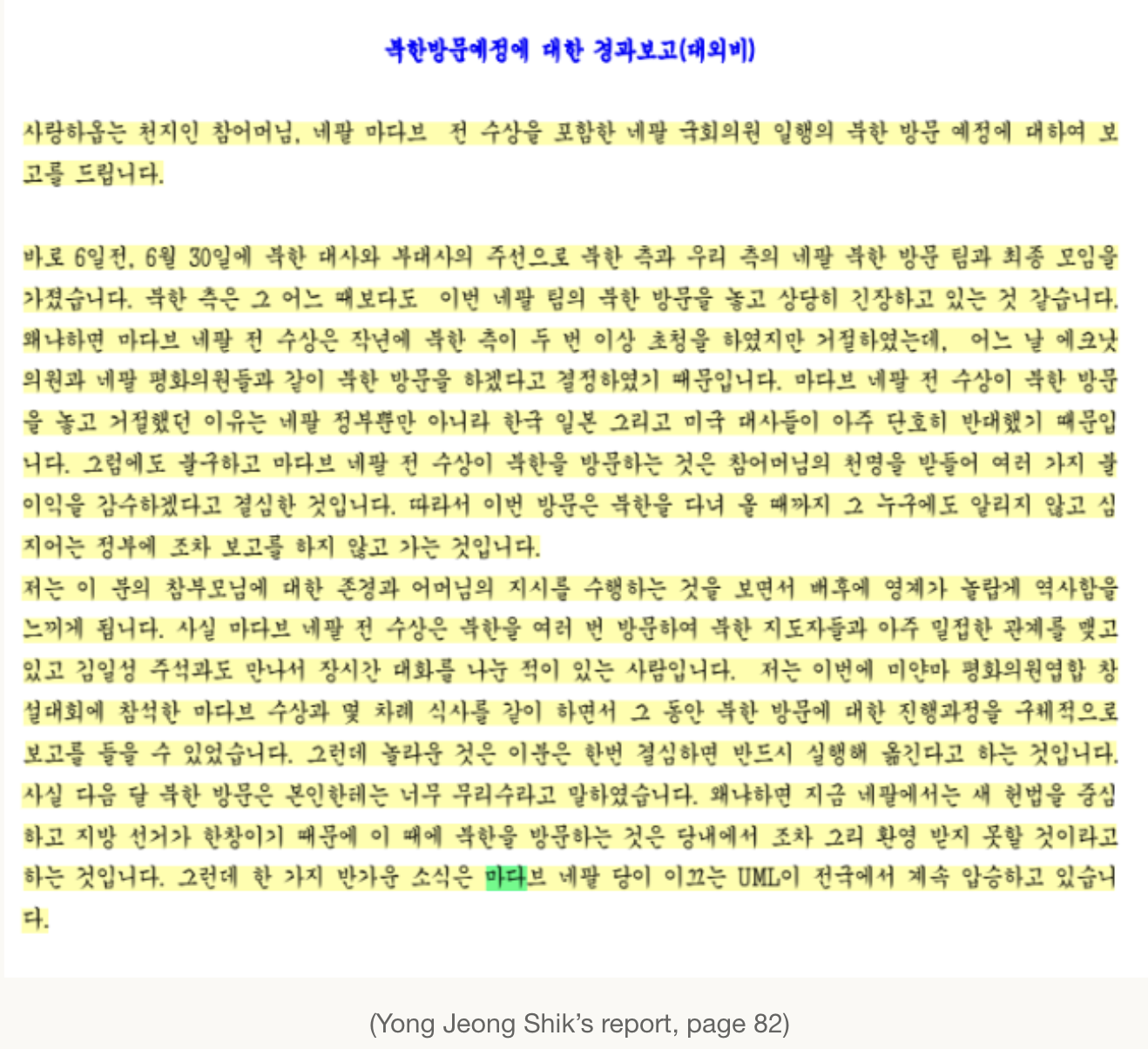
Documents show that the Unification Church had tried to get then UML Chair Madhav Kumar Nepal to Pyongyang, but the Nepal government supposedly under pressure from the South Korean, Japanese and US ambassadors got him to call it off. Madhav Nepal had also insisted that he meet Kim Jong Un, but the North Korean side had said it was not possible.
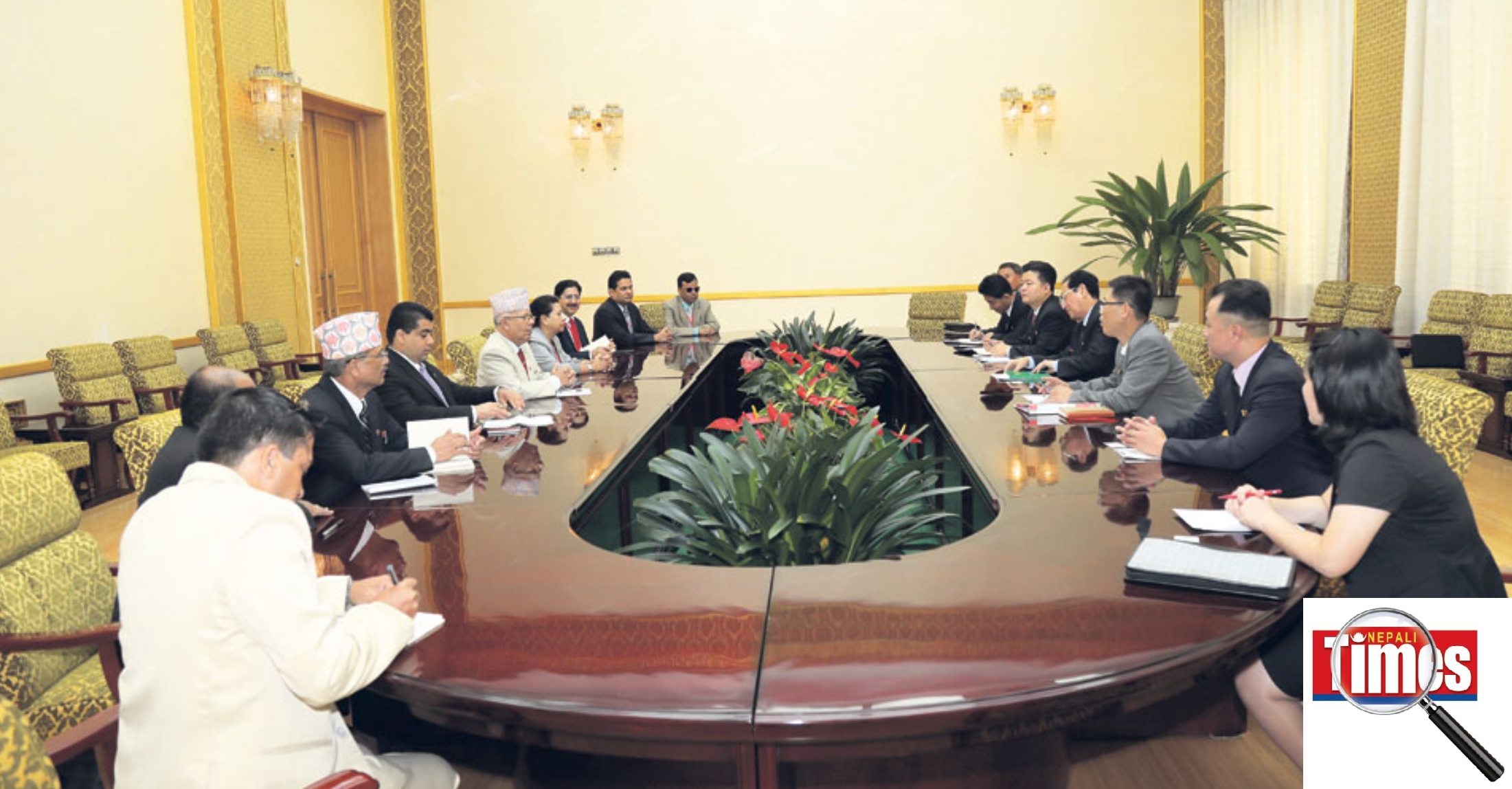
But after Nepal left the UML to form the Communist Party of Nepal (Unified Socialist) he met the North Korean Ambassador in the presence of Ek Nath Dhakal to plan a visit in order to work towards Korean unification. A 11-member delegation composed of Nepal, Dhakal, MPs and a newspaper publisher visited North Korea in 2017 (pictured below).
METICULOUS ARCHIVE
An extract from correspondence is indicative of the former prime minister’s links to the Unification Church: ‘Madhav Kumar Nepal … maintains a very close relationship with us and could become Prime Minister again at any time. There is no one who knows us as well or respects the Parents as much as former Prime Minister Madhav does … he is someone who regards the True Parents like God.’
The internal documents of the Unification Church obtained by Newstapa is called the ‘TM [True Mother] Special Report’ and appears to have been prepared for Hak Ja Han. The 3,212-page text provides a chronological account of the Church’s management of politicians internationally, its handling donations, and plans to expand political influence through its affiliated media outlets.
The document is a meticulous archive apparently compiled by Yun Young Ho, the former Director General of the Unification Church’s International Headquarters, the organisation’s second-in-command.
This suggests church affairs were reported directly to Hak Ja Han. Korean investigators are now focusing on whether Han merely received these reports or issued specific directives based on them.
Yun testified during the trial in Seoul that the Church’s regional leaders and local partners would send daily field reports which he would synthesise into a ‘Special Report’ format to provide oral briefings to Han.
Hak Ja Han therefore may have been personally involved in the Church’s operations in granular detail. Korean special prosecutors are viewing these documents as critical evidence in her trial to prove that she was directly involved in political lobbying.
Last week, during a hearing on the Hak Ja Han bribery case, a regional Church leader admitted to personally drafting segments of the ‘True Parents Correspondence Report’ featured in the document.
The ‘TM Special Report’ appears to be a compilation of internal documents reprocessed into a single file and includes emails and direct messaging. Certain periods are missing, leading to gaps in the narrative, raising the possibility that specific portions of the report may have been selectively curated or redacted.
Both Koreas in Nepal
Buddhism spread northwards across the Himalaya from Nepal to China and Korea 1,000 years ago, but in the past decades two of Korea’s powerful ideologies have come to Nepal.
Nepal’s leftist movement, most notably the Nepal Workers Peasants Party (NWPP) inspired by North Korea’s Kim Il Sung’s Juche Idea espouses a nationalist agenda, and has a strong base in Bhaktapur. Meanwhile, South Korea’s Unification Church of Sun Myung Moon has influenced Nepal’s political, administrative and religious spheres.
After establishment of Moon’s Universal Peace Federation (UPF) in 2005, the Church has a sizable presence in Nepal. The movement’s leader is Ek Nath Dhakal of the Nepal Paribar Party (above) who is affiliated with the UML and even served as a minister in a UML-Maoist coalition after being nominated as a PR member to Parliament.
He told this paper in 2016: “I am a Hindu, associated with the Unification Movement.
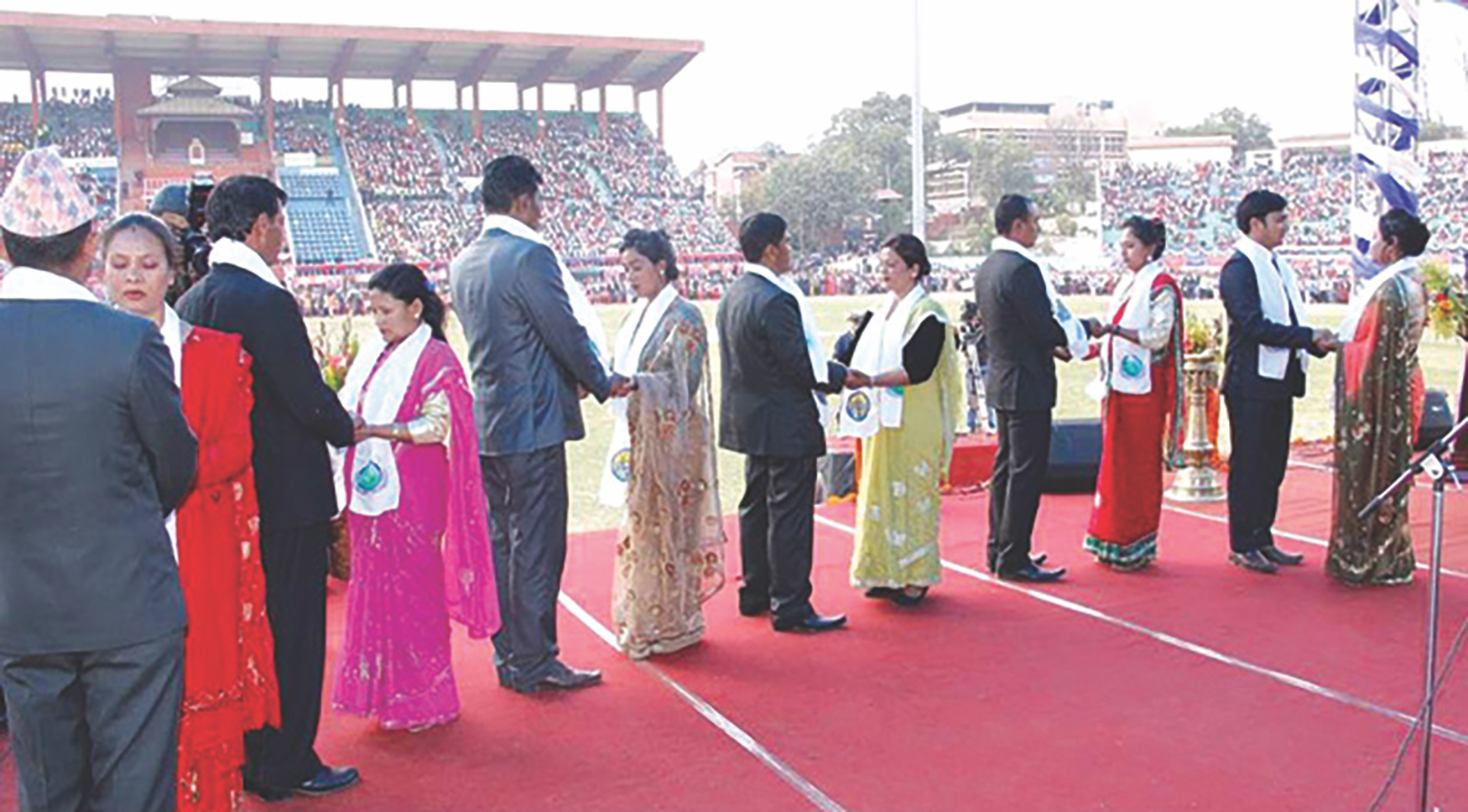
The UPF staged one of its mass weddings at Dashrath Stadium in Kathmandu in 2017 (below). The movement recruits public figures like former president Bidya Devi Bhandari, Madhav Kumar Nepal and others as Ambassadors for Peace. Before he died in 2012 at age 92, Rev Moon had picked Nepal as a ‘model peace nation of God’. The Church says it embraces all religions, and does not even display the Christian cross at its places of worship.
While young Nepalis follow South Korean pop culture fever, in Bhaktapur it is Kim Il Sung’s Juche Idea that is the dominant ideology. The Nepal Workers Peasants Party has won just about every district and local election from Bhaktapur, not so much for its politics, but because its representatives have performed well.
Bhaktapur’s following of Kim Il Sung is based on Bijukchhe’s vision that his town be self-reliant and deliver development equitably.
A worldwide web
In 2022, the Unification Church (Family Federation for World Peace and Unification) arranged a meeting between Yoon Suk Yeol, who was then presidential candidate, and former US Vice President Mike Pence just before South Korean elections. The visit was timed for the ‘World Summit 2022’ hosted by the Universal Peace Federation (UPF), a Unification Church affiliate.
The visit was widely covered by the media at the time, but a Newstapa investigation last year confirmed that the Church paid Pence $550,000 to visit Seoul. The visit was designed to bolster Yoon’s diplomatic and security credentials and appeal to religious voters. Yoon knew Pence was a devout Christian, and media at the time reported that both prayed before the meeting.
Just like the UPF’s World Summit 2018 in Kathmandu, Cambodian PM Hun Sen was in attendance as was former UN Secretary-General Ban Ki-moon.
The welcome remark at the Summit was delivered by Yun Young Ho, then-Director General of the Unification Church’s World Headquarters. South Korean Special Prosecutors are currently investigating Yun for allegedly bribing former president Yoon Suk Yeol’s wife Kim Keon Hee.
Newstapa also dug up Pence’s financial disclosures filed with the US Office of Government Ethics and the Federal Election Commission and found that Pence reported receiving $550,000 from the UPF for ‘a speaking engagement’ in Seoul in 2022 — an unusually hefty fee.
Cambodian Premier Hun Sen has hosted K P Oli several times in Phnom Penh, once as prime minister in 2019, and again last year in August. There seems to be a similar nexus between Hun Sen, the UPF and former President Yoon and his wife Kim Keon Hee.
When he became president in 2022, Yoon visited Cambodia with his wife, and South Korea doubled its development assistance to Cambodia to $1.5 billion. The Special Prosecutor in Seoul is investigating allegations that the Unification Church provided funds to Kim Keon Hee in helping a Mekong River project in Cambodia.