
The series Nepal Made profiles Nepali products and the people who make them possible.
Named after the mythical bird-like creature, GarudX is Nepal’s first precision manufacturer of UAV platforms. They offer a wide range of drone products and services.
Last month, GarudX won first place at the US-Nepal Startup Weekend Challenge, a three-day accelerator-style program that gathered 25 of Nepal’s most promising early-stage companies.
These include custom drones, cinematography, virtual tours, first-person-view (FPV), drone racing, 3D reconstruction, ground control software, and drone light shows.
“I think they liked that we pitched the company as a Drone Enterprise System, as a company providing large-scale, integrated drone services,” says Dipawoli Malla, an AI software engineer with GarudX.
The company sees a lot of potential in AI-based aerial computer vision, which is already used for infrastructure planning and land surveys, and could be vital in tracking wildlife poachers and assisting search and rescue during disasters.
“Our vision for the company has always been to be the one stop solution for every drone problem,” says GarudX CEO Avash Thapa, who also oversees video production.
Drones have gained high profile in the past five years due to their widespread adoption in war. While they do work with the Nepali army, GarudX wants to focus on the idea of drone for good. For Nepal, the potential is great for civilian applications especially because of the country’s terrain. Past efforts have been experimental, like a project to deliver tuberculosis treatment in Piuthan in 2019, and for wildlife censuses in Chitwan.
Journalists now regularly use drone footage to get a bird’s-eye view for investigative stories on illegal sand-mining or delays in infrastructure projects. Drones were vital during the GenZ protests last September, in which aerial videos provided clues about what actually happened when the crowd surged towards Parliament. They also captured the dramatic aftermath of the destruction of government buildings featured in this paper.
“A lot of people do not know or appreciate that drones are also made in Nepal,” notes Malla. “We export a lot of technology as software. It is a big achievement that we can also export hardware.”
GarudX was informally started and active on social media since 2018, and officially registered as GarudX Multipurpose in 2024. Founder and Managing Director Adarsha Raj Bhusal had experience working with robotics and FPV drones when he launched the company, as an engineering group interested in custom-built high-performance aerial robotics.
“I design our products,” says Bhusal. “We send designs to China where they are manufactured as individual parts. Costs are low when importing from China. Then we assemble and sell them here. It's a system that works well for us.”
Among the UAVs GarudX makes include the Skyreaper, which is a long-range drone with advanced obstacle sensing; the GX8 Pyro which is Nepal’s first cinema-grade cinelifter; and the Aether Zoom which is a 4K UAV camera designed for tactical, industrial, or reconnaissance missions.

NO CERTIFICATION
The main obstacle to GarudX's growth has been the lack of a national certification system. Permits to use drones are convoluted and require applications to various government agencies.
“We miss out on so many international projects, for national park footage for example, since there is no way to get our drones registered — even after the army thoroughly checks our craft,” says Adarsha Raj Bhusal.
GarudX says it now has the capacity to export its drones overseas at competitive prices, but Nepal does not have a registration system in place. “We can’t legally ship them,” says Avaya Pokharel, Chief Operating Officer who oversees service and repairs.
With a new RSP government in place with an ambitious blueprint for digitisation, things could soon change. Relevant bodies are the Home Ministry, the Civil Aviation Authority and the Ministry of Defence because of privacy, aviation safety and national security issues.
“There are meetings going on, and there is hope that progress will be made. Of course we want certification to be easy, but it is hard for the government as they have to understand the technology and what is coming in future,” says Bhusal.
Legislation could look like a Remote ID system to register every drone. It could also specify pilot verification, placing limitations on what a pilot can do based on their skill level. It could also look at revising drone policies in the capital. Most of Kathmandu Valley is technically a no-fly zone for drones at present because of the concentration of government buildings, army bases and the international airport flight path.
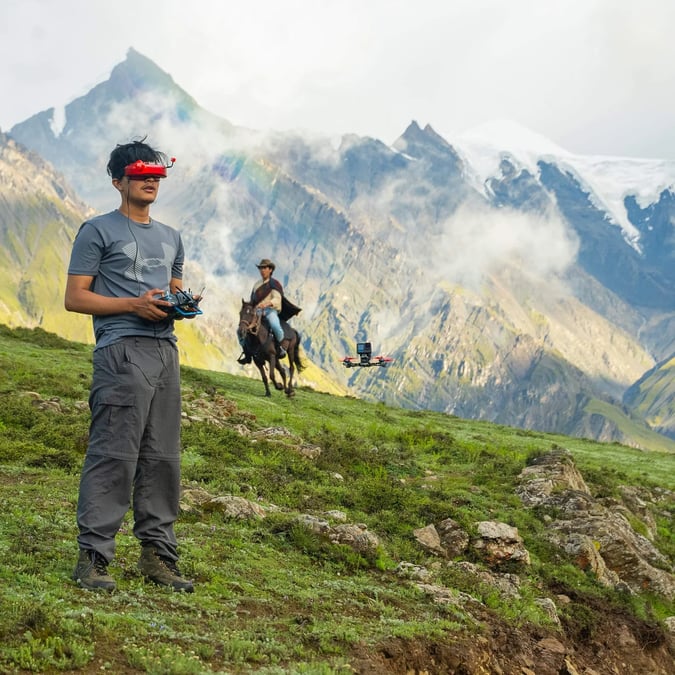
To comply with current regulations, GarudX has focused on lightweight FPV drones: small, nimble craft that can be maneuvered at high speed in tight spaces, operated by a pilot wearing immersive goggles. This results in exciting fast-paced footage, particularly useful for clients like Redbull or vehicle companies.
“It feels like you are flying,” testifies Bhusal, who has flown FPV for commercials and movies, and ranks way ahead of runner ups in drone races. His work can be seen @adars_fpv on Instagram.
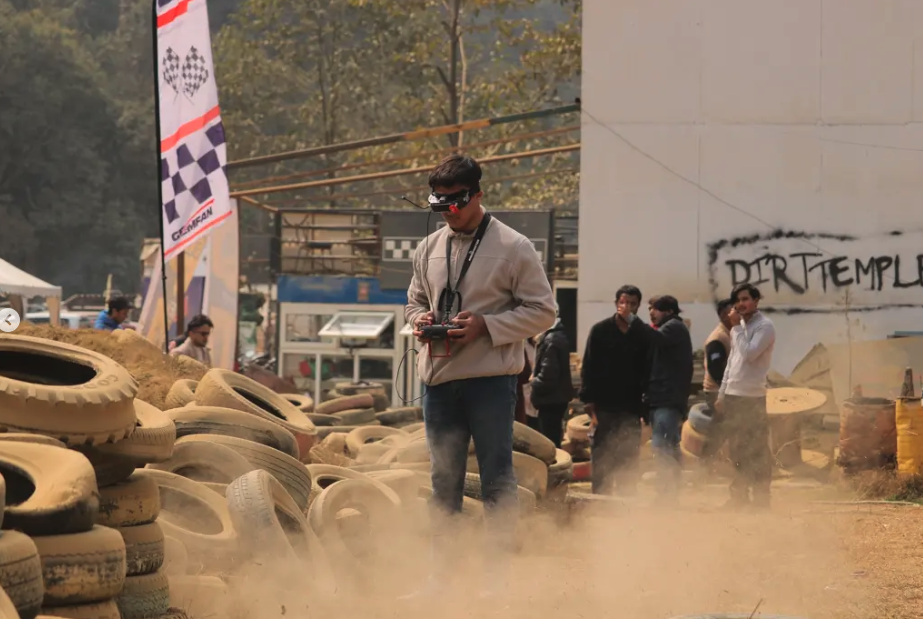
The company has built a community of FPV drone racers, and is working with the government to certify it as a sports competition. It holds race events at colleges in Kathmandu and also consults for FPV events in in India.
MULTIPURPOSE
Drones can be versatile tools, but they are particularly helpful in Nepal and the Himalaya. Powerful drones have been used for the last two years to transport ropes and ladders up Mt Everest to reduce the dangers on the Khumbu Icefall, and to bring trash down. If scaled with many pilots and drones, this could be a complete solution to the Everest trash problem while massively reducing risk to human lives.
GarudX has also tested its products in the mountains. A recent blog entry on their website is titled, ‘Flying at 6,120m: What We Learned Testing Drones on Lobuche Peak’. They document the process of using different battery tricks and propellers to see what combination allows for more flight time in the thin, cold air.
It is refreshing to see a Nepali company making such progress in a unique industry while also documenting advances.