
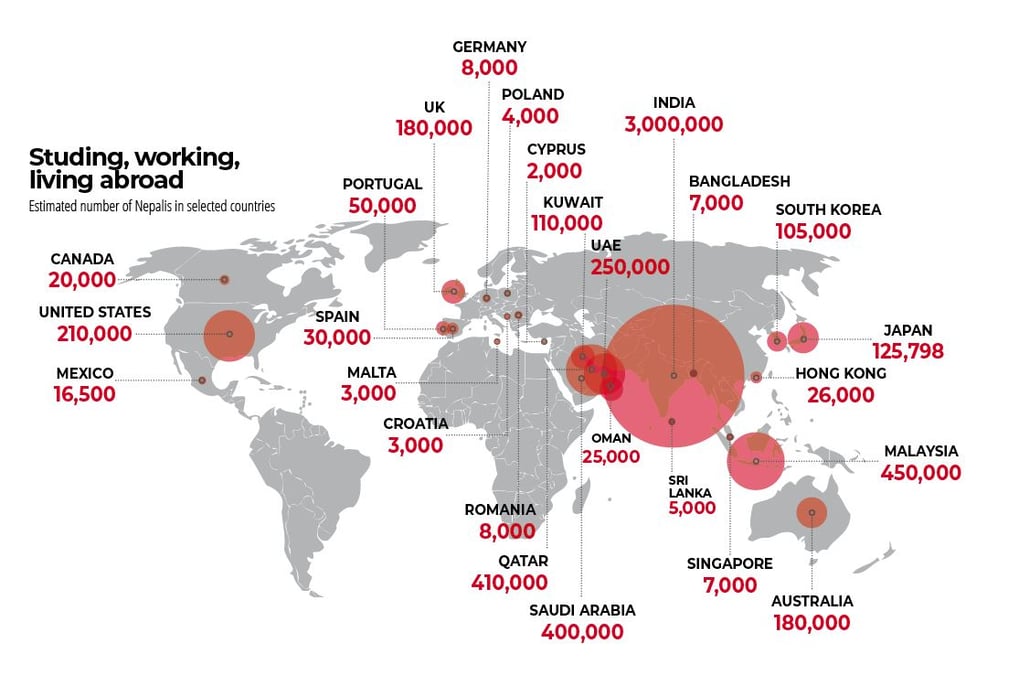
Nearly 750,000 Nepalis went abroad for employment in the past year. Another 112,000 left initially on student visas, many of them also to work and emigrate. These figures do not include those who went to India or left through unofficial channels. Back of the envelope, it would mean at least 1 million Nepalis left Nepal last year.
Besides these there are Nepalis settled permanently overseas, spread across North America, Europe, Australia, and East Asia. There are 290,000 documented people of Nepali origin in the US alone – their average yearly household income is more than $100,000.
Nepalis can run into compatriots in just about every corner of the globe, and the money they send home annually just through official channels totals $11 billion. The real figure is much higher.
The decentralisation of the passport distribution in the 1990s for the first time made international movement easier for Nepalis. The Non-Resident Nepalis Association (NRNA), was established in 2003 and now has 97,000 members and chapters in 87 countries.
In 2008, the Nepal government introduced the Non-Resident Nepali Act, categorising Non-Resident Nepalis (NRNs) as either being an individual of Nepali origin who has acquired foreign citizenship, or a Nepali citizen residing abroad for more than two years. It excludes people of Nepali origin and Nepalis residing and working in SAARC member countries.
The 2015 Constitution stipulated that overseas Nepalis could ‘enjoy economic, social, and cultural rights in accordance with federal law’. However, it took another eight years for Parliament to pass the Nepal Citizenship (First Amendment) Bill under which overseas Nepalis (except those in South Asia) had all the rights of Nepali citizens except the right to vote or run for political office.
The provisions laid down in the Constitution and law are not for dual citizenship, but for second citizenship.
Indeed, those who have gone through the process of obtaining an NRN citizenship have described it as needlessly convoluted. District Administration Offices refuse to issue US-based NRNs a second citizenship without their Social Security number despite American laws prohibiting the disclosure of the number outside of the US. If they obtain Nepali citizenship, NRNs have had to pay visa fees even though there is a government directive that they do not have to do so.
The idea was to make it easy for many to invest in Nepal, or retire in their motherland in the hope that this would boost the economy. Many first and second generation Nepali émigré across the world have children and grandchildren who want to know about their heritage.
Non-Resident Nepalis can acquire property in Nepal through purchase, inheritance, or investment. Those with foreign citizenship can obtain 10 year visa. They are also entitled to run any industry or business in Nepal, to set up bank accounts, and to bring in either Foreign Direct Investment (FDI) or make investments just like Nepali citizens. NRNs are exempt from taxes on investment, and may repatriate the investment and profits to their home country.