
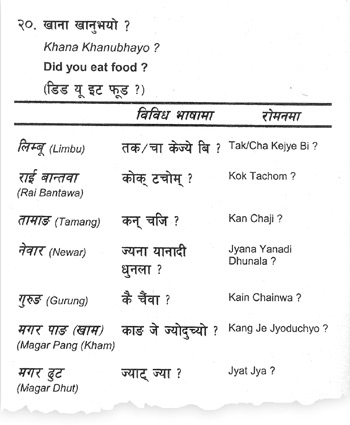
 Talking to Hill Peoples, or Pahadi Bolichali, is an amusing diversion from the slew of academic and otherwise weighty books which set forth a series of problems and solutions for Nepal. For anyone who has ever moaned about the absence of local cultural knowledge in the undertakings of non-profits or central planners, this squat volume provides one of the first steps. It teaches the brave of tongue to say anything from "Don't you have any other food than chauchau", to "I'm suffering from yesterday evening" to requesting a visit to "the water source to determine how many taps are needed", in nine languages in Devanagari and Roman scripts: Nepali, English, Limbu, Rai Bantawa, Tamang, Newar, Gurung, Magar Pang (Kham), and Magar Dhut.
The English versions of some of the sentences will give the native speaker pause, but a quick survey of some Limbu, Tamang, Gurung, Newar, Magar Kham, and Rai Bantawa speakers suggests that the translations in those languages are more or less adequate.
Pahadi Bolichali offers further instruction at the back of the book in the form of tables of janajati lipi, or scripts, and brief introductions to each of the ethnic groups represented in the book, which each end with a quirky list of possible areas of research, such as how Tamangs treat their sons and daughters, and the overlaps between Magar customary law and contemporary Nepal's justice system. The 600-page volume closes with a quick rundown of terms of social organisation in each community, and a little combined glossary.
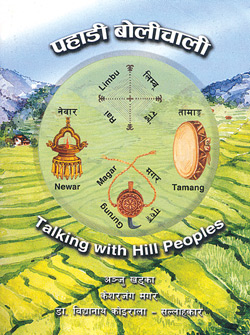 Talking with Hill Peoples/