
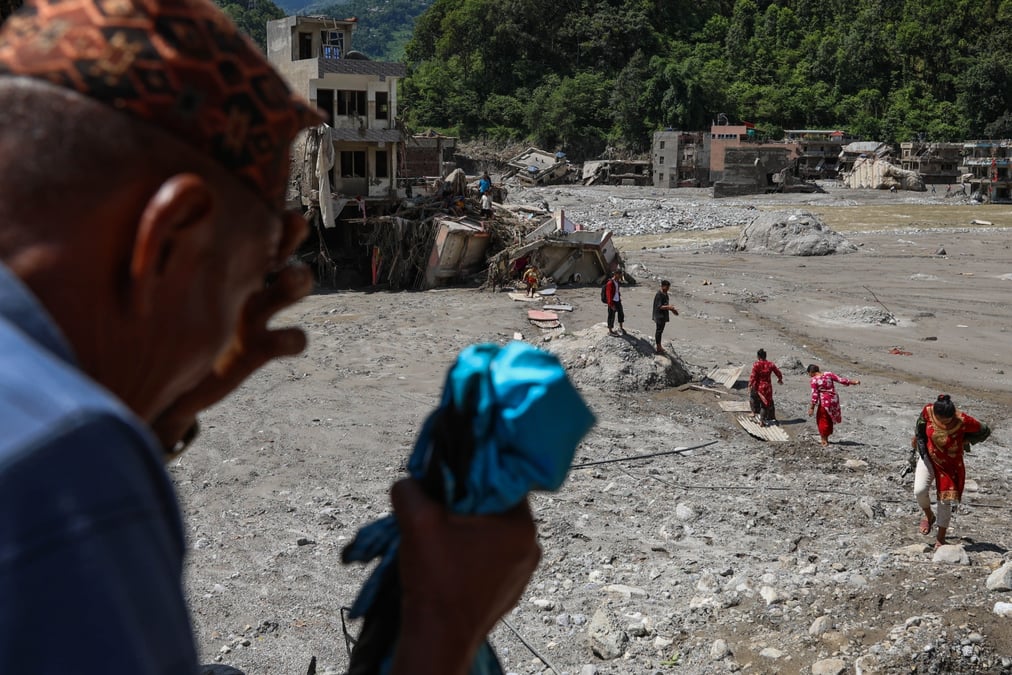
When the Climate summit (COP31) is held in Antalya, Türkiye on 9 November memories of the Bhote Kosi–Trisuli disaster will still be raw.
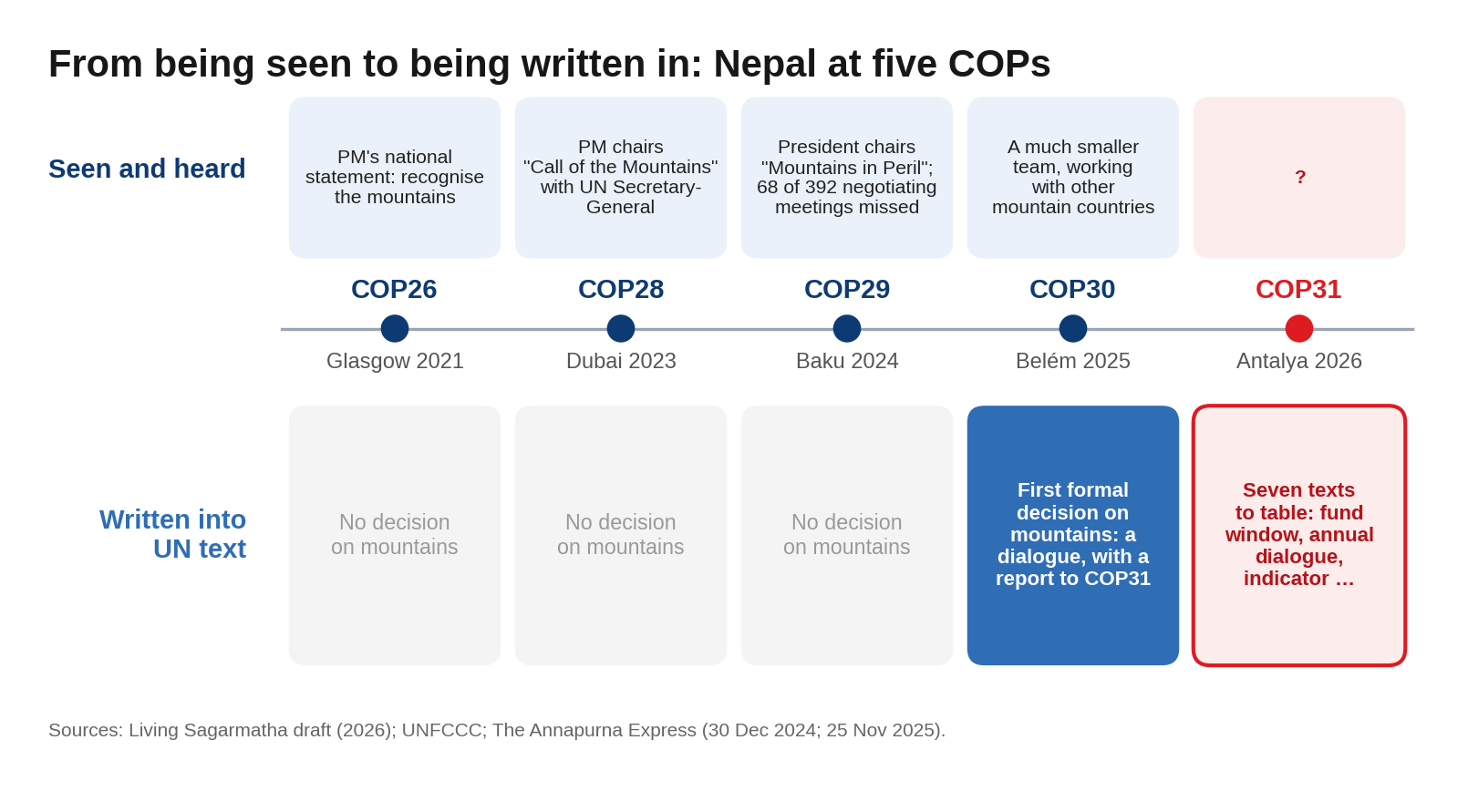
For a decade Nepal has gone to the climate negotiations to be seen and heard. In Glasgow, Dubai and Baku our prime ministers and president spoke for the world’s mountain countries, and chaired high-level events. Those moments built goodwill, but none of them put mountains into a decision of the 198 participating countries.
What Nepal lacked in Baku was not people, but the right people. Delegations numbered 50, yet our delegates covered 324 of 392 negotiating meetings. Meetings went unattended for want of staffers, and officials admitted that our negotiating power was weak. The Secretary called for a permanent negotiating team.
Then came Belém. With a much smaller team, and working alongside other mountain countries, Nepal helped secure the first formal UNFCCC decision on mountains and climate change. Living Sagarmatha, the Ministry’s draft Nepal Mountain Resilience Strategy was ‘modest in scope’.
A COP is two events under one roof. The first is the one we see in photographs: speeches, and side events in the pavilions. The second happens in a set of rooms, each working on a single agenda item under two co-facilitators, where delegates go through draft text paragraph by paragraph and anything not yet agreed sits in square brackets.
Countries negotiate mostly in blocs, and Nepal does so through the Least Developed Countries (LDC) Group. Nothing important is written on the day. The paragraphs that end up in a decision were drafted, circulated and lobbied for months before, and the calendar is unforgiving.
Written proposals for this year’s guidance to the loss-and-damage fund were due on 17 August -- nine days before the Trisuli Valley flood, and the draft was settled in Sydney in late September. The LDC Group’s COP31 declaration, agreed in Dili on 3 September, does not mention mountains or sudden-onset disasters.
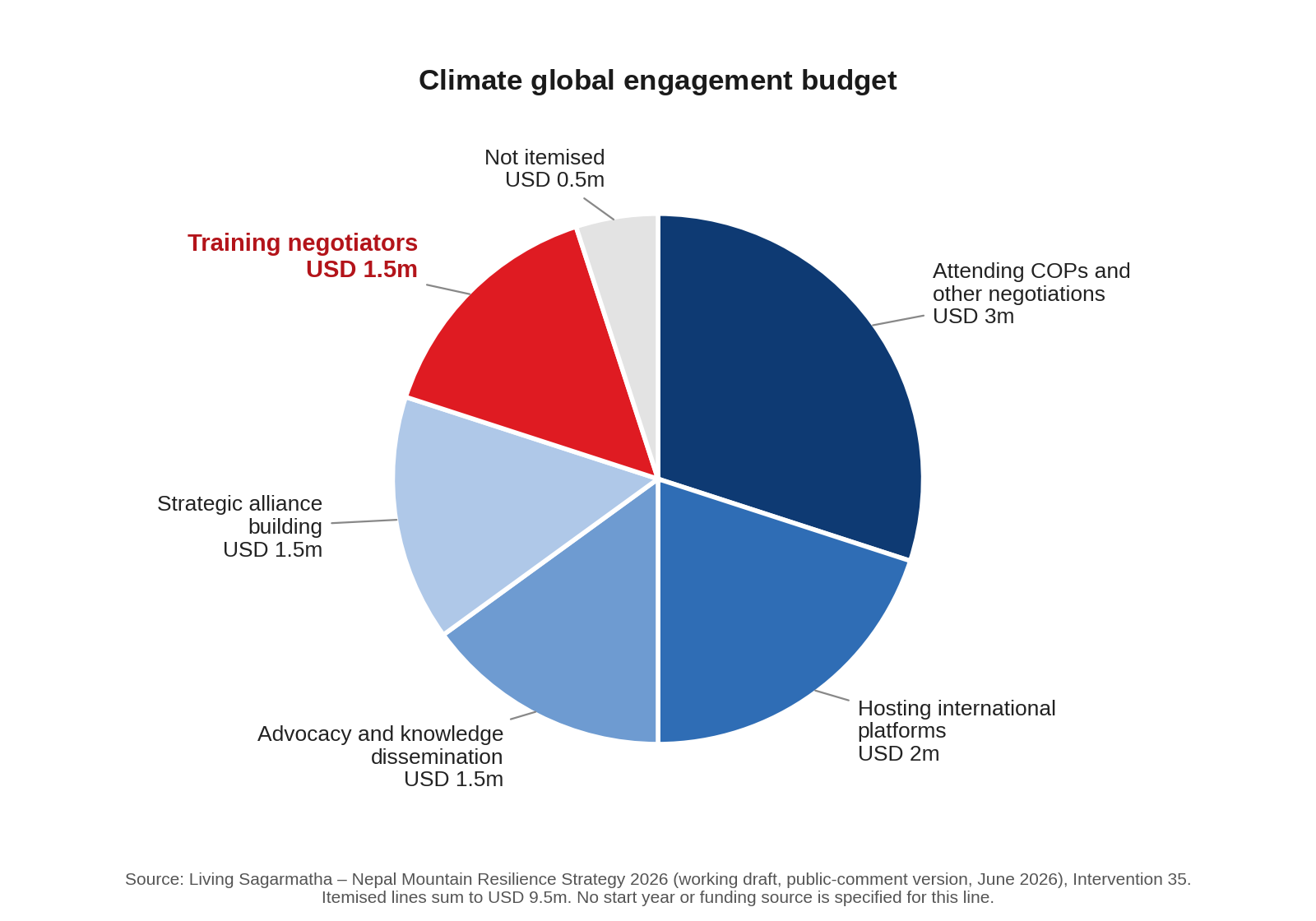
Nepal now has to get its own text to the Group’s Chair before the final coordination meetings on the eve of Antalya. So when people and money are short, as they always are, they should go to the rooms first. If all we want is to tell our story, a speaking slot at someone else’s pavilion does the job. There is no need to pour money and effort into hosting one.
Living Sagarmatha leans the other way. Of the $10 million it proposes for global engagement, training negotiators would get $1.5 million: half the sum for attending meetings, which is largely travel, and less than the sum for hosting events. The strategy document names no start year for its seven-year horizon and no source for the money.
Nepal’s statement in Baku asked for ‘reparations for loss and damage’, and for the ‘polluters pay and compensate’ principle. Two months after Baku, the United States announced that it would leave the Paris Agreement for the second time, and the withdrawal took effect in January this year.
In Nepal we have a new Parliament, a new government, and a generation with little patience for speeches. The lesson is not that our leaders were wrong to speak of justice. It is that justice arrives through mechanisms, and mechanisms are won in text.
TWO CASES
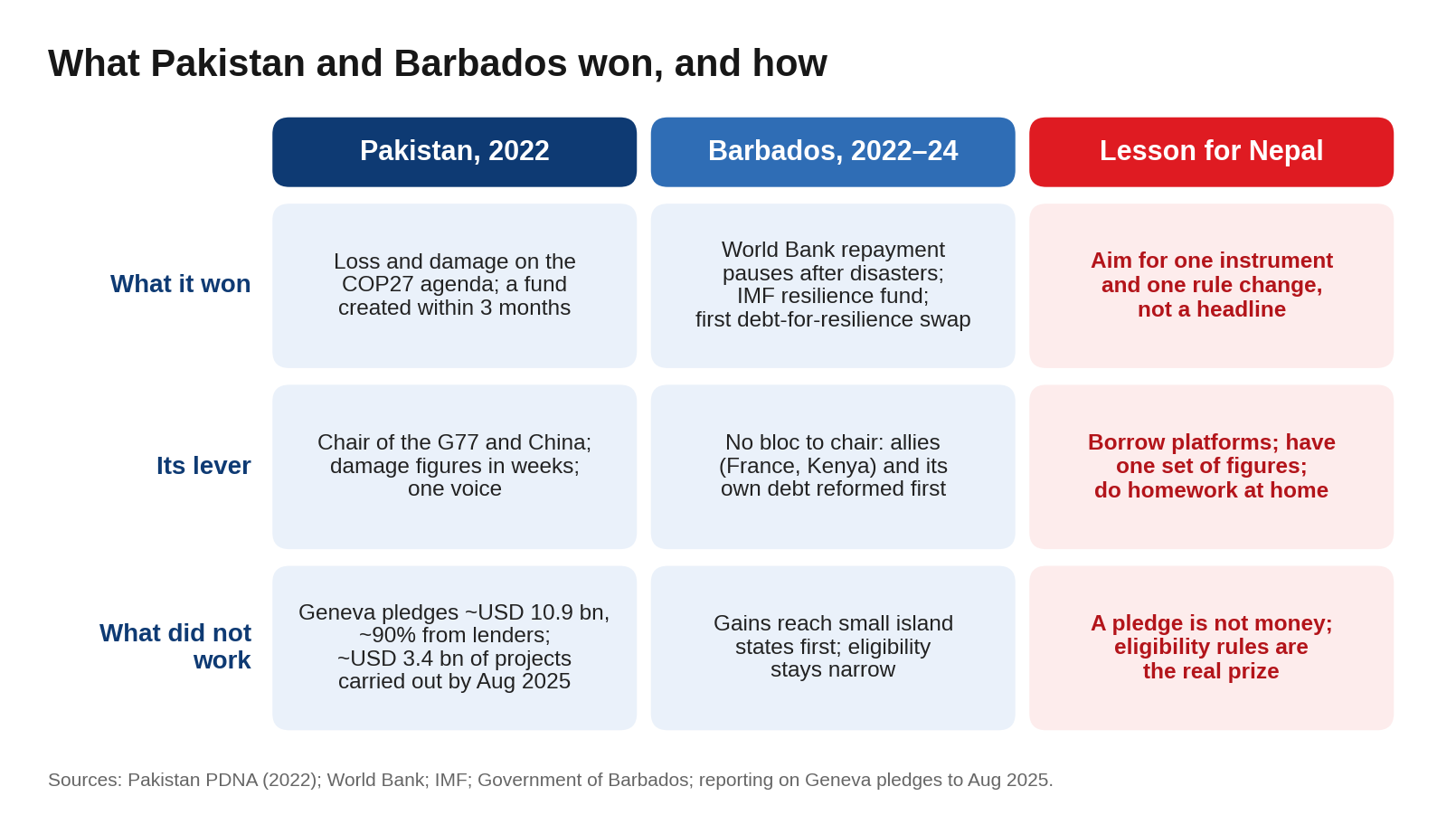
In 2022 floods left a third of Pakistan under water. Within three months Pakistan had done what vulnerable countries had failed to do for three decades: it put loss and damage on the COP27 agenda and won the decision to create a fund. It could do so because it chaired the G77 and China that year, which gave it a hand on the agenda.
It also had a damage assessment, prepared with the World Bank, the Asian Development Bank, the EU and the UN, within weeks of the floods. And from start to finish it spoke with one voice.
In 2024, Barbados suffered heavy damage from the Category 4 Hurricane Beryl. Barbados chaired no bloc, but it changed the rules of lending. Through its Bridgetown Initiative, the World Bank paused loan repayments for small states hit by disaster, the IMF has a fund for resilience, and Barbados closed the world’s first debt-for-climate-resilience swap.
It began by writing disaster clauses into its own debt, and with France and Kenya carried it to every forum where finance rules are made.
Not everything worked. Pakistan’s reconstruction conference in Geneva in January 2023 drew large pledges, mostly as loans, and two and a half years later only about a third had become projects on the ground. A pledge is not money, only a rule change can do that.
Pakistan’s losses four years ago ran to $30 billion, so Nepal cannot argue on scale. But it can put the case for the kind of disaster: a rock–ice avalanche that turned into a debris flood. The World Weather Attribution’s assessment named climate change as a destabilising factor acting on a geological predisposition, not the sole cause.
It found the event ‘beyond the design and predictive limits of existing risk reduction measures’ and such cascading hazards lie ‘beyond adaptation limits’.
The words we use in our texts should stay exactly where the current science is: no less, and especially no more. Putting ‘climatic’ before ‘catastrophe’ invites an attribution test, and may close doors in other rooms where our calls are negotiated.
Scientists are now investigating how the slope moved in the months before it failed, and whether shaking from the 2015 Gorkha earthquake had already weakened the rock wall – a contribution the assessment says cannot yet be confirmed.
Today’s instruments do not fit such a disaster. No catastrophe model yet prices this peril, so no disaster bond can cover it. The loss-and-damage fund works through calls for proposals and has no fast route for sudden disasters. Nepal has asked it for $20 million, and the request goes before the fund’s Board in Manila in December.
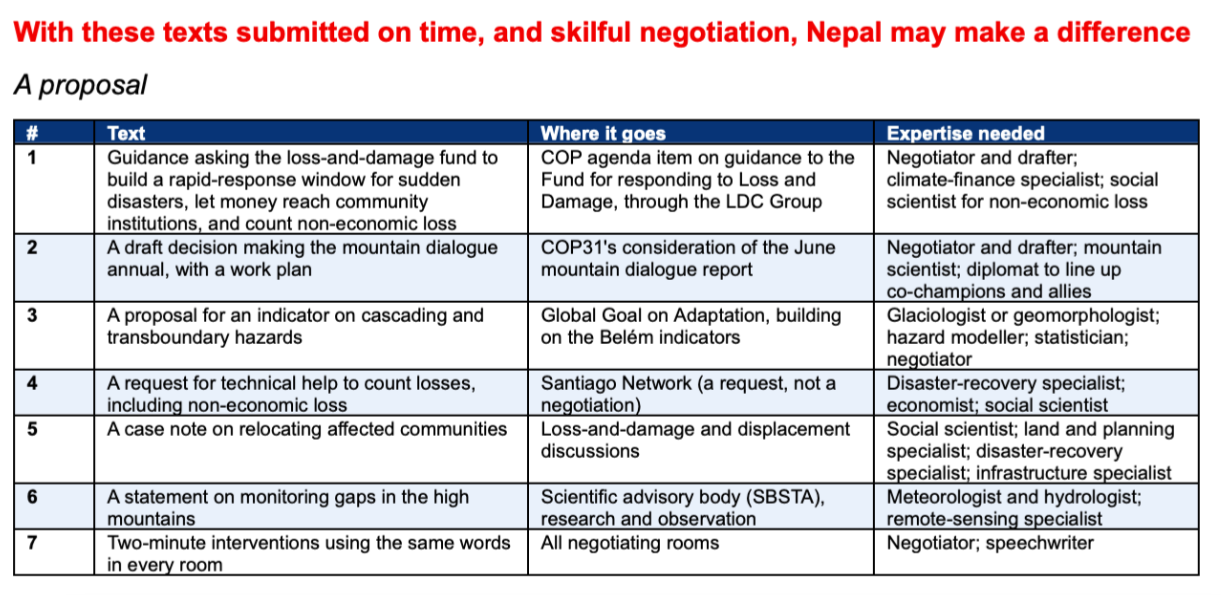
Whether the fund can answer quickly depends on paragraphs that Nepal can still help write in Antalya. Seven of them are proposed (below).
Negotiation is a drafting job, and loss-and-damage and adaptation specialists cannot carry it alone. An indicator for cascading hazards needs glaciologists and hazard modellers to defend it, non-economic loss – Tamang heritage, language and sacred places – needs social scientists to evidence it.
Most of these people already work in our universities, the Department of Meteorology, the National Planning Commission and civil society. If knowledge is power, every webinar, hybrid gathering and presentation since 26 August has been worth as much as a transfer to the relief fund.
Nepal’s scientists, scholars and practitioners are ready to unite for the cause; the delegation only has to ask. The Ministry’s call for a permanent negotiating team is right, and that team belongs to the whole of government and the whole of society, not to one ministry.
Nepal should also arrive with something to offer, not only something to ask. Four decades of community forestry have shown that money given to communities is well spent, and community forest user groups are a ready channel for recovery finance. Nepali scientists were among those who issued the first risk assessment of this disaster, in Nepali, within 48 hours.
Nepal holds the Asia–Pacific government seat on the Mountain Partnership, a platform from which to convene other mountain countries. It can commit to rebuilding the corridor with risk-informed infrastructure – roads, bridges, hydropower and settlements sited and designed against the hazards we now know – so that recovery money is not washed away a second time.
And Nepal can promise what Geneva lacked: a public tracker following every pledge to the money actually spent.
Disasters do not keep to negotiating calendars, but we can still control the substance: quality texts ready on time, the right people in the rooms, and results that reach the people of the six districts along the Trisuli corridor. It is time to put our money where our mouth is.
Next year’s calendar is already out: windows for written submissions, the Bonn sessions in June, the Second Global Mountain Summit in Bishkek in October and COP32 can all be read now, and our texts drafted before each window opens. Turning the calendar to our advantage is a small innovation with a large effect: acting ahead of events instead of reacting to them.
It is the essence of the anticipatory action we ask of every early warning system. A COP is not one more global event, a stage for telling our stories. It is where we state our agenda, set our own goals, and pursue them with a plan of action that requires several ministries to work together.
The Pre-COP in Fiji this week was the place to launch a Sagarmatha Agenda with specific asks, find a co-champion, and request speaking slots for Antalya. Those three steps must be taken in the weeks that remain. This time next year, Nepal should be able to report what it truly achieved for the country – not a tick-box of participation and a tally of events.
Climate justice is the destination. But the road runs through a paragraph of guidance to a fund, a decision that makes a dialogue annual, and an indicator in a table. If in December Nepal can point to text adopted and a Board decision taken, Antalya will have been worth the journey. In Bishkek next October, we should arrive with results rather than requests.
Truong Huyen-Chi (Shachi) is a Nepali of Vietnamese origin who lives in Kathmandu, and is Director of the Asia Coordination Office of the Asian Mountain Academic Alliance (AMAA).