
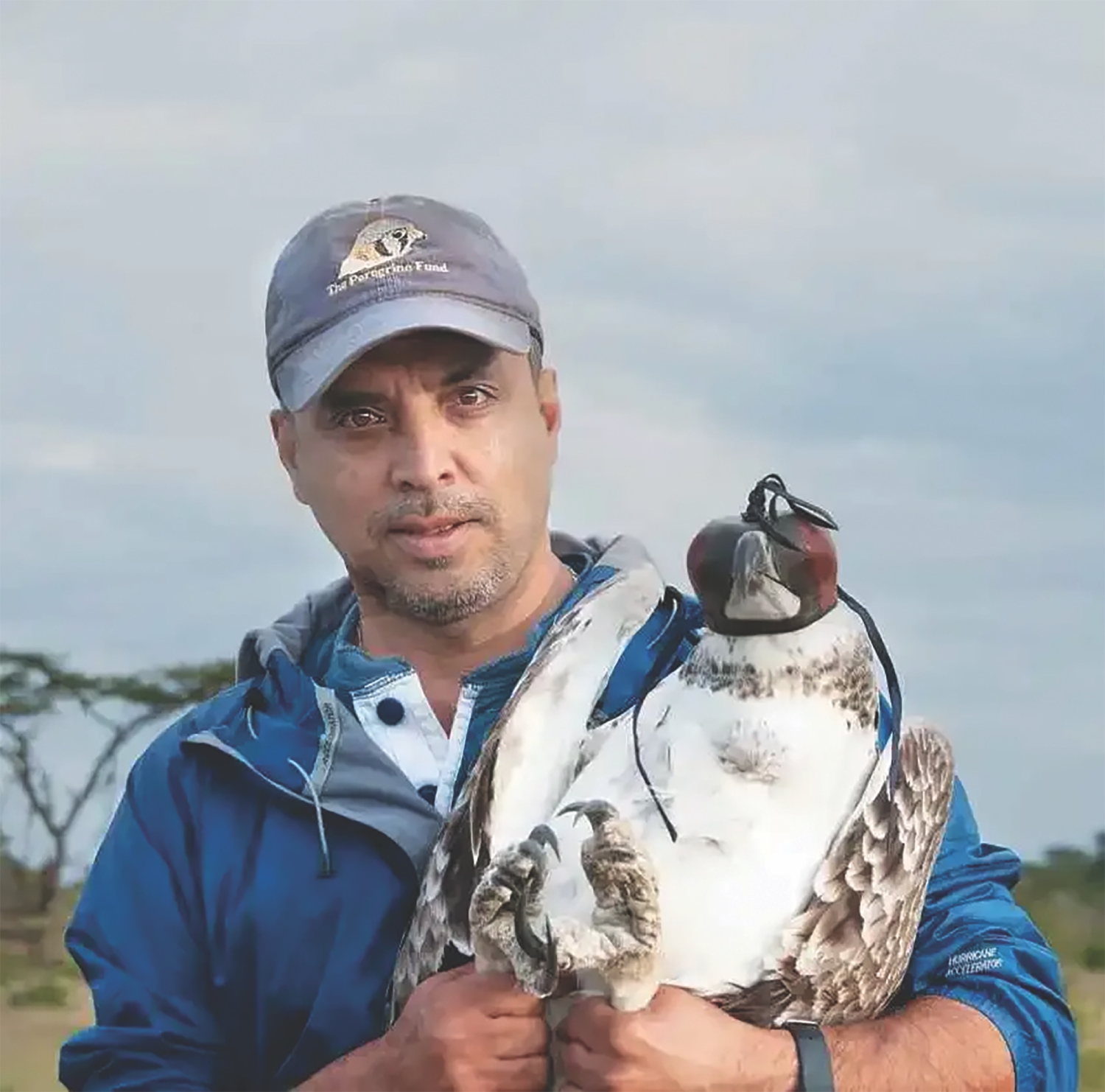
Munir Virani is a conservation biologist and filmmaker who has dedicated his life to protecting birds of prey. Born in Kenya and now based in Abu Dhabi with the Mohamed bin Zayed Raptor Conservation Fund, Virani played a key role in uncovering why South Asia’s vulture population had collapsed. He is a Whitley Award winner and a featured TED speaker, known for his work on tackling major threats to raptors worldwide.
Excerpts from journalist Ramesh Bhushal’s recent interview with him:
Ramesh Bhushal: What are birds of prey?
Munir Virani: These are birds that have very sharp bills, hooked talons, and forward-facing eyes. They are really the tigers, leopards, and lions of the sky. They’re predators. Out of about 10,000 species of birds globally, raptors or birds of prey make up about 5%—around 560 species across the globe.
What brought you to Nepal?
I must have been about five, sitting in my grandfather’s living room watching an old black-and-white TV set. I remember listening to the voice of David Attenborough; people were sitting on an elephant, radio-tracking tigers, and you could see the mountains in the back. I told myself I will make it to Nepal.
I completed my doctorate studies in 1999 and two weeks after I got married, my boss phoned me to go to India for the Peregrine Fund. Vulture numbers had gone down by 95%. Having seen that documentary when I was five, I saw my chance to go to Nepal. I traveled by road from West Bengal and took a 16-hour bus journey to Kathmandu from the border. My job was to find partners in Nepal to set up field and diagnostic studies to understand what was causing the vultures to die.
How did you find what was causing the vultures to die?
This was a complete team effort involving the Peregrine Fund, my job was a fact-finding mission.
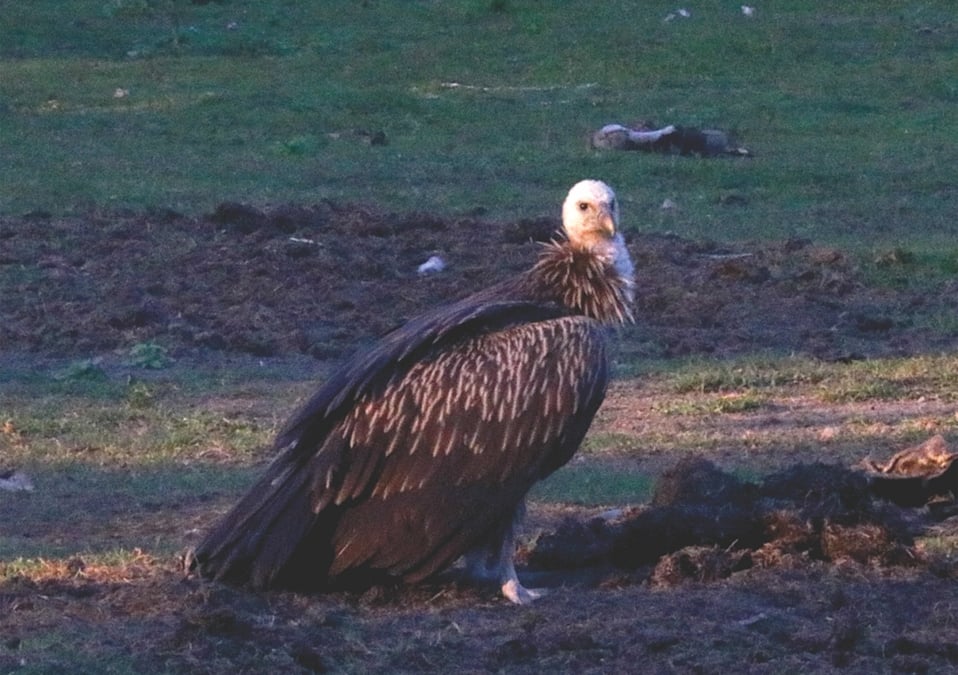
Three species—the Oriental white-rumped, Indian long-billed, and slender-billed vultures had collapsed, though there were still a few down in the Tarai. To understand the cause, we needed fresh tissue samples stored in liquid nitrogen to send to labs in the United States. We worked with virologist Lindsay Oaks at Washington State University, who unfortunately passed away later.
Was it tough to take genetic material out of these countries?
It was very tough. That’s where Pakistan came in. India and Nepal have very strict laws against exporting DNA material, We did start programs in both countries. We worked with Bird Conservation Nepal at Kosi Tappu Wildlife Reserve, where a student monitored nests from 2000 to 2002 and saw a catastrophic drop.
We succeeded in Pakistan, partnering with the Ornithological Society of Pakistan. Thousands of vultures were still there, which was baffling, but we were also finding many dead birds. We had students monitoring 1,800 nests across the country. We got permission to export tissue samples to the US.
What did you find?
We looked at their diet —livestock carcasses and wanted to find what was causing kidney failure in vultures. When you opened a dead bird, internal organs were covered in a white chalky paste of uric acid. Diclofenac stood out. When Lindsay tested four samples, all four were positive. We nailed it in 2003 after four years of work.
You went back to Pokhara recently. What did you see after 23 years?
One of my former students Tulsi Subedi is now a leading raptor expert and runs a site 45 minutes outside Pokhara called Thulakharka. It’s one of the best locations to observe migratory raptors coming from the north toward India. It was extremely nostalgic to see white-rumped and red-headed vultures back in the skies again. Twenty-six years ago, you couldn’t have seen them.
Ten million birds are electrocuted on power lines every year. Forget about other causes, how do we deal with this?
There is a huge demand for energy, including renewables like wind, solar, and hydro. While electricity is necessary, the issue lies in how the distribution networks are constructed. Old power lines used wooden poles with T-frames and insulators, which were 100% safe. Now, wooden poles are being replaced with cheap concrete ones containing steel rebar and metal cross-arms. Everything is exposed.
In big grasslands like Mongolia, raptors sit on power poles to hunt rodents. When they land on these power lines, they touch two phases or a phase to ground, complete the circuit, and get zapped. Every three seconds, a bird dies of electrocution globally because power poles are being put up without proper design.
Is it expensive to fix them?
I’ll give you the example of our work in Mongolia where power lines were killing 18,000 birds of prey every year, including 4,000 Saker falcons. The UAE invested in local partnerships with the Mongolia Bird Conservation Center, and since 2019, we have insulated 27,000 poles covering 3,000km of lines across 80% of the country. It costs roughly $40 per pole, so it’s a very doable fix that should be scaled up globally.
Do people take birds for granted?
Historically, people shot birds of prey in places like the UK and US before awareness grew. It comes down to education about the ecosystem services birds provide. For instance, the crash of vultures in India led to an estimated half a million human deaths because the disappearance of vultures allowed feral dog populations to surge, spiking rabies cases. India was spending $1.5 billion annually treating rabies, a service vultures previously provided for free.
We live in a complex age with economic, political, and daily struggles. In India, for example, young researchers are studying dusky eagle owls, vultures, mountain hawk eagles. Nepal needs to inspire this young generation.
How can citizens help?
Take a pair of binoculars and get out of your home. You will never regret it, and it will make you a better person. Get in touch with local bird organisations and volunteer. Giving up cricket to pursue bird conservation completely changed my life, and I have no regrets. You don’t necessarily have to do research just enjoy looking up at the sky.
Read the full interview here.