
 |
This may be the wrong time to discuss the latest findings of a new poverty survey, when the whole country is consumed by uncertainty as parliament tries for the third time to elect a new prime minister. Or this may be just the right time because it proves that it is political mismanagement that has turned Nepal into the poorest country in Asia.
To be sure, we have taken giant strides in the last 20 years in child and maternal survival, the distribution of safe drinking water, and promoting literacy. But imagine how much more progress we would have made if it hadn't been for that ruinous war, if there was a government that could ensure efficient delivery, if the development budget was actually spent, and if there was political stability.
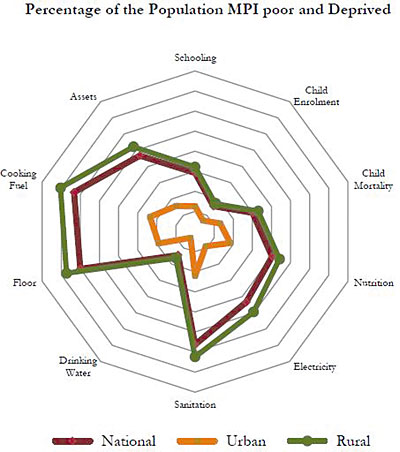
Nepal ranks 82 among 104 countries in the latest Multi-dimensional Poverty Index (MPI) put together by the Oxford Poverty and Human Development Initiative and UNDP's Human Development Report Office. The new index uses 10 indicators grouped under health, education, and living standards and tracks the level of deprivation from these services. It shows that 84.7 per cent of Nepalis are deprived, and more than 18 million people are 'poor'. It should be little comfort to us that India ranks 74 in the MPI: even war-torn Sri Lanka is way ahead at 32.
In fact, what little progress we've made since 1990 has been achieved despite government, mostly through individual and community-based initiatives. What is perhaps surprising, to put a positive spin on this shameful national ranking, is that with all the mismanagement and political disarray, Nepal did not fare worse. If we want to feel still better, we can cite the National Planning Commission's figures which show 'only' 31 per cent of the people living below the poverty line, or the World Bank's estimate that 55 per cent live on less than $1.25 a day.
