
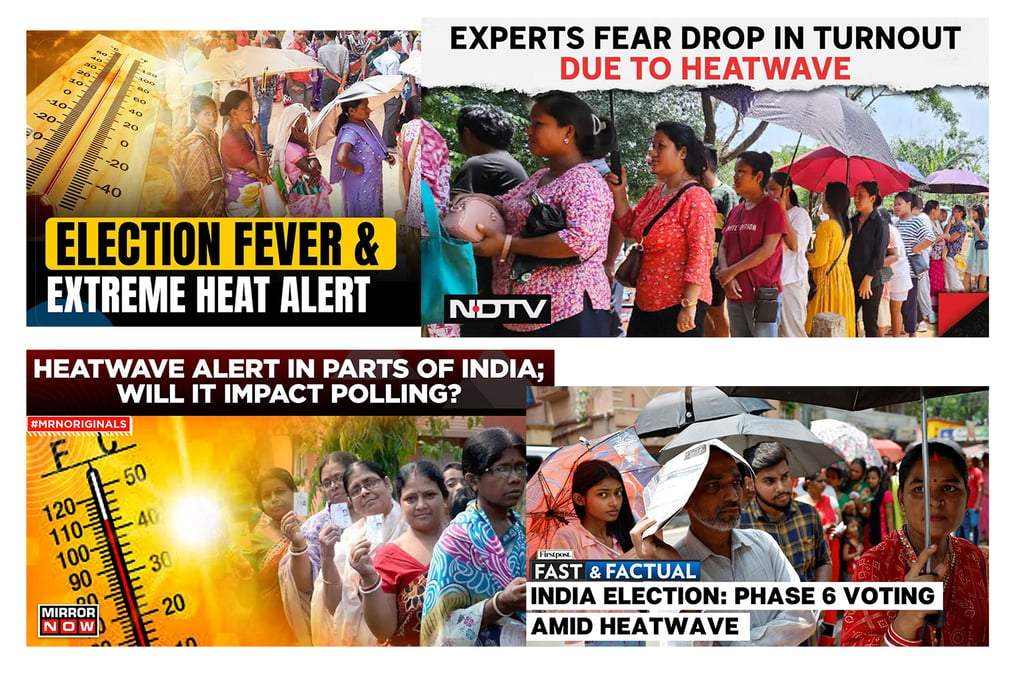
The recently concluded general election in India was shrouded in irony. The six-week-long voting period coincided with one of the worst heat waves yet recorded, but there was hardly any discussion of climate change or environment-related issues in the public political discourse. The idea that the climate is political is clearly still to drive home to the average Indian voters, politicians, and the media alike.
The worst of the heatwave this year in northern India was recorded in late May, coinciding with the 7th phase of the election when many parts of the region went to the polls. In Delhi’s Mungeshpur and neighbouring areas, temperatures reportedly soared to 52.9°C. However, the Indian Metrological Department issued a clarification days later that there was an error in the weather sensor which resulted in an additional 3°C reading over the actual temperature. Regardless, the heat took its toll.
As of early June, the total number of heat-related deaths in India for 2024 was pegged at 219. Among these, at least 33 were officials and personnel on election duty who succumbed to heat wave-related stresses in the 7th phase of the election alone. Public sector workers in India are compulsorily bound to perform election duties as and when required.
While sweltering heat engulfed northern India, the north-eastern states of Assam, Manipur, Mizoram and Tripura were battling the wrath of Cyclone Remal which flooded multiple cities, destroyed homes, drowned railway tracks and washed away bridges, cutting off the region from the rest of the country. Incessant rains induced by the cyclone caused massive landslides in Mizoram which killed at least 39 people while dozens were reported missing.
The heatwave that gripped India during its mammoth election was seen as a concern in that it was deemed to cause low voter turnout (pictured, above). Many media outlets speculated how this would affect the election results and particularly the prospects of the ruling party. Some argued that the Election Commission should have taken care to ensure that voting days did not coincide with heat-wave conditions.
But there was hardly any discussion on what was causing these extreme temperatures, (or the cyclone), nor any debate on the responsibilities of government to address environmental and climate change issues. In fact, the issue of climate change and environmental degradation were conspicuously absent from the mass discourse as seen through social media engagements, and the mass media’s focus.
The election manifestoes of both major parties, the Bharatya Janata Party (BJP) and the Indian National Congress did include measures to tackle climate change and environmental issues.
The BJP’s manifesto had a section titled “Modi ki Guarantee for Sustainable Bharat”, outlining a broad range of plans to address environmental issues including climate change while also underlining what it has achieved so far.
The Congress’ manifesto had a section titled “Environment, Climate Change and Disaster Management” which aimed to, among other things, institute an “independent Environment Protection and Climate Change Authority to establish, monitor and enforce environmental standards and to enforce the National and State Climate Change plans”.
Climate change and environmental issues were not totally absent from the electoral focus of the political parties, however tokenistic they were.