
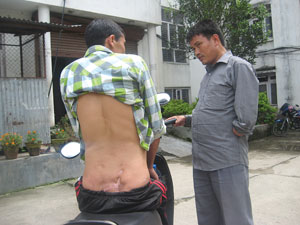
 RAMESWOR BOHARA PRIMARY CLASS: Policeman Dev Bahadur Thapa (left) of Rolpa has been put in the 'primary' category despite his immobilising spinal injury. Dipendra Pun Magar (right), who lost his arm while setting off a bomb in Palpa, is also in the same category. |
When Krishna Kathayat of Darna came to district headquarters in Achham in July to collect his disability pension, Chief District Officer Ram Kurumbang and officials at the Local Peace Committee did not know what to make of Kathayat. The Ministry of Peace had put him under the '100 per cent' disabled category and his papers said he was immobile with a missing arm and ear. But Kurumbang saw nothing unusual except a slightly crooked arm with a small lump at the elbow. No one could question Kathayat because he had all the necessary documents. So he collected his four months worth of pension amounting to Rs 24,800 and walked back home.
Similarly, Arjun Prasad Poudel of Bhorle in Rasuwa district went to the headquarters to claim his pension. He told the officials that he had become blind after the army beat him during the war. When the officials asked him to remove his glasses, they found out he was lying. Poudel then claimed he couldn't hear. His name is now being removed from the list of the conflict-hit.
Seven months after the government started the lifelong pension scheme for war victims and ex-combatants, the full extent of corruption and deceit is finally emerging as more and more scam cases are revealed. From medical reports to victims' stories to the disability criteria used by the state, everything is forged.
"People paralysed before the war and even those who fell from trees have papers to prove they are war victims. When they present these 'authentic' documents, we have no other option than to provide the pension," admits Jora Singh Bista, secretary of Achham's Local Peace Committee.
In November 2011, the Maoist-led cabinet formed a committee headed by Krishna Regmi to collect data about ex-combatants wounded during the war, and help with the rehabilitation process. Three months later, the cabinet announced a rehabilitation and support manual without waiting for the committee's recommendations. Maoist fighters, war victims, and families, as well as those injured during the 2006 Jana Andolan and the Madhes Uprising,who are deemed to be '51 per cent or more' disabled, became eligible for the lifelong pension and health care services.
The manual also divided the disabled into two categories: special and first. People with 76 to 100 per cent disability, who cannot walk without support fall under the 'special' category and receive Rs 6,200 as monthly stipend, and their caretakers also get the same amount. Those with 51 to 75 per cent disability who cannot earn a living are in the 'primary' category get Rs 6,200 every month. Out of the 736 beneficiaries, 446 are Maoist cadres while others are mostly Maoist supporters or family members.