
As the US and Israeli war against Iran puts oil at the centre of global concerns, a new intergovernmental coalition is seeking to accelerate the energy transition outside the UN climate convention system.
The coalition’s 57 members who account for almost half of global GDP met last week in Santa Marta, Colombia, for the First Conference on the Just Transition Away from Fossil Fuels, co-hosted by the Netherlands and Colombia.
‘It is essential to keep our planet liveable, to safeguard energy security, and to build economic resilience to volatile fossil fuel markets, states the conference’s final communiqué.
Rather than duplicating the UN’s climate summits to establish new greenhouse gas reduction targets, the coalition agreed ‘to advance and accelerate the implementation of agreed goals’.
The conference was significant for its discussions on what the consequences of decarbonisation mean for oil exporters, said Susana Muhamad, Colombia’s ambassador for the initiative to create a Fossil Fuel Non-Proliferation Treaty. It was the first time such conversations have been had at “a diplomatic forum on climate issues”.
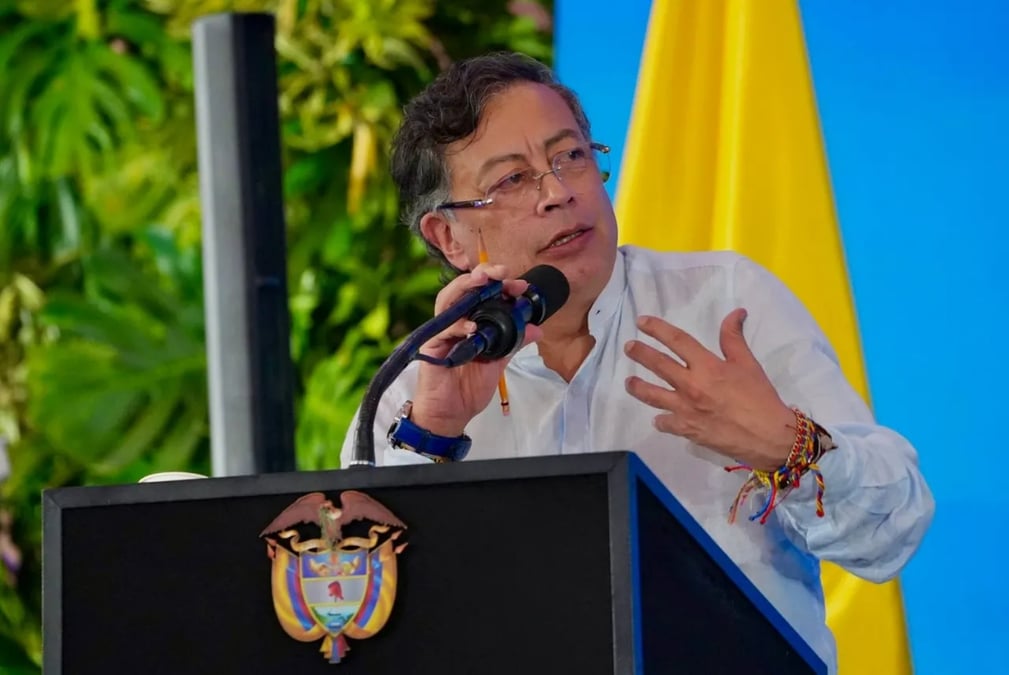
“Can capitalism adapt to an energy system that is not fossil-based?” asked Colombian President Gustavo Petro in an auditorium full of delegates from Brazil, Mexico, Nigeria, the United Kingdom, France and the European Union as well as small island states in the Caribbean and the South Pacific.
Noticeably absent were representatives of the United States and China, the world’s two biggest carbon emitters, as well as Russia and India. They were deliberately not invited to avoid the kind of obstructionism that led to the deadlocks in COP negotiations.
“When you make a plan, you first call your closest friends, and then you send the invitation to the rest,” Juan Carlos Monterrey Gómez of Panama’s Ministry of the Environment said. “With this first group, we can have an honest conversation, without administrative roadblocks. This conversation has never taken place before, and that is historic.”
Other attendees had mixed feelings about the invite list.
While Claudio Angelo, an international policy coordinator at the Climate Observatory, a network of Brazilian environmental organisations, agreed that inviting Donald Trump’s climate-denying US administration would have been “unnecessary”, he added: “China should be here, as it supplies renewable energy technology to the whole world.”
The conference was also attended by representatives of social movements, academia, multilateral institutions, parliaments, trade unions, indigenous peoples, women and diverse communities.
A new report by 350.org, a global grassroots movement to accelerate the transition away from fossil fuels, found that consumers pay three times for fossil fuels: through public subsidies, on their bills, and through the natural disasters that are a direct consequence of the climate crisis.
“Oil is nobody’s friend,” said Angelo, noting that the international community has viewed the energy transition more favourably as solar and wind technologies have become more accessible over the past decade.
Installed capacity of renewable energy was 50% higher last year than in 2023 and almost all new energy demand is being met by renewable sources, according to the final communiqué of the meeting.
For Colombian environment minister Irene Vélez Torres, the event marked the beginning of a new era of global environmental democracy.
“This new method of dialogue between civil society, parliamentarians and governments represents a new multilateral collective force that is not bound by consensus and is led by women,” Torres said at the conference’s closing.
Stientje van Veldhoven, the Dutch minister for climate and green growth said the meeting was the first step towards a proactive coalition of governments that do not negotiate, as happens at the UN, but rather collaborate with one another.
Harjeet Singh, the founder and director of the India-based Satat Sampada Climate Foundation that advocates for global climate justice, said the war in Iran has opened people’s eyes to the vulnerability inherent in dependence on fossil fuels.
“In a recent statement, India’s road and transport minister said that the era of diesel and petrol vehicles is over. It's all about clean fuels, biofuels and electric vehicles,” Singh said, adding that this is meaningless without “international cooperation in green finance”.
India self-funds 80% of its climate initiatives despite being a part of the Global South – and needs trillions more dollars for its transition away from fossil fuels.
Carlos Nobre, a researcher at the University of São Paulo and a member of the scientific panel for a Global Energy Transition, highlighted the risk that citizens might elect leaders who deny climate change.
Colombia remains the world’s deadliest country for environmental activists – an issue that must be addressed at the election on 31 May and can serve as a gateway to discussing wider environmental policies, says Liberal Party congressman Juan Carlos Losada, a member of Colombia’s Parliamentarians for a Fossil-Fuel-Free Future network.
“The debate on energy security has changed, and fossil fuels are seen as part of the insecurity issue,” said Brazilian Ana Toni, the executive director of COP30, noting: “It’ll be interesting to see how different actors act from now on.”
Climate hazards will be on full display at next year’s COP, where delegates will visit one of the countries most threatened by rising sea levels: the South Pacific island nation of Tuvalu that is co-hosting the second conference with Ireland.
“We, the small Pacific Islands, have no choice but to be ambitious,” said Brianna Fruean, a climate activist from Samoa, at a rally during the Colombian conference. “The next summit in Tuvalu will put faces to our countries and bring world leaders to the frontline of the climate crisis.”
A longer version of this article was originally published on opendemocracy.net